Home » Jazz Articles » Catching Up With » Charlie Porter: Discovering Horizons Past, Present and Future
Charlie Porter: Discovering Horizons Past, Present and Future

All About Jazz: Charlie, on behalf of All About Jazz, thanks for taking time to chat and congratulations on your Grammy win for Joyce DiDonato's Songplay. (related video).
Charlie Porter: Thank you, Nick.
AAJ: How did you get involved in that project?
CP: I do a fair amount of work here in the Northwest with bassist Chuck Israels. It was he who brought me into it.
AAJ: Did you know Joyce DiDonato before?
CP: No. I knew her name and knew of her reputation in the opera world.
AAJ: On "Songplay," are they operatic arias that were performed?
CP: Actually, the selections—except the three jazz standards ("Lullaby of Birdland," "With a Song In My Heart," and "In My Solitude") which Joyce also wanted to do—are from 24 vocal etudes that vocalists use in their practice, similar to the trumpet etudes we play in our Arban's method book. It's funny; I won a Grammy for the "Best Classical Vocal Album" when I mostly played jazz trumpet on it!
AAJ: "Songplay" features classical vocal material that was adapted integrating jazz in a very unique way. Who did the arrangements?
CP: We hadn't rehearsed beforehand. We rehearsed and recorded together at Skywalker Studios. All of us kind of arranged the songs on the spot in the studio. It was a pretty organic process.
AAJ: Well, I think it's a terrific concept, a terrific album, and you play great, as always.
CP: Thanks, Nick.
AAJ: Can we talk a little about your current album, Immigration Nation and how it came about?
CP: Sure. Over the last few years, we have all seen and heard a lot about the subject of immigration in the media and most of the time the focus on immigration is negative. However, the greater majority of people in this country—unless you are descended from Native Americans or from African slaves—are indeed the descendants of immigrants. I wanted to celebrate our rich immigrant history and frame the word immigrant in a positive way. We're all part of the same fabric that makes up this country. People who are third, fourth or fifth generation removed from their immigrant ancestors may not even relate to the subject of immigration. So, with Immigration Nation I'm just trying to put a new and positive perspective on the concept.
AAJ: So, the album has a historical concept as well as somewhat of a political one?
CP: Yeah. You can't have one without the other. I'm not speaking about how I feel about the subject, but, the idea that we can't escape from the fact that most of us are descended from immigrants. My first album was strictly music for music's sake—perhaps with one track's exception. With Immigration Nation, there's more of a message as well as the music. The liner notes detail all of that.
AAJ: What's the instrumentation for Immigration Nation?
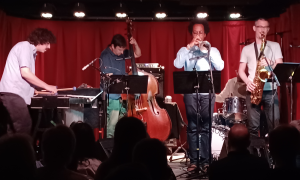
CP: It's trumpet, tenor sax, piano, bass and drums. That's it. I recorded in New York because I wanted it to have a "New York" energy. And, where better to record an album about immigration? The picture on the album's cover is that of a line at Ellis Island and the back cover actually includes a picture of my great-grandfather who came from Lebanon when he was 16 years old. My own heritage is Lebanese, Greek, English and Italian.
AAJ: You did all the charts for Immigration Nation?"
CP: Yes, I did. They're all originals that were written, mostly over a four month period. However, I didn't even know I was writing for this album. I was writing some tunes and had written one tune called "Immigration Nation" and then I realized that all of the tunes I had written fell under the same umbrella, with the exception of one or two that were written earlier. The album sort of wrote itself and came together with the same story line. For example, there's Part 1: "Leaving Home" and Part 2: "New Beginnings." Each part has six songs within, so it's sort of a two-part album.
AAJ: That's a lot of material.
CP: Yes, if it were released on vinyl—which I may do later down the road—it would be perfect for a double album. This was the first album I've done for Origin.
AAJ: How's the album been received?
CP: I've gotten a fair amount of airplay and a very nice review here at all About Jazz by Paul Rauch and another at DownBeat. So, it's been quite positive.
AAJ: Are you considering taking the project on the road?
CP: We did a brief West Coast album release tour of four dates. I'd love to do one on the East Coast, too—maybe New York, Boston—and Florida and work our way up.
AAJ: I think that because of the subject matter of the recording, colleges and universities might be likely performance opportunities.
CP: Sure. By the way all of the guys on the album are all New York guys.
AAJ: Who are they?
CP: Nick Biello—a killer alto saxophonist—is on tenor here, Oscar Perez on piano, David Wong on bass, Kenneth Salters on drums. Sabine Kabongo on vocals on a track. We also had worldwide participation by way of social media on the last track, "Chant."
AAJ: Looking ahead to the future, where is Charlie Porter headed—as player, composer and arranger?
CP: Man, that's the million dollar question. I have so many ideas about what I want to do. It's just a matter of picking one and perhaps multi-tasking. I know I want to do a classical album, as well. I like to play all different types of stuff, you know? I never wanted to be pigeon-holed into one style. There's so much stylistically within each style—jazz has swing, '30s, '40s, Bop—and classical has everything up from Renaissance stuff to modern stuff. There's that cliché: "there's only two types of music—good and bad." I'd like to show something that I can do classical, as well. I've got this four concerto album that I want to do; two brand new concertos—one by me and I've commissioned a friend to write and two old concertos: the Haydn and the Hummel, but both done with reduced orchestration...a chamber album with about ten players on it. I've never heard them done like that and to juxtapose them against the others would be a really novel fun idea.
AAJ: Would you re-arrange them?
CP: Well, when you do a reduction, it's the opposite of what Ravel did with Mussorgsky's "Pictures at an Exhibition." When you do a reduction, there's transparency, but, you don't want to lose some of the colors, and, you might want to add some slightly different colors. So, to get back to the original question, I just want to do projects that are interesting. I want to write and record more. I have about six or seven jazz projects I'd like to do. The next jazz one would possibly include a gospel choir and an orchestra. For 2020, I've got a special album in mind that's also not just music for music's sake, but I don't want to reveal too much about it for right now.
AAJ: Charlie, this has been absolutely fascinating. Thanks for taking time. Best of Luck.
CP: It's been my pleasure, Nick. Thank you and All About Jazz.
 FOLLOW Nicholas F. Mondello
and get notified whenever a new article published.
FOLLOW Nicholas F. Mondello
and get notified whenever a new article published.
Nick Mondello is a pro trumpeter, writer and marketing/production consultant to musicians worldwide.
About Charlie Porter

Tags
PREVIOUS / NEXT


Become a Sustaining Member

Since 1995, All About Jazz has championed jazz as an art form and supported the musicians who create it. Over three decades, it has grown into one of the world's leading jazz resources, serving hundreds of thousands of readers, musicians, presenters and industry professionals each month.
Help Build the Future of All About Jazz
Your support helps us continue building All About Jazz for the next generation—expanding our editorial coverage, preserving jazz history, developing new community features and creating better ways to discover the music and the people behind it.
Become a sustaining member for as little as $20 per year and you'll immediately enjoy an ad-free experience along with access to subscriber features and future articles for a full year.
Together, we're not simply sustaining All About Jazz—we're building its future. Thank you for being part of the journey.