Home » Jazz Articles » Interview » An Uplifting Tragedy: Everybody Digs Bill Evans
An Uplifting Tragedy: Everybody Digs Bill Evans
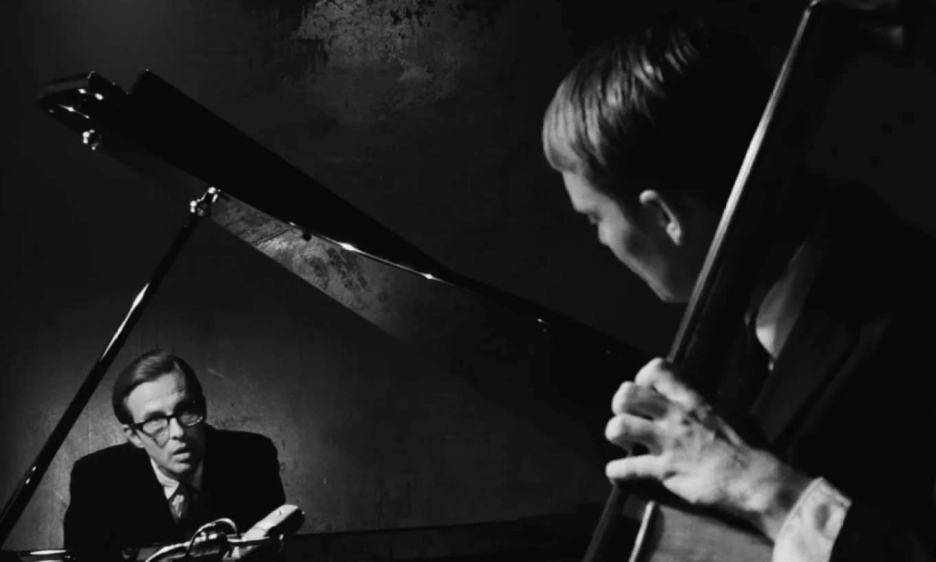
We thought the carnage of his life could sit alongside the discipline, decency and lightness of his artistic practice.
—Grant Gee
On learning of Scott's death, Evans went into a period of mourning so intense that he was unable to play the piano for three months, until he was finally enticed back into the studio by Riverside Records head honcho Orrin Keepnews to do a session for the Mark Murphy album Rah.
So what happened in between? This musical blank or dead zone in Evans's career is the subject of both Owen Martell's 2013 novel Intermission and of its new film adaptation, titled Everybody Digs Bill Evans.
Shot in luminous black-and-white, with a few colour flash-forwards to the 1970s, the film is profoundly moving and beautiful in all sorts of surprising ways. The first is that it features very little music—although a moment's reflection will remind you that this absence is the whole point.
'What,' I asked British director Grant Gee, 'made you think that an hour and a half of Bill Evans doing nothing would make a great movie?'
"Perversity, maybe," he replied. 'I haven't worked out the way to say this without sounding like an arse, but I love music, and in theory I love films about musicians, and I love some of them. But quite often with biopics, I go along with the film, and then there's a moment where the artist played by the actor plays the music, and I just get this kind of "oh no, that's not it." I'll go along with the the actorly impersonation, but when they start to play the music, it's like, well, that's not it. That's not the thing that we're all here for—really to try and understand.
"So I think saying 'perversity,' reading Owen's book, it was kind of like, he doesn't play much. I don't think he plays anything in Owen's book. In our film there's a few performance moments. A biopic of the artist where we don't have to shoot the artist making the art is an interesting start."
It certainly is. Grant Gee's point is that as an audience we want something more from a bio-pic than we'd get from a concert video. We want to get under the skin of the artist, appreciate what makes him or her tick, and we won't necessarily get that from watching the artist at work.
It seemed reasonable to ask whether Gee and his team had come up against the problem that bedevils so many films about jazz: innumerable projects have foundered due to the exorbitant music clearance fees demanded by record companies and other rights holders. But by focusing on a period during which Bill Evans barely touched a piano, this film has the perfect get-out clause.
"Absolutely," Gee agreed. "And the whole four-minute Village Vanguard sequence that starts it off was added relatively late to the script. We were going to have less music. So yeah, for sure the amount it costs to license music when you're making a little low budgetfilm is frightening, and that was a consideration, but it was built in from the start. So that was part of the attraction for the producer—[that] we're not going to have to have 15 tracks in here. In the event we have four, I think."
These are "Jade Visions" and "Gloria's Step," plus a version of Leonard Bernstein's "Lucky to be Me" at the end. There is also a snatch of "Waltz for Debby" in a heartbreaking scene where, during a visit to Bill's brother Harry, the little girl insists that her uncle Bill play the tune he wrote for her. He tries, but he can't do it.
Fans of jazz movies will spot parallels in Bruce Weber's masterful 1988 Chet Baker documentary Let's Get Lost—not just in the monochrome cinematography but in the fragmented narrative and ultimately tragic theme. Grant Gee knows and loves Weber's film, and it had a big impact on him.
"That film, when I first saw it... went really deep into me. That was one of the films I thought got it right." But in the end, he considered Weber's work so distinctive that he didn't want his own film to become some kind of homage. It turns out that his main visual influence was the 1963 British film The Servant, directed by ex-pat American Joseph Losey. "It was a built set... packing people into small interiors and then making use of compositions in depth, not a lot of camera movement, all that. And you know that that was really important to us." Admirers of William Claxton's iconic jazz photography will also appreciate the look of Gee's film.
Four people die during Everybody Digs Bill Evans, including Bill himself, and the other three expire violently. But despite it being such a death-haunted film, it is not depressing, nor even particularly gloomy. Somehow or other, Gee has succeeded in making an uplifting film about death and suffering and artistic withdrawal—not to mention drug addiction. Much of this is down to the nuanced performance of Norwegian actor and musician Anders Danielsen Lie in the title role.
"Both myself and Anders thought and talked a lot about what we thought Bill might be, and how we thought the carnage of his life could sit alongside the discipline, decency and lightness of his artistic practice. So, you know, that paradox, and it really was carnage around him. It's like you say, three deaths and a terrible physical habit and everything. So we thought a lot about what sort of character could we imagine can live through that, and it's got to be someone who's not a suicidal depressive. And it was really important for us when we got to the point of talking about the character where we decided to reject Gene Lees's line after after Bill died. Gene Lees said, that's the longest suicide in history. And being a really close friend of his, and his manager's [Helen Keane] boyfriend, and all that stuff that's been taken almost as gospel. And we got to the point where we went, you know what? Whatever it was, whatever his life and death and art was, it wasn't that."
Anders Danielsen Lie smiles and mumbles and chain-smokes his way through the role, always quiet, always friendly and amenable to the people around him, never rocking the boat, although his girlfriend Ellaine is frustrated by his lack of commitment,because really he's married to music. His portrayal of Bill Evans is all internalised.
"Yeah. Yes. Yes. Oh, absolutely. And I was just thinking that one really simple thing which does a lot, and did a lot both for me and for Anders to play him, was just the words 'no self-pity,' and approaching the character so that he doesn't have self-pity through whatever he's going through, [and this] allows him to stand upright and face it."
Everybody Digs Bill Evans is in theatres now.
 FOLLOW Peter Jones
and get notified whenever a new article published.
FOLLOW Peter Jones
and get notified whenever a new article published.
Author, journalist, singer, composer, promoter.
About Bill Evans

Tags
PREVIOUS / NEXT

Become a Sustaining Member

Since 1995, All About Jazz has championed jazz as an art form and supported the musicians who create it. Over three decades, it has grown into one of the world's leading jazz resources, serving hundreds of thousands of readers, musicians, presenters and industry professionals each month.
Help Build the Future of All About Jazz
Your support helps us continue building All About Jazz for the next generation—expanding our editorial coverage, preserving jazz history, developing new community features and creating better ways to discover the music and the people behind it.
Become a sustaining member for as little as $20 per year and you'll immediately enjoy an ad-free experience along with access to subscriber features and future articles for a full year.
Together, we're not simply sustaining All About Jazz—we're building its future. Thank you for being part of the journey.