Home » Jazz Articles » Live Review » Vijay Iyer Quartet at Smoke
Vijay Iyer Quartet at Smoke
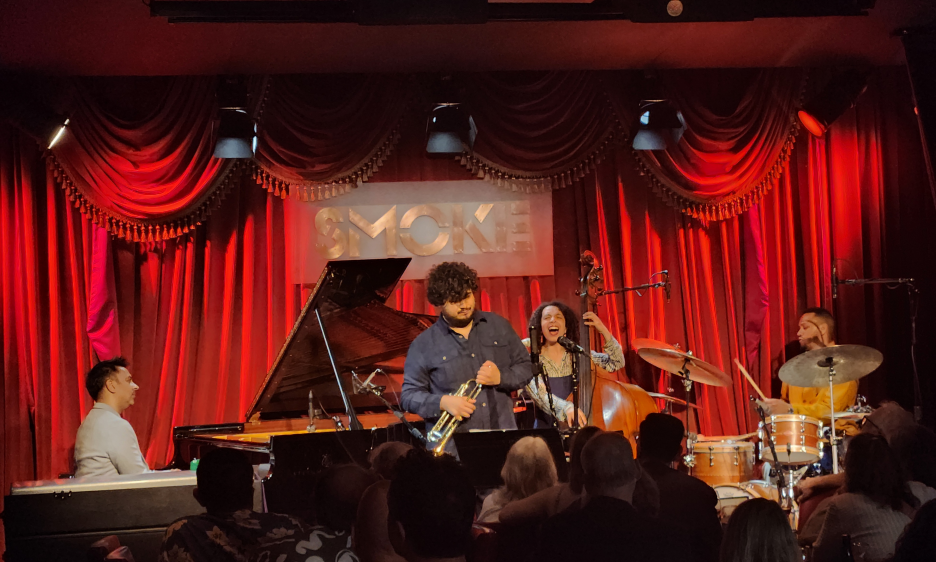
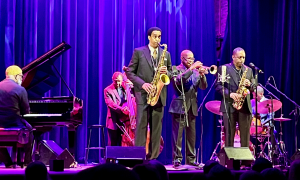
Courtesy Paul Reynolds
The set ran without interruption – as a “tale of tales,” in Iyer's words – with the pianist directing the choice of pieces, almost all of them Iyer compositions, and transitions between them, on the fly.
Smoke Jazz Club
New York NY
April 16, 2026
The career of pianist Vijay Iyer—in addition to stretching to chamber music, big-band compositions and projects with rappers—has included collaborations with those from other cultural traditions, notably musicians from his own South Asian heritage.
The storied surname of Iyer's trumpet collaborator at Smoke might suggest the partnership is the pianist's latest ethnic music venture. After all, Adam O'Farrill is the grandson of Chico O'Farrill, the Havana-born composer, arranger, and bandleader who was a key figure in the rise of Afro-Cuban jazz in the late 1940s and early 1950s, and the son of Arturo O'Farrill, the multi-Grammy-winning leader of Arturo O'Farrill & The Afro Latin Jazz Orchestra.
Yet this third-generation O'Farrill—now in his early 30s—evinces little Latin jazz influence, and more belongs to the same diverse and adventurous artistic paths trod by Iyer and other O'Farrill collaborators, such as Mary Halvorson and Tyshawn Sorey.
That said, the Iyer/O'Farrill set at Smoke was stylistically more inside—that is, closer to the tradition—than many of the projects these musicians pursue alone. Iyer introduced O'Farrill as a player he's known since the trumpeter was 13, when "he already sounded like Freddie Hubbard, which didn't seem possible at that age."
At Thursday's early set, O'Farrill still sounded somewhat like Hubbard, who stylistically bridged post-bop and fusion, more than he did the avant—trumpet players one might have assumed were among his influences—Lester Bowie, say, or Wadada Leo Smith (with whom Iyer last year released a defiantly adventurous duo album, Defiant Life (ECM Records, 2025). Like Hubbard, and unlike those particular "outside" trumpeters, O'Farrill has a fulsome tone and a penchant for solos built on fluttering melodic bursts of notes.
As with practically any modern trumpeter, some shadings of Miles Davis crept in, and of the trumpeter's fusion era. At the beginning of the set, Iyer created atmospherics on the Fender Rhodes electric piano, and O'Farrill responded with spacy playing colored by subtle electronic embellishments of his sound. As the elements came together, they conjured up the quieter moments between Davis and the Fender-Rhodes playing of Chick Corea and Joe Zawinul on Davis's Bitches Brew (Sony Records, 1970).
As usual, Iyers was commanding in his leadership, yet also preserved room for his colleagues to shine. Retaining his characteristic harmonic freshness, his fluid piano playing and compositions tended on Thursday to prettiness and melodicism.
The set ran without interruption—as a "tale of tales," in Iyer's words—and the pianist, in a chat after it ended, said he directed the choice of pieces—almost all of them Iyer compositions—and their transitions on the fly. Never one to coast or opt for the obvious, Iyer chose as the set's sole non-original "Gallop's Gallop," an obscure Thelonious Monk composition with an especially knotty melody, even by that composer's challenging standards.
The division of focus between the four musicians was surprisingly democratic. Bassist Devon Gates lent the music an emotional and visual center. Continually smiling, she radiated joyfulness while also holding down a rock-solid rhythmic and harmonic foundation. Early in the set, over the loping piece that followed that atmospheric introduction, she even soaringly sang for a few minutes, in wordless vocalese that justified Iyer's introductory observation that "she's a wonderful singer."
Like Kendrick Scott, who preceded him in the drum chair the previous week with the Kendrick Scott Quintet at Smoke, Jeremy Dutton was anything but a straight-ahead time keeper, instead sustaining a rolling—and riveting—repertoire of textures and techniques.
It takes commitment and chutzpah to hold the attention of an early-evening club audience who are eating dinner with sunlight still streaming through floor-to-ceiling windows, and with less-than-conventional jazz, to boot.
Yet Iyer pulled it off. No matter the context or company he keeps, this polymath—who, among other achievements, has a doctorate in music cognition from the University of California, Berkeley and teaches at Harvard University—seems incapable of creating music that is less than engrossing, or in some way surprising.
 FOLLOW Paul Reynolds
and get notified whenever a new article published.
FOLLOW Paul Reynolds
and get notified whenever a new article published.
Journalist and programmer in jazz, folk, country and other musics
About Vijay Iyer

Tags
PREVIOUS / NEXT

Become a Sustaining Member

Since 1995, All About Jazz has championed jazz as an art form and supported the musicians who create it. Over three decades, it has grown into one of the world's leading jazz resources, serving hundreds of thousands of readers, musicians, presenters and industry professionals each month.
Help Build the Future of All About Jazz
Your support helps us continue building All About Jazz for the next generation—expanding our editorial coverage, preserving jazz history, developing new community features and creating better ways to discover the music and the people behind it.
Become a sustaining member for as little as $20 per year and you'll immediately enjoy an ad-free experience along with access to subscriber features and future articles for a full year.
Together, we're not simply sustaining All About Jazz—we're building its future. Thank you for being part of the journey.