Home » Jazz Articles » Album Review » Thelonious Monk: Live In Paris, 1967. Volume Two
Thelonious Monk: Live In Paris, 1967. Volume Two
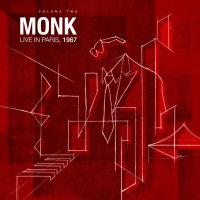
In 1967, George Wein presented six Monk concerts in Europe and was determined to break the routine of the quartet format. Wein proposed that a larger group would appeal to audiences and promoters—and, he hoped, to Monk himself. Monk, however, was initially reluctant: he worried about leaving the security of his working quartet. It was suggested that the Hall Overton charts prepared for concerts in the 1950s and early 1960s would be used; Monk knew these arrangements were differently voiced from his usual small-group approach. He was also not keen on using Clark Terry but eventually agreed to feature him on "Blue Monk" and the "Epistrophy" theme.
The tour began in London on 27 October. The group arrived that morning and was due to play that night; none of the band had seen the music and there had been no rehearsal. Publicity emphasised that the larger group would be playing in Europe for the first time. The hall was packed. There was clear disappointment from some in the audience when the quartet played the first part of the concert. The nonet played the second part, presenting: "Evidence," "Oska T," "Blue Monk" and "Epistrophy."
On "Blue Monk," Terry, with his unique tone, lifts off over Monk's accompaniment. The clarity of Terry's improvisation—as he structures a solo rich in invention and grace notes—is striking. He is obviously inspired by the theme and soon soars above the bass and drums; the nuances he displays are captivating. This is Monk with a difference—a real difference.
"Epistrophy" is just the theme chorus, but it gives a chance to enjoy, for a moment, the richness of Overton's chart.
A bass solo opens "Oska T." It is a tentative start, with the melody carried by the bass. The first solo is by Ray Copeland, who seems inspired by Terry—except Copeland is more wayward. Johnny Griffin and Phil Woods are just as wayward; some of the quotes are a little obvious, as if they were straining for inspiration. The arrangement behind Griffin's solo has interesting figures. Jimmy Cleveland is technically daring; his solo is imaginative, spirited and inventive. The arrangement behind the solo is astringent and gives the full flavour of Overton's writing. Monk's solo takes some moments to sidle into his invention; when he does, it is both creative and percussive. The bass solo with the full nonet ends the piece.
Larry Gales and Ben Riley obviously enjoy being able to use their gifts in the context of the nonet rather than the quartet, and they lift the whole group.
The three compositions date from different periods of Monk's career. Co-written with drummer Kenny Clarke, "Epistrophy" belongs to Monk's earliest period. "Blue Monk," first recorded in 1954, became one of the pieces Monk returned to most often. Monk first recorded "Oska T" in 1963.
The Monk estate began trying to recover bootlegged Monk recordings in the 1980s. Eventually they acquired the Paris recordings, and Rudy Van Gelder mastered them in 2002. Lack of capital and time meant that the release was delayed until 2026.
Splitting the concert into two volumes and two separate purchases is unfortunate. It is to be hoped that if Rhythm-A-Ning Entertainment presents more music, they will consider the finances of the purchasers as well as their own.
The Van Gelder remastering has added some clarity to what was always a good recording.
 FOLLOW Jack Kenny
and get notified whenever a new article published.
Jack was turned on to jazz by a mixture of Stan Getz, Lee Konitz and Earl Bostic.
Track Listing
Introduction; Blue Monk; Epistrophy; OskaT.
Personnel

Thelonious Monk
piano
Charlie Rouse
saxophone, tenor
Clark Terry
trumpet
Larry Gales
bass
Ben Riley
drums
Johnny Griffin
saxophone, tenor
Phil Woods
saxophone, alto
Jimmy Cleveland
tromboneRay Copeland
trumpetAlbum information
Title: Live In Paris, 1967. Volume Two | Year Released: 2026 | Record Label: Rhythm-A-Ning Entertainment
About Thelonious Monk
Tags
PREVIOUS / NEXT


Become a Sustaining Member

Since 1995, All About Jazz has championed jazz as an art form and supported the musicians who create it. Over three decades, it has grown into one of the world's leading jazz resources, serving hundreds of thousands of readers, musicians, presenters and industry professionals each month.
Help Build the Future of All About Jazz
Your support helps us continue building All About Jazz for the next generation—expanding our editorial coverage, preserving jazz history, developing new community features and creating better ways to discover the music and the people behind it.
Become a sustaining member for as little as $20 per year and you'll immediately enjoy an ad-free experience along with access to subscriber features and future articles for a full year.
Together, we're not simply sustaining All About Jazz—we're building its future. Thank you for being part of the journey.