Home » Jazz Articles » Live Review » Dan Pugach and the Macedonian National Jazz Orchestra at the NOB
Dan Pugach and the Macedonian National Jazz Orchestra at the NOB

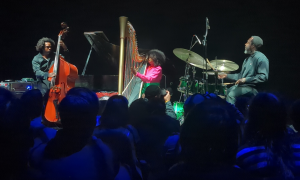
Courtesy Maja Argakijeva
NOB
Skopje, Macedonia
October 7, 2026
Big-band jazz thrives on a productive contradiction. Its arrangements demand discipline, coordination, and a collective sense of direction, yet the music comes alive when individual musicians find room to assert their personalities within that carefully constructed framework. At the National Opera and Ballet in Skopje on October 7, Dan Pugach and the National Jazz Orchestra demonstrated just how much expressive freedom a large ensemble can accommodate without sacrificing cohesion.
The concert, which opened the orchestra's new season under conductor Džijan Emin, brought the Israeli-born, New York-based drummer, composer, and arranger to Skopje alongside vocalist Nicole Zuraitis and trumpeter Jonathan Saraga. Pugach won the 2025 Grammy Award for Best Large Jazz Ensemble Album for Bianca Reimagined: Music for Paws and Persistence, and the evening offered an opportunity to hear his approach to contemporary big-band writing in a setting that extended beyond the conventional jazz-club format.
From the outset, the music established its own momentum. "Belo's Bellow" began with a short, angular introduction before taking off in a joyful, playful passage with a distinctly Brazilian flavor, as the orchestra gathered force and the arrangement opened up. Pugach played with evident enjoyment, supplying propulsion without dictating every turn and allowing the brass and saxophone sections to build their own momentum. Kiro Kuzmanov seized the opportunity for an extended, emphatic solo, his playing adding a muscular counterweight to the ensemble's intricate writing. The effect was immediate: this was music that could be meticulously arranged and exuberantly spontaneous at the same time.
That balance became one of the evening's defining characteristics. Pugach's compositions and arrangements draw on the historical vocabulary of big-band jazz without treating it as a museum piece. The writing has a melodic directness that makes the music accessible, but beneath its inviting surface lies considerable harmonic and rhythmic detail. The orchestra had to negotiate shifting textures, tightly coordinated ensemble figures, and passages that left room for individual expression. The results were most compelling when these elements seemed to emerge naturally from one another.
Pugach was also at ease with the audience. From time to time, he addressed the hall alongside Emin, introducing some of the pieces and the events that inspired them, which gave the evening the feel of a shared occasion rather than a formal concert.
If "Belo's Bellow" had set a playful, Brazilian-tinged tone, "Schleppin'" brought a different kind of energy. Pugach explained that the piece recalls his first days in New York, when he couldn't find work as a musician and moved furniture to make ends meet. Its voicings evoked the buoyant swing of 1930s jazz, with rich harmonies giving the arrangement a warmth that extended beyond nostalgia. Rather than simply reproducing the sound of an earlier era, Pugach used its vocabulary as a starting point for a contemporary ensemble. The piece's forward motion and the interplay between the sections revealed the orchestra's ability to handle both the rhythmic lift and the more intricate details of the writing. Pianist Gordan Spasovski was among those who found room to distinguish himself, contributing some beautiful solo moments.
Where "Schleppin'" emphasized swing, "Tolerance" introduced a more reflective dimension. Its melody, infused with traditional musical influences, brought a different color to the program. The orchestra shifted into a more restrained mode, allowing the melody to breathe rather than relying on sheer volume or density. Alto saxophonist Borislav "Bobi" Veselinov was particularly striking here, his phrasing bringing lyricism and sensitivity to the piece. The arrangement demonstrated how Pugach could incorporate elements beyond the conventional big-band vocabulary without making them feel like decorative additions. The contrasting textures were part of the composition's identity, and the orchestra gave them room to unfold.
"Coming Here" continued that emphasis on contrast and featured two soloists. Guest trumpeter Jonathan Saraga delivered a brilliant solo, while tenor saxophonist Ivan Ivanov followed with a gentle, beautifully phrased solo. In a program full of ensemble power, such moments of intimacy were essential. They revealed the expressive range available to Pugach's writing and reminded the audience that the effectiveness of a large orchestra depends as much on its ability to listen as on its ability to play together.
The program also moved between original compositions and reinterpretations of familiar material. George Gershwin's "But Not for Me" placed an established American song within the concert's broader exploration of orchestral jazz. Such standards carry the weight of their performance histories, making fresh arrangements a delicate proposition: too much deference can leave them inert, while excessive reinvention can obscure the qualities that made them endure. Here, the piece formed a natural bridge between the concert's contemporary compositions and the older repertoire from which much of big-band jazz continues to draw its language.
Nicole Zuraitis provided another important dimension to the performance. A Grammy-winning vocalist, pianist, and arranger, as well as Pugach's wife and longtime collaborator, she was an expressive singer who held the audience in the palm of her hand. She sang with emotion and gusto, bringing a distinct musical personality to the program. Her presence was particularly significant in "Travel," a composition associated with her own repertoire, where the relationship between voice and ensemble could be heard as a genuine musical conversation rather than a vocalist simply placed in front of a big band.
"Jolene" carried a special meaning that night. Zuraitis offered it as a tribute to Dolly Parton, who had died only weeks earlier, noting that the band had already been playing an arrangement of the song. It offered a familiar melody through a different musical lens, demonstrating how a song can be transformed by its arrangement without losing its underlying identity. In a big-band setting, the interest lies not merely in the novelty of the instrumentation but in the possibilities created by changing the song's harmonic, rhythmic, and textural context. The arrangement opened up a space between familiarity and discovery, allowing listeners to reconsider a song they might otherwise know by heart.
The appearance of "My Funny Valentine" brought the program into more intimate territory. Long established as a vehicle for expressive interpretation, the standard gave the musicians another opportunity to explore nuance and melodic restraint. These quieter moments helped prevent the concert from becoming an uninterrupted succession of powerful ensemble passages and showcased the versatility of the musicians assembled onstage.
Elsewhere, the program continued to move between contrasting moods, from the contemporary character of "As Long as I Know Where You Are," "Little Fears," and "Discourse This!" to Van Halen's "Dreams," a playful and unusual choice that nonetheless worked, since a good song is a good song. Such stylistic shifts could easily have made the evening feel fragmented, but Pugach's work as an arranger provided a unifying thread. His interest is not simply in transferring different kinds of music to a big band; it is in discovering what the ensemble can reveal about each composition. Jazz, pop, and rock become material for the same ongoing investigation into color, rhythm, and collective sound.
Pugach's own role behind the drum kit was central to that process. His playing supplied the music with its underlying pulse and energy, but he rarely needed to dominate the foreground. The most successful passages were those in which the rhythm section established a secure foundation while the horns developed their own internal dialogue. Solos emerged as part of the larger design, and the ensemble's responses gave individual contributions a sense of context. The result was a performance in which virtuosity served the music rather than becoming an end in itself.
The concert concluded with "Dreams," but the audience was not ready to let the musicians go. The audience called the musicians back for two encores, including "Our Blues," bringing the night back to the rhythmic and collective pleasures that had animated it from the beginning. The final impression was of a band capable of navigating a broad musical landscape while retaining a clear sense of identity.
For the National Jazz Orchestra, the concert was an encouraging way to begin a new season, placing its musicians in dialogue with a contemporary American approach to large-ensemble writing. For Pugach, it offered a reminder that the big band remains a flexible, evolving form, capable of accommodating personal expression, historical reference, and stylistic experimentation within a single musical framework.
The strength of the evening lay not in the Grammy-winning credentials surrounding it, but in the music's ability to make those credentials secondary. The arrangements provided structure without constriction, the soloists brought individual character to the proceedings, and the orchestra supplied the collective force that made the whole greater than the sum of its parts. Big-band jazz, in this telling, was neither a nostalgic exercise nor an exercise in orchestral precision. It was a living music, animated by the tension between composition and improvisation, and at its best when the two became indistinguishable.
 FOLLOW Nenad Georgievski
and get notified whenever a new article published.
FOLLOW Nenad Georgievski
and get notified whenever a new article published.
For as long I can remember music has been a focal point in my life.
About Dan Pugach

Tags
PREVIOUS / NEXT

Dan Pugach Concerts
Become a Sustaining Member

Since 1995, All About Jazz has championed jazz as an art form and supported the musicians who create it. Over three decades, it has grown into one of the world's leading jazz resources, serving hundreds of thousands of readers, musicians, presenters and industry professionals each month.
Help Build the Future of All About Jazz
Your support helps us continue building All About Jazz for the next generation—expanding our editorial coverage, preserving jazz history, developing new community features and creating better ways to discover the music and the people behind it.
Become a sustaining member for as little as $20 per year and you'll immediately enjoy an ad-free experience along with access to subscriber features and future articles for a full year.
Together, we're not simply sustaining All About Jazz—we're building its future. Thank you for being part of the journey.