Home » Jazz Articles » The Jazz Life » The Scent of Swing: Jazz, Fragrance, and the Invisible A...
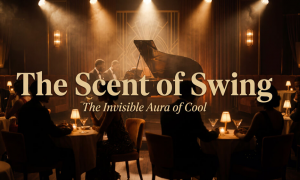
The Scent of Swing: Jazz, Fragrance, and the Invisible Aura of Cool
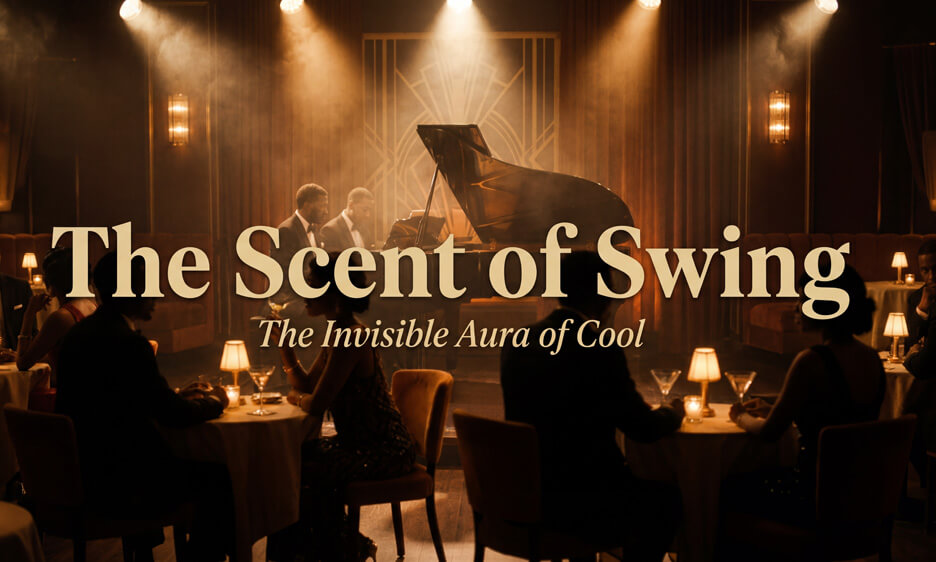
Courtesy Patrick Doyle
You’ve welcomed our scents into your story. That’s no small thing. To me, it means you see yourself in this legacy. And I want you to know… the journey doesn’t stop here. The way you layer memory, identity, and artistry makes you unforgettable. I’m so glad you’re here.
—Teri Johnson Harlem Perfume Co.
Atmosphere as Art: Where Jazz Meets Scent
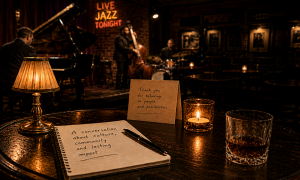
Jazz has never belonged solely to the ear. It lives in the atmosphere—in the way light hits a lacquered piano, in the hush between notes, in the glide of a well-cut suit across a crowded room. It is configuration, timing, presence. It is the ineffable quality we call "cool," a sensibility that resists definition precisely because it exists beyond language. Fragrance occupies that same elusive register. It cannot be seen or held, yet it shapes perception, remembrance and deep feeling with remarkable precision. Where jazz composes in sound, scent invents invisible auras.At their core, both are built from the same fundamental language. A note in music is mirrored by a note in perfumery. A chord becomes an accord. A full composition emerges through structure, balance, and intuition. The perfumer, like the bandleader, arranges these elements into something that unfolds over time—guided by rhythm, shaped by melody, deepened through harmony, and expressed through dynamics and timbre. What we smell, like what we hear, is not static—it is a living, temporal experience.
Long before fragrance became codified as luxury, it was already embedded in the culture of jazz performance. The bandstand was not only sonic—it was visual, tactile, and olfactory. Musicians and dancers understood that style extended beyond sound into every detail of presentation: tailoring, posture, gesture, and, importantly, scent. In Harlem's golden era, atmosphere was part of the performance. The room itself was an instrument, and every element—down to the cologne worn by the artist—contributed to the total composition.
That reality comes into sharp focus through the recollections of pianist Andy Wasserman, who in the 1970s worked closely as an accompanist and freelance musical director with members of The Copasetics Club, a Harlem-based fraternity of master jazz tap dancers. These artists—Charles "Honi" Coles, Charles "Cookie" Cook, James "Buster" Brown, Leslie "Bubba" Gaines, Albert "Gip" Gibson, and Earnest "Brownie" Brown—had performed with the Duke Ellington Orchestra and Count Basie's Big Band during the height of the swing era, when tap dance was an integral part of big band performance. In fact, when the Apollo Theater on 125th street in Harlem opened in 1934, many of the top acts included jazz tap dance luminaries Bill "Bojangles" Robinson (who popularized the phrase ""Everything is copasetic"}, and the Nicholas Brothers (Fayard and Harold).
Wasserman recalls that for these men, cologne was not incidental. It contributed to their singular identity as artists. It projected their charisma and presence. It was part of the performance before a single step was struck. Through hanging out with them, Andy heard repeated stories of Duke Ellington's legendary relationship with scent—how Ellington traveled with a collection of his personal niche perfumes, blending them into a personal, ever-evolving formula. According to Andy's mentor, the jazz piano virtuoso Dwike Mitchell (of the Mitchell-Ruff Duo), Ellington's fragrance announced him before he spoke; it lingered in a room long after he had left. For The Copasetics, this was not vanity—it was artistic expression. Ellington's scent was as composed and deliberate as his music: a perfectly balanced framework of concordance, rich in resonance, unmistakable in its tone.
Harlem's Soundscape, Harlem's Scentscape
To understand jazz culture at its peak is to understand Harlem as a fully immersive sensory world. During the 1930s, '40s, and '50s, Harlem was not merely a geographic center of Black artistic innovation—it was an interconnected atmosphere of community. Music spilled from clubs onto sidewalks. Conversations in salons shaped intellectual life. Fashion signaled identity and aspiration. And scent—though rarely documented—was everywhere.Tobacco smoke curled through dimly lit rooms. Polished wood and brass warmed under stage lights. Perfume and cologne mingled with the faint sweetness of spirits and the density of night air. These were not background details; they were part of the experience. The audience didn't just hear Ellington—they entered an environment calibrated for elegance and intensity.
Scent, in this context, functioned much like euphony in jazz: often unnoticed in isolation, but essential to the communal effect. It created texture, softened edges, and anchored memory. Like a sustained accompaniment beneath a soloist, it held the room together.
The Ritual of Presence: Style, Scent, and Self-Definition
For jazz musicians and dancers, personal style was inseparable from artistic identity. The cut of a suit, the shine of a shoe, the tilt of a hat—all were deliberate choices. Cologne belonged to this same vocabulary. It was the final, invisible gesture that completed the aesthetic statement—the closing note in a perfectly phrased line.The members of The Copasetics, as Wasserman observed, treated scent as an extension of their individuality. Each performer cultivated a presence that began before movement and lingered after it. This was their dynamics—some projected like a brass section at full forte, others moved with the intimacy of a late-night ballad played piano.
Ellington exemplified this philosophy at its highest level. His music was refined, layered, and unmistakably his own—and so was his scent. The stories suggest his fragrance behaved like a signature motif, returning again and again with subtle variation, evolving yet always recognizable. It was, in every sense, his personal composition.
Teri Johnson and the Modern Translation of a Lost Sensibility
It is within this historical and cultural framework that Teri Johnson's work as founder of the Harlem Perfume Co. finds its deepest sonority. While her brand is contemporary, its conceptual foundation is rooted in this largely unspoken tradition: the role of scent in shaping the atmosphere of jazz culture.Johnson's contribution is not to invent a connection between jazz and fragrance, but to articulate and reimagine one that has always existed. Her work approaches scent as a parallel language to jazz—structured yet improvisational, ephemeral yet emotionally precise.
Her fragrances draw on iconic figures such as Duke Ellington and Langston Hughes, not as static inspirations, but as dynamic tonal frameworks. Each composition becomes an olfactory performance. And crucially, the perfumers behind these works—Hamid Merati-Kashani and Ilias Ermenidis—approach their craft much like jazz musicians. They are not merely technicians; they are improvisers. They are jamming with raw materials, testing their master plan of combinations, building the structure in the way a quartet builds a groove—listening, adjusting, responding in real time.
A citrus note enters like a horn line. Tobacco answers like a baritone sax. Resin and wood form the rhythm section. What emerges is not formula alone, but feeling—a living, breathing ensemble.
Duke: Structure, Swing, and Signature
In Duke, created by Hamid Merati-Kashani and Ilias Ermenidis, this improvisational spirit is shaped into a lyric of pure poetry. The fragrance opens with brightness and motion—pink pepper, citrus, ginger—the tempo is immediate, upbeat, like a swinging introduction.But as in any great jazz piece, the opening gives way to development. Tobacco, lavender, rockrose, and olibanum create a layered harmonic line, forming a rich, resonant counterpoint that deepens the composition. The texture becomes fuller, more orchestral.
The base—bourbon honey, guaiacwood, styrax—acts as the bass line, grounding the entire structure with warmth and sustained timbre. This is where the fragrance lingers, where its emotional weight settles.
Duke is not linear; it evolves. It moves attacca from one phase to the next, seamlessly transitioning without pause. Like an Ellington arrangement, it balances precision with flow, complexity with ease. It swings—not just metaphorically, but with inner-moving voices.
Langston: Intimacy, Memory, and Mood
Where Duke projects outward, Langston, created by Hamid Merati-Kashani, turns inward. Its opening—cinnamon, caramel apple, chocolate—feels like a soft melodic phrase, intimate and inviting.As it develops, orange brandy, jasmine, and orris create a nuanced tone color, shifting the emotional vibe inward. The modulation changes—from sweet and bright to something more velvety, more nocturnal.
The base notes of tonka bean, sandalwood, musks, and vanilla becomes a quiet, persistent drone, a sustained presence that hums beneath the surface. The dynamics remain low, close to the skin, drawing the listener—or wearer—closer.
Langston is a nocturne, a piece of atmosphere and introspection. If Duke is the full ensemble, Langston is the late-night solo—subtle, personal, deeply felt.
Jazz and Scent: Parallel Languages of Memory and Time
What emerges from both historical accounts and contemporary interpretation is a profound structural symmetry. Jazz and scent are both temporal arts. They unfold. They evolve. They rely on contrast, tension, and release in the moment.Both operate through form—an introduction, a development, a resolution. Both rely on improvisation—whether in a musician's solo or in the way a fragrance interacts with each person's individual skin chemistry and the seasons with which they apply it. No two performances are ever exactly the same.
And both create memory through sensation. A chord progression can transport you instantly. So can a scent. They bypass analysis and move directly into feeling. They resonate.
The Invisible Aura of Cool
At its core, jazz has always been about more than music. It is a way of being—a philosophy of presence defined by ease, confidence, and depth. This is what we recognize as "cool," and it is as much about atmosphere as it is about expression.Scent, as both the stories of Ellington and the practices of The Copasetics reveal, was an integral part of that atmosphere. It was the final, invisible layer—the resolution of chord/scale unity.
Through history and reinterpretation, that dimension is coming back into focus. Teri Johnson's work stands as one contemporary articulation, but the deeper story belongs to the culture itself—to the musicians, dancers, and creators who understood that artistry extends beyond time: from sound into an open space, floating horizontally into memory and vertically into the air.
To quote George Russell, the legendary Jazz master of tonal gravity—who himself reveled in his private collection of scents: "what's life for, if not to explore?"
In that sense, the scent of swing has always been there—spontaneous, soul-searching, imaginative and as inquisitive as a song that never quite ends.
References
- Scent Veteran official website: https://ScentVeteran.com/
- Harlem Perfume Co. official website: https://harlemperfumeco.com/
- Duke Eau de Parfum product page: https://harlemperfumeco.com/products/duke-eau-de-parfum
- Langston Eau de Parfum product page: https://harlemperfumeco.com/products/langston-eau-de-parfum
- Andy Wasserman website: https://andywasserman.com/lydian-chromatic-concept
- ESSENCE: "Behind The Beauty: Teri Johnson Is Celebrating Black Icons Through Harlem Perfume Co."
- Bluemercury: The Founders Series, Teri Johnson
- Wikiparfum: Hamid Merati-Kashani
 FOLLOW Patrick Doyle
and get notified whenever a new article published.
FOLLOW Patrick Doyle
and get notified whenever a new article published.
As the founder of NativeRadio.com and a veteran webmaster for jazz artist Andy Wasserman, I have spent 27 years leveraging technology to broadcast hundreds of live concerts and champion the vital contributions of First Nations musicians to the world.
About Andy Wasserman

Tags
PREVIOUS / NEXT


Become a Sustaining Member

Since 1995, All About Jazz has championed jazz as an art form and supported the musicians who create it. Over three decades, it has grown into one of the world's leading jazz resources, serving hundreds of thousands of readers, musicians, presenters and industry professionals each month.
Help Build the Future of All About Jazz
Your support helps us continue building All About Jazz for the next generation—expanding our editorial coverage, preserving jazz history, developing new community features and creating better ways to discover the music and the people behind it.
Become a sustaining member for as little as $20 per year and you'll immediately enjoy an ad-free experience along with access to subscriber features and future articles for a full year.
Together, we're not simply sustaining All About Jazz—we're building its future. Thank you for being part of the journey.