Home » Jazz Articles » Interview » Atlantic Road Trip: Three Voices, One Journey
Atlantic Road Trip: Three Voices, One Journey
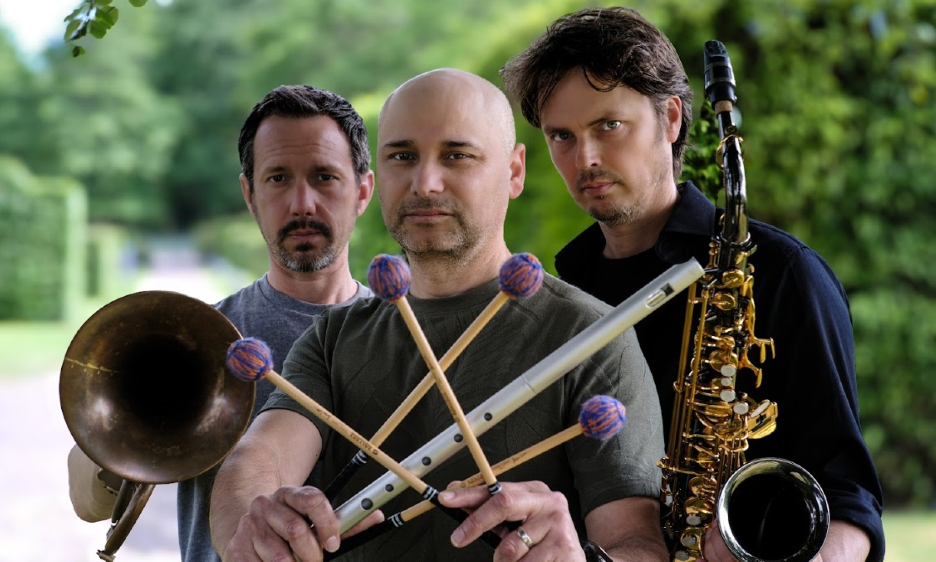
Courtesy Atlantic Road Trip
…one of the tunes that we had played, originally with a full big band and orchestra, and then with a quintet, and then we did a duo, and it was great. It was just a different kind of paradigm.
—Chad McCullough
All About Jazz : You all hail from different parts of the world. Remind us how you got together?
Miro Herak: I met both of the others in 2009 in different places. I met Paul in Italy, where we were both part of a European Big Band project, rehearsing and then touring. The same year I was in Banff, Canada, for a workshop in jazz and improvised music where I met Chad. After that I played in different projects with both of them. And in 2019, I had a great idea to get us all together and form a band—initially a quintet. We were supposed to play at the Glasgow Jazz Festival, but then corona hit, and everything was canceled. So then we recorded remotely together—as was normal at that time—and the recording was played in the online Glasgow Jazz Festival. That was the beginning of the group.
AAJ: Why the name Atlantic Road Trip?
Paul Towndrow: We wanted to look at something that indicated the beautiful impossibility of it all—the obvious thing being that we were divided by an ocean, but at the same time, we were connected in a very 21st-century kind of way. Any sort of artistic endeavor, at risk of sounding clichéd, is about the journey. We threw a few ideas back and forth and then we settled on Atlantic Road Trip, and it worked for us. It has felt more and more apt the more we've played together. The name of a project is important, because you start with an extramusical concept and build music around that. So, yeah, I think we're happy with it, and people ask us about it. If nothing else, it's a good conversation starter! Also, when you have a band name, it becomes something you can put on a t-shirt so people can take something away from the gig. (Holds up natty t-shirt.)
Chad McCullough: There's an identity where the sum is greater than the parts. We wanted it to be a collaborative thing, and we each had very different things to bring.
AAJ: How do you work together? You all live in very different places...
CM: Well, great, because we don't ever have to see each other for more than two weeks at a time!
PT: That's the secret to keeping a band together... just put everybody in different parts of the world! But we're in constant contact, as it turns out. Miro is the great connector in this scenario... Miro and I got on really well, and he kept talking about this guy Chad, and it was, like, the last thing I want to hear about is another American trumpet player. But he insisted over the course of a good ten years that we needed to play together, and he was absolutely right. My way of working, something that's backed up by things like the way music is funded, is that things are forced into six-month and one-year and two-year cycles. And that's actually not how we best work together as musicians. It's a long play.
CM: I think that's evidenced by the differences between the first album and the second album. The first, it was like, oh, well, we can kind of do this and we can do that, and it's gonna sound like jazz, we all come from a jazz background; we all can talk about these chords, we're on the same page, and we've all played a million gigs all over the place, and so it's not a problem to get together and play with people you're less familiar with. On the second album, where we have years of talking three times a week or more, it was very different. Less of a spoken goal, and more of, okay, well, this is what we're gonna do. You can do these things, and you can do these things, and I can do these things, and... and let's see what happens.
AAJ: Your first album featured the three of you along with a bass-drums rhythm section. How come the latest album is just you three?
PT: It was kind of a feasibility study. We had arranged to meet up in The Hague, which is where Miro lives and works, and try to develop some music and some ideas, and essentially just to see if it would work. But Miro had managed to find some studio time. So we got into recording some things, and that's how it all started with Watch As The Echo Falls (Calligram Records, 2026), the new album.
CM: I spent about two weeks really trying to write stuff, you know, a thousand different things that could work. When we had played the year prior, we were in Scotland at a jazz festival where Miro and I did a duo thing for a little bit. It was one of the tunes that we had played, originally with a full big band and orchestra, and then with a quintet, and then we did a duo, and it was great. It was just a different kind of paradigm. We came into the studio with a lot of stuff, then we had our typical two days of 13-hour rehearsals, and trying to go, this... this is stupid, this doesn't make sense, this works really well, but it works better over here... I knew that that was going to be the process of collaborative dissection, and my role was just to bring in as many little pieces as possible that maybe could be thrown away. When we got to the studio, it was really what if we do this, and what if we do that, and how do we make this go to this thing? And I think it worked.
MH: Going into the studio, I was really not expecting that we would come out with an album. I said that repeatedly over the course of both days that we were recording, that it would be fine if we had two or three things that are presentable, something for the future. So I'm really pleasantly surprised that we actually got it to work. It was a truly collaborative thing, although Chad brought most of the compositions to the table. He was also doing some synthesizers, and we were adding them to beginnings or endings of the tunes. There was also an idea that came spontaneously during the recording that it would be nice to have some interludes, a little bit like Mussorgsky. I'm happy that we got the chance to test it live as well, because one thing is to do something in a studio, and it's something else to play everything from beginning to end, just as it is. It turns out, it works very well.
AAJ: Is there some multitracking on the album?
CM: On one of the tunes we have maybe five vibraphone parts. I get a little overexcited sometimes, and I had written this thing that maybe carried a little too far, but it worked. So we had something like five vibraphones, and probably four whistle parts, and three trumpet parts at some point. But most of the record is really just the three of us.
AAJ: Paul, you've been putting in a lot of work lately on the low whistle. What's the fascination with it?
PT: I've always been a big fan of traditional music, and I've found myself involved in a whole load of different band recordings and gigs, often built around Celtic Connections events, and so I've always been working with traditional musicians. My second last album, Deepening the River (Keywork Records, 2021), which is a big band suite that also features Miro, was really a compositional attempt to bridge a lot of those worlds and where they intersected in my own ears. Coming out of that project, I realized that if I were to do this properly, I needed to learn more of the musical language—that huge tradition. So partly as a byproduct of COVID, I bought myself a penny whistle and set myself the challenge of learning a new tune every day. I managed to get some lessons from piper Ross Ainslie, who is somebody I've worked with for a number of years. He helped show me some of the technical approaches, ornamentation, and various other bits of advice.
Towards the end of the pandemic, I treated myself to a low D whistle, and I just found myself practicing more flutes and whistles than saxophone. I realized that, actually, this was something I might be able to incorporate into the small-group jazz that I was doing. Then Chad got into whistling too. He bought one of the first Midges, which is a high D, tunable whistle from MK Whistles in Glasgow. It's a beautiful thing.
(For readers who may never have seen a low whistle, it looks like a very big penny whistle but it's considerably more difficult to play. With saxophones and flutes there are keys that cover the holes, but with a low whistle, you must cover them with your fingers—there are no keys—and the holes are quite far apart, which brings a lot of technical challenge and muscle stretch for the player -Ed).
PT: Then Chad decided that he was going to start to learn how to play all of these whistle tunes on the trumpet, which is a whole other level of technical difficulty. He's one of the few trumpet players I've ever met who can really do that.
AAJ: There's a track on the album called "Parting of the Adriatic," where you're all getting into that kind of traditional feel.
PT: I was working on one of Miro's tunes which had a lot of Balkan and Slavic influence, and it was written in five beats to the bar. I realized that I was really terrible at playing in five, and my attempt to remedy that was to compose something that would represent a bit of a challenge for me, and I wrote these two tunes and sent them to Chad and Miro, and Chad said, well, I can't play that, and I said, well, I think you probably can. It's another example of using what we have and what we can bring to the table to bridge our respective musical and cultural backgrounds, and that's kind of the theme of the band and the album.
AAJ: Chad, you are the American teamed up with two Europeans... how does the American element show up in this music?
CM: You know, I think the American element of jazz... as a historical thing... is so not just an American element anymore. It's often perceived as such until somebody leaves America and goes, oh, oh, you guys, you can do this also, you know?
As an American, leaving and going to another country and realizing that music is studied and worked on in the same ways, just like every other aspect of life—I think that's beautiful and wonderful and unifying. I really don't see any aspect of what we do as distinctly American. That being said, I do have a fascination for Americana and the folk music of America, but I don't necessarily think that what I bring to it is distinctly American.
I don't feel like I'm playing swing that is unique to Chicago. I feel like we all have the same albums, and we all have access to the same music, regardless of where I am, and the more important thing is that we all have a shared background. We've all listened to the same (John) Coltrane records a thousand times. And that is evidenced because we can say, oh, this is the way that we're gonna approach this modal thing, and then Paul is gonna play a whistle solo. And Miro is going to comp using these sorts of voicings that are appropriate, all filtered through our shared experiences. In some ways, a lot of what we can bring is very, very regionalized. In other ways it's a very universal experience. I'm not showing up with a banjo! And anyway, that's an African instrument...
AAJ: Miro, your playing has been described as the architectural framework of the music. What's it like to be both the only percussion and only chordal instrument in the group? That feels like a lot of responsibility... how is it for you?
MH: It feels like a lot of responsibility to me too! And thankfully, I am the only chordal and rhythm instrument, so I don't have to compete with these two guys. It's sort of a challenge for me, for sure, because I feel very comfortable playing in my own projects. I really like piano as an instrument, and I really like the capabilities of piano, and I like the sound, and I like the options that piano has. What I'm trying to do is basically piano on vibraphone.
But it's been a challenge for sure, because I feel like I have to hold it together. The truth is, I don't have to hold it together, because these guys have great rhythm and great harmonic knowledge, so they don't need me as much as may seem. So even if I stop playing, it still sounds great. I don't feel like I have to show them where the time or the harmony is. I feel like we are three distinctive voices in the whole group making the sound together. Although most of my parts would be in the bottom, and most of their parts would be in the melody or feeling the harmony. They work as well as rhythm and harmony as much as me.
AAJ: What is coming up for you—and what plans do you have for more live dates?
PT: This time in 2027, approximately, is our window for touring in the UK. Chad put a fantastic tour together in the US, and we played in Holland and Slovakia, and then we came over to play in Scotland and the rest of the UK, so the rotation has been fairly even. We are very keen to try and take the music to more remote, rural places, which is going to be slightly easier with the trio format, but we absolutely intend to play more quintet gigs as well. We'll be looking to tour the whole of the UK between February and May 2027. If anybody's reading this and they run a jazz club, then they can expect an email from us very soon. And a word about our label, Calligram Records. They are the bravest record label in the United States of America.
CM: It's half me, and half Geof Bradfield, a great saxophonist in Chicago, and we've been doing that for about three years. I just finished the art for the thirty-second (Calligram Records) album.
AAJ: Thank you very much.
 FOLLOW Mark McKergow
and get notified whenever Mark has a new article published.
FOLLOW Mark McKergow
and get notified whenever Mark has a new article published.
Saxophonist, clarinetist and writer living in Edinburgh, Scotland
About Atlantic Road Trip

Tags
PREVIOUS / NEXT

Become a Sustaining Member

Since 1995, All About Jazz has championed jazz as an art form and supported the musicians who create it. Over three decades, it has grown into one of the world's leading jazz resources, serving hundreds of thousands of readers, musicians, presenters and industry professionals each month.
Help Build the Future of All About Jazz
Your support helps us continue building All About Jazz for the next generation—expanding our editorial coverage, preserving jazz history, developing new community features and creating better ways to discover the music and the people behind it.
Become a sustaining member for as little as $20 per year and you'll immediately enjoy an ad-free experience along with access to subscriber features and future articles for a full year.
Together, we're not simply sustaining All About Jazz—we're building its future. Thank you for being part of the journey.