Home » Jazz Articles » The Jazz Life » "My Feelings Are Wings / That Can Never Be Clipped"—The ...
"My Feelings Are Wings / That Can Never Be Clipped"—The Jazz Poetry Of Adele Sebastian

Sunrise to sunset / intro to finé / spontaneous improvisation / that’s jazz...
—Adele Sebastian
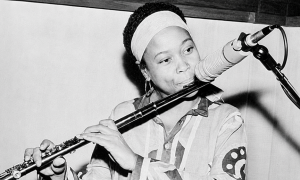
In a kinder world. In this one, Adele Sebastian tragically died on September 29, 1983, after a decade-long struggle with the kidney disease lupus. She left behind a small but exquisite body of music: one solo album, Desert Fairy Princess (Nimbus West, 1981); her contributions to the free/spiritual jazz classic albums of bandleader and pianist Horace Tapscott's The Pan Afrikan Peoples Arkestra (PAPA), Flight 17, The Call (1978) and Live at I.U.C.C. (1979) (plus several more recently released live recordings, such as Live at I.U.C.C. 11/26/1978); and a few appearances on other musicians' recordings, such as fellow PAPA member pianist Linda Hill's Lullaby for Linda. A worthy discography for a twenty-seven-year-old musician, let alone one fighting a debilitating disease for the entirety of her career; and yet, clearly, there should have been so much more.
While Desert Fairy Princess, particularly its hypnotic title track on which Arabic-inspired melodies fuse with Latin grooves, has steadily attained classic status in recent years, accounts of Adele's life often omit to mention that she was also an accomplished poet. It was through poetry that she most directly expressed her feelings about jazz, her health struggles and being a Black woman in the United States. By exploring her short life through excerpts from a few of her poems, this article seeks to redress the balance.
While she was born into a highly musical family, Adele's life was revolutionized by encountering Tapscott and the avant-garde music of PAPA. In a radio station interview, she recalled "something about that music, it turned me all the way around. It was like a culture shock, it was like a reflection, like seeing myself or seeing who I was." Tapscott's impact on the young musician is made clear in Adele's poem "The Musician (For Horace Tapscott)":
i watch and listen
in complete wonder and admiration
as you fingers dance upon you instrument
your music taking me to
mystical, tropical places
i have never been
[...]
At the age of sixteen, Adele joined PAPA, and was soon learning to improvise at the collective's free concerts regularly given at venues rooted in the Los Angeles Black community, such as the Immanuel United Church of Christ and the Watts Towers. For more on Tapscott and PAPA, and Adele's role within PAPA, readers can do no better than seek out historian Steven L. Isoardi's excellent The Dark Tree: Jazz and the Community Arts in Los Angeles.
Adele's poetry features as lyrics on several of her own and PAPA's compositions. On The Call's "Quagmire Manor at 5 A.M.," her lyrics refer to a large house in south-central Los Angeles, where PAPA members had lived communally since 1975. Over walking bass, Adele playfully tells of the all-hours music-making which was a part of life at "the Quag":
Now, if you've ever been to Quag at 5 A.M.
Then you must really be in tune,
'Cause all the music spirits hear the call, they awaken
And they blow from room to room
before the song dissolves into PAPA's signature up-tempo improvisation, around the same melodic line just sung by Adele. At the other end of a spectrum are the melancholy, gospel-infused lyrics to the haunting coda of Desert Fairy Princess, "Prayer for the People," an artist laying bare her soul over whether music can heal a broken world:
Oh, my my, oh my,
Hear the children crying,
See the weak ones dying.
[...]
Feel the women aching,
Strong backs close to breaking.
An' Lord, my Lord,
What can I do?
And will my music do anything for you?
Adele balanced her musicianship with studies at California State University, writing music journalism and volunteering in the Federal Correctional Institution, Terminal Island, staging concerts for the inmates. But it was her lupus diagnosis, the same year she joined PAPA, that would dominate most of her time. As she explained:
Rapidly my life changed. I was swept up into the vast world of medicine [...] Tests, needles, medication, surgery and probing doctors all began making decisions about my life and future. [...] After a period of denial, anger and self-pity, I began to adjust to this new way of life. I had to learn to cope with pain, medication, bizarre side effects, extreme high and low blood pressure, dehydration, nausea, massive weight and muscle loss, cramping and respiratory difficulty to name but a few of the problems.
Adele expressed the loneliness of long hours spent in hospitals, and a yearning for a more normal life, more poetically in "Dialysis Blues":
i wish you were here
to help me go through this
wouldn't take much
just your presence
contagious joy
a little understanding
a hand to hold
so it doesn't hurt so much
[...]
Nevertheless, capable of finding joy in desolate places, in "Surprise at BMA," its title referring to the Bio-Medical Association in Beverly Hills where she received treatment, she tells of making a friend of a nurse at the hospital:
i walked in today with my
usual tuesday morning apprehension
and there you were
with a smile as bright as the sun itself
[...]
Many of Adele's poems are deeply personal. Her mother Jacquelyn noted that "Adele often wrote poems for her friends instead of the traditional note or card celebrating various occasions." Yet some speak to the political atmosphere of America in the 1970s and early '80s. She dedicated "Poem for an Indian Inmate" to Bobby Gene Garcia, incarcerated poet and activist of the American Indian Movement. In "Black Woman Don't Need No Women's Lib," she turned to her own community's struggles, questioning the relevance of white-dominated feminism for Black women:
[...]
black woman don't need no women's lib
to know she's free
has always done
what she had to do
has always worn pants
and that's survival...
The year after Adele's death, Jacquelyn organized the publication of some of her poems in the volume Intro to Finé. Jacquelyn was herself the subject of several of Adele's poems, such as the simply titled "Poem For My Mother," which tenderly addresses its subject in aquarian tones similar to the imagery evoked by Adele's signature song "Desert Fairy Princess":
earth song desert flower
sister sapphire
queen of the nile
mother Africa
[...]
A brief introduction was provided by leading Black American poet Nikki Giovanni, who aptly wrote "Adele Sebastian is a young poet no longer with us in body. [...] Adele's mother had to bury the body, but, fortunately for us all, she did not bury the soul. We have in Intro to Finé the spirit of a vibrant, young woman with so much to give."
In 1995, an expanded second edition of Intro to Finé appeared, published by the independent feminist press Woman in the Moon Publications, including 48 poems in total. Long out of print, and largely forgotten by comparison with Adele's musical output, it is nevertheless worth tracking down in libraries or bookshops. No mere footnote in a musician's short life, it is a collection of accomplished, original and moving poetry, as this essay has hopefully shown.
The last words belong to Adele—her poem about the music she loved, "That's Jazz":
my feelings are wings
that can never be clipped
i am
looking only up and away
into the cycle-rhythm
of the universe
stopping only for the chance
to sing about love
be about love
free the love inside
sunrise to sunset
intro to finé
spontaneous improvisation
that's jazz...
With thanks to Steven Isoardi.
Excerpts from "The Musician (For Horace Tapscott)," "Dialysis Blues," "Surprise at BMA," "Black Woman Don't Need No Women's Lib," "Poem For My Mother" and "That's Jazz" taken from Intro to Finé: The Expanded Second Edition, courtesy of Women in the Moon Publications.
Lyrics from "Quagmire Manor at 5 A.M." and "Prayer for the People" courtesy of Nimbus West Records.
 FOLLOW Gabriel Polley
and get notified whenever a new article published.
FOLLOW Gabriel Polley
and get notified whenever a new article published.
Music-lover, historian and activist based in London.
About Adele Sebastian

Tags
PREVIOUS / NEXT
Become a Sustaining Member

Since 1995, All About Jazz has championed jazz as an art form and supported the musicians who create it. Over three decades, it has grown into one of the world's leading jazz resources, serving hundreds of thousands of readers, musicians, presenters and industry professionals each month.
Help Build the Future of All About Jazz
Your support helps us continue building All About Jazz for the next generation—expanding our editorial coverage, preserving jazz history, developing new community features and creating better ways to discover the music and the people behind it.
Become a sustaining member for as little as $20 per year and you'll immediately enjoy an ad-free experience along with access to subscriber features and future articles for a full year.
Together, we're not simply sustaining All About Jazz—we're building its future. Thank you for being part of the journey.