Home » Jazz Articles » Book Review » Tad Hershorn: Norman Granz - The Man Who Used Jazz for Justice
Tad Hershorn: Norman Granz - The Man Who Used Jazz for Justice

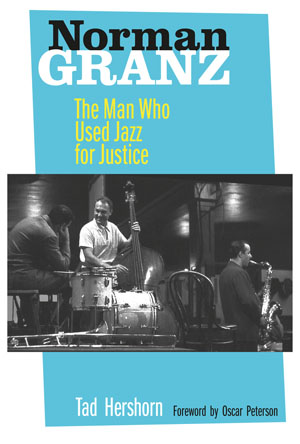 Norman Granz: The Man Who Used Jazz for Justice
Tad Hershorn
Hardcover, 488 pages
University of California Press
ISBN: 9780520267824
2011
Impresario Norman Granz changed the course of jazz in so many ways, as creator of the Jazz At The Philharmonic (JATP) tour package and as founder of Verve and other labels. His most indelible contribution may be, as biographer Tad Hershorn recounts, that he used jazz as a vehicle to advance civil rights causes. Granz was a fearless advocate for African American and minority musicians who were systematically discriminated against by record companies, theaters, radio stations, big bands and unions.
Granz's reputation as a protector of American artists, and as jazz as a unique art form, is legendary within the music industry. Hershorn starting writing the book in 1996, while still in college, and came to know Granz, who previously rebuffed requests for a book about his life—even though he was at the epicenter of the jazz world for two decades. He captures the fast and furious atmosphere of the era.
Granz was so smitten with the jazz scene that he ditched his own college career when he started hanging out at West Coast clubs in the 1930s. In a few years he was an insider in that world, as a powerhouse broker for such seminal artists as saxophonists Charlie Parker and Lester Young, singer Billie Holiday, pianist Hank Jones—the whole A-list including jazz royalty from singer Nat King Cole to bandleaders Count Basie and Duke Ellington. JATP packed them in as it crisscrossed the US in the late 1940s and early 1950s, eventually becoming an international entity. He presented jazz and blues musician in classical concert halls, to challenge the public to appreciate the artists and their music on par with European classical music.
Granz was a savvy businessman, who became rich parlaying every angle of the music business to his advantage, and was one of the first jazz producers to demand top dollar wages for his clients, often paying out of his own pocket if tour dates were less lucrative than expected. He was highly respected among musicians, even if others in the industry saw him as a self-promoter, among other things. He even went head to head with big band leaders to lure musicians into his roster for the JATP concerts and his brand of live recording, which up until then was untested territory.
He conspicuously worked for racial equality in the business—for black and for white musicians—and would not tolerate any reverse discrimination. He would secure hotel rooms for JATP musicians, and when they arrived and the segregated hotel found out they would have black guesst and tried to cancel reservations, Granz would produce the contract and threaten to sue them. He even stared down the House Un-American Activities Committee (HUAC). He not only told them he was a one time communist sympathizer, he defied them to do something about it. They didn't.
Granz also refused to book the highly successful JATP series in segregated theaters, starting a boycott petition that included names of world famous personages such as Igor Stravinsky, Leonard Bernstein and Duke Ellington. Still, Granz could only do so much; he couldn't stop black musicians from continuing to perform in the segregated south for instance, because they needed the work to keep their bands intact.
As Hershorn details, even with a long list of musicians weighing in with gratitude, Granz was not universally applauded within the industry. Charlie Parker, for one, bristled at some of his tactics. Indeed, Granz's brand was not without its critics, the main complaint being that his mainstreaming of artists put jazz at odds with the genre's purest creative development. But Granz maintained a progressive view that jazz needed to be constantly evolving, even if it wasn't apparent in the commercial market of the time. He championed the Cuban jazz movement in New York, for example, at a time when few other mainstream promoters were.
Hershorn's exhaustive factoids—personnel lists of concerts, jam sessions and recording dates—may be all for the record but, at times, becomes distracting. Actually, it becomes almost funny, but well worth it to get to such scintillating stories as Billie Holiday's return to the New York stage after losing her cabaret license.
Holiday had a stellar first set at Carnegie Hall that was marred by club-style rowdiness from the crowd. Granz stepped in and told the audience "I'm getting sick and tired of you few idiots who are spoiling the show for everybody. Shut up and let Billie Holiday sing." Meanwhile, Holiday tanked and shot up between sets and was out of it when she returned to the stage. Granz had to lead her off and the comeback was ruined, but he never held it against her.
In contrast, he outright loathed critics and would take them to task for even glancing criticisms of performances. He threatened one with a libel suit when he called Granz "the P.T. Barnum of jazz."
As the market for concert jazz shifted in the 1950s, with changing trends—people fleeing the cities, the advent of jazz festivals—Granz shifted his focus to the international scene. He founded Verve Records and exclusively managed pianist Oscar Peterson and singer Ella Fitzgerald, carefully steering her career in a way that would be a business model for the entire industry. Hershorn's capsules on the artists are invaluable and his meticulous research, for the most part, doesn't slow down the story of this unique figure. This is an exhaustively rich portrait of a man and his times.
Tags
PREVIOUS / NEXT


Become a Sustaining Member

Since 1995, All About Jazz has championed jazz as an art form and supported the musicians who create it. Over three decades, it has grown into one of the world's leading jazz resources, serving hundreds of thousands of readers, musicians, presenters and industry professionals each month.
Help Build the Future of All About Jazz
Your support helps us continue building All About Jazz for the next generation—expanding our editorial coverage, preserving jazz history, developing new community features and creating better ways to discover the music and the people behind it.
Become a sustaining member for as little as $20 per year and you'll immediately enjoy an ad-free experience along with access to subscriber features and future articles for a full year.
Together, we're not simply sustaining All About Jazz—we're building its future. Thank you for being part of the journey.