Home » Jazz Articles » Album Review » Rahsaan Roland Kirk: Seek & Listen: Live At The Penthouse
Rahsaan Roland Kirk: Seek & Listen: Live At The Penthouse
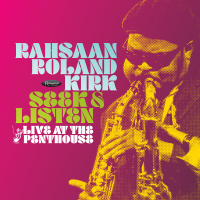
Seek & Listen: Live At The Penthouse, recorded in 1967 and newly restored and remastered by Matthew Lutthans at The Mastering Lab, documents the multi-reedist at the height of his creative powers. The period was a prolific one, and this live set stands among his most vital. Across a program that blends originals, a Duke Ellington medley and an unexpected reading of Bobbie Gentry's "Ode to Billie Joe," Kirk's restless imagination and technical daring are on full display. He shifts effortlessly among tenor, manzello, and stritch—often two or three at once—deploying his signature double-blowing and circular breathing to conjure choruses that seem to defy human limitation.
The Resonance Records release benefits from a typically generous presentation. John Kruth, Kirk's biographer, contributes wide-ranging liner notes that situate the music within Kirk's evolution and eccentric brilliance. Kruth details not only the array of modified horns—the stritch, a straight alto sax fitted with a French horn bell—but also the working method recalled by bassist Steve Novosel: no written charts, only spontaneous creation. "Each night was different," Novosel observes, a truth confirmed by the recordings themselves.
Saxophonist James Carter notes that Kirk could sound like an entire sax section, blending horns to produce contrapuntal lines as if two or three musicians were playing at once. Producer Zev Feldman, who first encountered these tapes years ago, calls the performance "monumentally high-level." Dorthaan Kirk, Rahsaan's widow, reminds us that his music continues to enthrall new generations, while novelist May Cobb neatly sums up his calling: "He played music because he had to."
The interpretations here are often revelatory. "Alfie" unfolds with an unabashedly romantic grace, the melody embellished in a way that feels old-fashioned and heartfelt. A sustained note held through circular breathing becomes its emotional anchor. Drummer Jon Hiseman once remarked that Kirk's solos were "individual compositions that fitted the ambience of the piece perfectly," a principle he and Barbara Thompson later applied to their own work. The observation resonates throughout this set.
The Ellington medley, curiously including the non-Ellington "Ev'ry Time We Say Goodbye" (Cole Porter), finds a playful symmetry between reverence and reinvention. The "Satin Doll" section alone, played with the gleaming texture of an Ellington reed choir, is worth the price of admission—its phrasing fresher and more vital than much contemporary big-band fare of the late '60s. On "Mingus—Griff Song," Kirk channels the electric fervor of Oh Yeah! (Atlantic, 1962), alternating horns chorus by chorus with exhilarating precision. The raucous "Bagpipe Melody" evokes Archie Shepp's serrated edge before exploding joyfully into "Happy Days Are Here Again," drummer Jimmy Hopps propelling a parade of sound that is at once chaotic and exultant. Even the tender "Prelude to a Kiss" reveals Kirk's gift for balance, transforming swing into something deeply conversational.
Humor was never far from his art. After playing "Funk Underneath" on the nose flute, Kirk quips, "the most educated nose in the world." Yet beneath the wit lay sincerity. "Now Please Don't You Cry, Beautiful Edith," dedicated to his first wife, carries heart-on-sleeve emotion with Mingus-like lyricism: long, swooning lines sustained with the circular breathing technique that made his phrasing seem eternal.
Steve Turre, a former band mate, perhaps describes Kirk best: He was a musician who could see truth in sound, feeling sincerity not by appearances but by a person's tone of voice. For Kirk, jazz was not a genre but a unifying force of spirit—and Kirk in Seattle captures that conviction completely.
In the end, this release stands as both document and testament: proof that Kirk's fire burned with equal parts technical genius, deep historical awareness and emotional candor. More than half a century on, Seek & Listen: Live At The Penthouse remains electrifying—a reminder that the borders of jazz are only as narrow as the imagination of those who play it.
This album captures the unique, almost ecstatic qualities of Kirk in all their glory—his boundless energy, masterly technique and the deep well of history reshaped in the moment.
 FOLLOW Jack Kenny
and get notified whenever a new article published.
FOLLOW Jack Kenny
and get notified whenever a new article published.
Jack was turned on to jazz by a mixture of Stan Getz, Lee Konitz and Earl Bostic.
Track Listing
Disc 1: The Jump Thing; Alfie; Mingus- Griff Song; Medley Ev’ry Time We Say Goodbye; I've Got It Bad (and That Ain’t Good); Sophisticated Lady; Satin Doll; Medley: Blues For C&T; Happy Days Are Here Again; Down by The Riverside. Disc 2Ode to Billie Joe; Prelude to A Kiss; Funk Underneath; Now Please Don’t You Cry, Beautiful Edith; Making Love After Hours.
Personnel


Additional Instrumentation
Rahsaan Roland Kirk: flute, stritch, manzello, flexatone, siren, whistle, vocals, etc.
Album information
Title: Seek & Listen: Live At The Penthouse | Year Released: 2025 | Record Label: Resonance Records
About Rahsaan Roland Kirk
Tags
PREVIOUS / NEXT
Become a Sustaining Member

Since 1995, All About Jazz has championed jazz as an art form and supported the musicians who create it. Over three decades, it has grown into one of the world's leading jazz resources, serving hundreds of thousands of readers, musicians, presenters and industry professionals each month.
Help Build the Future of All About Jazz
Your support helps us continue building All About Jazz for the next generation—expanding our editorial coverage, preserving jazz history, developing new community features and creating better ways to discover the music and the people behind it.
Become a sustaining member for as little as $20 per year and you'll immediately enjoy an ad-free experience along with access to subscriber features and future articles for a full year.
Together, we're not simply sustaining All About Jazz—we're building its future. Thank you for being part of the journey.