Home » Jazz Articles » Live Review » Maria Schneider & UMO Helsinki Jazz Orchestra at Savoy T...
Maria Schneider & UMO Helsinki Jazz Orchestra at Savoy Theater, Helsinki
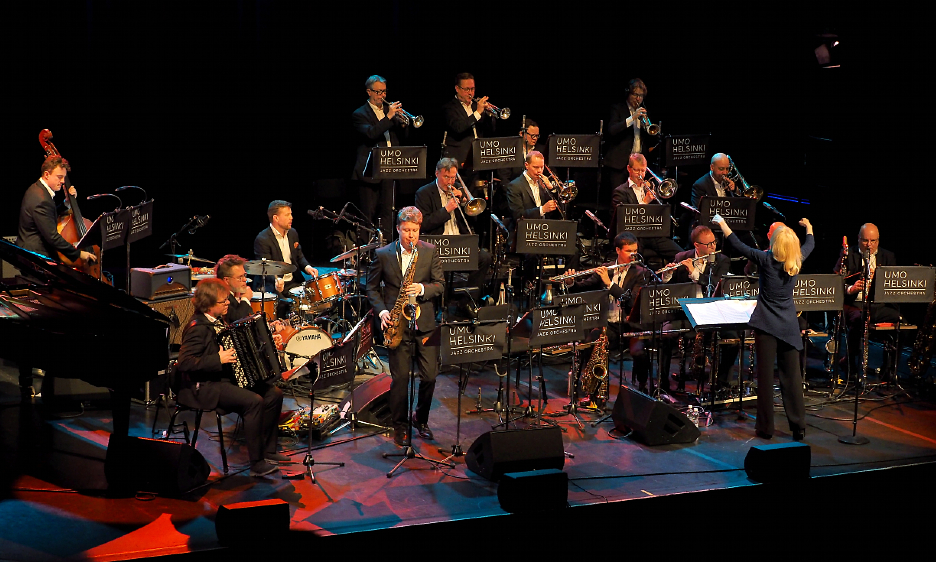
Courtesy Olli Nurmi
Savoy-teatteri
Helsinki, Finland
November 13, 2025
The Finnish jazz community is celebrating—and by extension, so are those of Europe and, truth be told, the entire world. The reason is no small matter: the UMO Helsinki Jazz Orchestra marks its 50th anniversary, remaining faithful to the principles that have made it one of the most compelling European ensembles active today. Arguably the most creative, versatile and experimental—within the boundaries of contemporary mainstream—in the Old World. What other orchestra could reinterpret figures as disparate as Duke Ellington, Benny Goodman, Muhal Richard Abrams or Frank Zappa, while maintaining a fierce coherence with itself and a profound respect—never eschewing exploratory re-elaboration—for the material at hand?
Where earnestness and playfulness go hand in hand
Since that pivotal 1975, the band has alternated between revisiting those external repertoires and presenting its own suites and compositions, collaborating along the way with luminaries as stylistically diverse as Dizzy Gillespie, Michael Brecker, Kenny Wheeler and Larry Coryell. Its greatest virtue, perhaps, lies in the way UMO traverses the stylistic history of the genre with dazzling brilliance—whether in traditionalist mode, swing, mainstream, avant-garde, fusion-esque or post-bop. Rooted in the inherent Afro-American influence, the orchestra shifts with breathtaking dexterity across musical landscapes, without losing its substantial jazz-centered focus—maintained, to varying degrees, even when venturing into distinctly funk and blues territories, as in its numerous collaborations with vocalists. Add to this a state-of-the-art execution that does not shy away from a certain jovial, vivacious sense of spectacle and a studied unpredictability—qualities through which it presents its complex creations and orchestrations, elevated by a roster of outstanding soloists. No wonder the highly prestigious The Penguin Guide to Jazz once hailed them as "one of the world's great jazz orchestras."To commemorate its half-century, a wide range of projects and events has been scheduled across Finland between summer 2025 and spring 2026. Among them are concerts where UMO collaborates—under a broad vision encompassing genres like rap and folk—with local and international formations and figures. The guests of honor notably include Maria Schneider, who on November 13 led a concert at Helsinki's Savoy-teatteri, marking her fourth artistic encounter with the band. The composer from Windom, Minnesota, had previously held a discussion entitled "Deeper into the Show"—moderated by Jouni Järvelä, leader of the saxophone section—initially focused on composition, but also touching on her early childhood with few musical incentives, until the providential stay of Evelyn Butler, a Chicago pianist who instilled in her the virus of musical curiosity. As expected, some of Schneider's deeply conscious leitmotifs also surfaced during the talk.
A keen sensitivity to the animal, vegetal, even mineral realms; the fragility of the individual against mega-organizations with dubious, if not outright criminal practices; Brazil—its people, landscapes and music; the universe inhabited by Gil Evans and Miles Davis; an unabashed trombonism, likely born of her studies under Bob Brookmeyer, who introduced her to Evans and with whom she maintained a close relationship—these are, in no particular order, some raw materials Schneider draws upon when composing and orchestrating her works. These ideas and motivations paraded through two brief yet splendid hours, embodied by the formidable Finnish orchestra, with its flawless, razor-sharp section work and that luminous, almost unmistakable sonority of its brass ensemble—perhaps its most distinctive hallmark. Among them, a trumpet line of historic stature, with Timo Paasonen as the veteran—his first recorded participation dates back to 1986—and the rest of the section hailing from the '90s. The trombone line featured Pekka laukkanen, who shared with Paasonen his first recording experience in Passions Of A Man - A Suite For Jazz Orchestra (Finnlevy, 1987), when the ensemble was still called the New Music Orchestra. Also present was the historic Kirmo Lintinen at the piano, a regular conductor and artistic director of the band.
The event drew a strong turnout, with a heterogeneous audience largely comprising restless seniors along with a notable contingent of younger listeners. Special mention goes to the pristine sound engineering, which allowed every nuance of the accordion, the subliminal effects of the electric guitar, and the double bass—that great loser in countless live performances—to shine with striking clarity, note by note. Beyond the skill of the sound technicians and the venue's acoustics, this is another of the orchestra's strengths: integrating its members into a brilliant homogeneity that nonetheless constantly leaves space for sophisticated individual details to emerge with crystalline precision.
"Don't Be Evil"—Seriously?
The concert traced Schneider's trajectory—always approachable and meticulously detailed in her explanations—from her beginnings to her most recent studio work, Data Lords (ArtistShare, 2020), which provided much of the evening's repertoire. From that album, she chose "Look Up" to open the night, commenting only that her intention was "reminding us to look up," without specifying further—though given the album's central theme, it is clear she meant against that increasingly refined and perversely wielded 'New Digital Order' we are facing. A piece of initially gentle contours, softened further by the extraordinary trombone of Kasperi Sarikoski, who carried the performance from start to finish. In his extended solo, he played with dynamics and moods, negotiating the occasional but complex chord changes skillfully.In the same accusatory register, "Don't Be Evil"—pointedly dedicated to Google—stood out for the resounding texture of Heikki Tuhkanen's bass trombone, hammering the beat in a tango-like yet martial exposition that later gave way to a dynamizing elasticity. Jarmo Saari burst in, à la Zappa, with a striking discourse full of timbral and expressive resources, leading to ominous, serpentine arabesques from the ensemble. Emerging from them, Mikko Mustonen's trombone sustained the oppressive atmosphere, playing with a deliberately harsh sonority that heightened the sinister vibe. Lintinen's piano introduced pause and space, with an ironic aestheticism that turned percussive when the band reappeared to, once again in Zappa mode, reestablish the malicious scenario. Without doubt, here UMO delivered one of the night's peak moments.
Musical Geographic
Two other pieces rounded out the first half of the concert. The first, "El Viento" from Coming About (ArtistShare, 1996), evoked the unmistakable spirit of Sketches Of Spain (Columbia Records, 1961), with Evans deliciously remembered. Tenor Ville Vannemaa began his statement ruminatively, gradually unleashing his powerful attack and the beauty of his warm tone, until it broke into a fiery dialogue with the band, particularly the sensational drumming of Jaska Lukkarinen. He was followed by the sensual depths of Laukkanen's trombone, whose brief solo radiated irrefutable authority, and trumpeter Teemu Mattsson, who ignited the hall with a climax of searing drama, supported by the orchestra at its most electrifying. The second, an accordion-featured piece, "Sanzenin," was born from the sensory and emotional impact of a serene Kyoto garden. Far from relying on Japanese melodic motifs, a borderless soundscape flooded the venue with a sense of inner peace, with Veli Kujala subliminally weaving into his simple yet refined harmonic vamp. His fingerwork blossomed unhurriedly, with delicate exuberance, like a fleeting but spectacular daylily—a flower that unfurls for a single day, only to wilt hours later with the same hushed secrecy with which it appeared.Take Fifteen
After a very generous fifteen-minute break, the orchestra opened the second half of the concert with "Dance You Monster To My Soft Song," another tour de force, in this case from Evanescence (Enja Records, 1994), Schneider's exceptional debut as a leader. This composition is inspired by Paul Klee's 1922 painting of the same name, where a tiny human, 'armed' with a piano, tames a monster of friendly appearance yet no less dangerous. At its core, it is the same idea that guides later works, such as the much-cited Data Lords: the smallness of the individual, who must be constantly on guard to confront the perils of our contemporary monsters—digital empires that, under an attractive, even beneficent appearance, hide abuses like the unapproved gathering of personal data.Musically, we witness an exercise in domination that describes the struggle between a threatening rage and a conciliatory beauty, personified, on the one hand, by a sinister orchestral ostinato and its multiple variations—including some intimidating glissandos—and, on the other, by the different soloists. Max Zenger carved his way through uncertainty and organized chaos, his solo moving from affability to power. Then, the air filled with Iberian aromas, with a succinct intervention from Filemon von Numers' double bass, followed by Tero Saarti's trumpet, which brought to mind the final section of Evans and Davis' "Soleá." Both soloists were supported by a terrific Saari—endowed with an inexhaustible panoply of resources—and by Lukkarinen's omnipresent support. A powerful musical outburst, the most overwhelming of the second half, and another of the concert's memorable instants, which, from that moment on, perhaps saw the rich energy radiated by the first half wane imperceptibly. Contributing to that subtle impression was the fact that, contrary to what was expected by some of us, there were no appearances by venerable former members of the band such as Eero Koivistoinen, Heikki Sarmanto or Juhani Aaltonen—the last of whom performed with Sarmanto just a few days later on the same stage, in a very special concert celebrating his 90th birthday, 70 of those years musically active. But needless to say, that was more a matter of our wishes than any fault of the magnificent band and its distinguished director.
My Favorite Things, But My Unfavorite Names
The last third of the night was marked by Schneider's manifest passion for that microcosm called Brazil and for its music, which, in her words, combines "joy and purity with depth and intensity." "Choro Dançado" served mainly as a vehicle for Joonatan Rautio to deliver his first solo of the night on tenor sax. Though splendid, this was soon surpassed by his second intervention in Brazilian contexts, this time with a classic much loved by Schneider, the buoyant "Hang Gliding," which describes the conductor's experience during an adrenaline-fueled hang-gliding flight on the outskirts of Rio de Janeiro. The historic Mikko Pettinen led off with an excellent air on flugelhorn, alternating references to the ever-reclaimable Kenny Wheeler with others to Tom Harrell. Ethereal yet explicit, Pettinen soared elegantly to describe the highest part of Schneider's flight, handing over to a stratospheric Rautio, who in Michael Brecker mode evolved inventively through elaborate changes, thus depicting the most vertiginous side of the experience, among currents, cliffs and favelas dangerously overflown.Between those pieces came two of the evening's most complex—and at the same time humorous—moments. The first, "Stone Song," a demanding composition dedicated to all the stones of the world, "which have many stories to tell us"—a filigree of classical aromas studded with intricate stops and runs and devilish rhythmic and harmonic changes. The performance became almost exclusively a labyrinthine dialogue between Järvelä's leaping soprano and a playful rhythm section, with special emphasis on Kujala's accordion and on Schneider's much-appreciated stone idiophone, skillfully handled by Lukkarinen. The second was the conductor's presentation of the 18 musicians, navigating as best she could the difficulties of Finnish, with its double consonants, double vowels and a pronunciation particularly complicated for English speakers. The audience compensated with polite silences, spontaneous laughter and grateful applause.
The closing was reserved for "Walking by Flashlight," from her lesser-known project Winter Morning Walks (ArtistShare, 2013), in which Schneider set to music several poems from the book of the same name by American poet Ted Kooser, written during his recovery from cancer. Under a rhythm evoking the tranquil walk, the contemplative pause, the damp auroral morning silence—barely broken by the hidden sounds of wild creatures—Zenger's bass clarinet took the reins of the piece, with the rest of the ensemble in subliminal mode. A balsam-like piece, which she also performed the previous year in Maria Schneider and the Clasijazz Big Band at the Barcelona Jazz Festival to pay tribute to those affected by the floods in eastern Spain in October 2024. On this occasion, it served as the sole encore and as a beautiful final touch to a memorable night, one of those that leave beautiful, unerasable scars in the memory of the privileged attendee.
Last Season
Experiencing a UMO concert is one of those essential moments that a good jazz and music enthusiast should not miss. Admittedly, they do not make it easy for us—their excursions outside Finland or its neighboring territories are virtually non-existent, so there is no choice but to travel to their area of action to enjoy, in person, their invitation to musical catharsis. Yet certainly, the effort, if feasible, is enormously worthwhile: UMO combines power and delicacy, depth and fun, tradition and innovation, and does so while preserving its unmistakable stamp and its very high quality standard. Its steely, colorful, three-dimensional fullness, like a sunny November morning in a clear yet freezing Helsinki, will hardly leave anyone with even a minimum of artistic sensitivity unmoved. If we add their collaborations with figures such as the immense Schneider, success is guaranteed, as indeed happened on that raw, rainy helsinkiläinen night. Consequently, do not wait another fifty years to go and see them: one of Northern Europe's best-kept jazz secrets is still waiting for you.
 FOLLOW Artur Moral
and get notified whenever a new article published.
FOLLOW Artur Moral
and get notified whenever a new article published.
An Absolute Listener
About UMO Helsinki Jazz Orchestra
Tags
PREVIOUS / NEXT

UMO Helsinki Jazz Orchestra Concerts
JAZZ-SUOMI 100: UMO Helsinki Jazz Orchestra feat. Selma...
Kulttuuritalo KareliaTammisaari, Finland
Become a Sustaining Member

Since 1995, All About Jazz has championed jazz as an art form and supported the musicians who create it. Over three decades, it has grown into one of the world's leading jazz resources, serving hundreds of thousands of readers, musicians, presenters and industry professionals each month.
Help Build the Future of All About Jazz
Your support helps us continue building All About Jazz for the next generation—expanding our editorial coverage, preserving jazz history, developing new community features and creating better ways to discover the music and the people behind it.
Become a sustaining member for as little as $20 per year and you'll immediately enjoy an ad-free experience along with access to subscriber features and future articles for a full year.
Together, we're not simply sustaining All About Jazz—we're building its future. Thank you for being part of the journey.