Home » Jazz Articles » Album Review » Dave Douglas: Four Freedoms
Dave Douglas: Four Freedoms
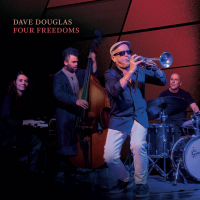
That sense of shared language is anchored in Douglas' long-standing rapport with Baron, a partnership that stretches back decades and countless contexts. Their intuitive exchanges supply both propulsion and elasticity, forming a flexible spine for the quartet. Warelis and Dunston extend that language forward, contributing distinct, contemporary voices that favor interaction over hierarchy. Rather than positioning Douglas as a singular narrator, the album unfolds as a continuous exchange, with ideas passed, reshaped and occasionally challenged in real time.
The nine-track set opens with "Grits," an up-tempo declaration that establishes momentum and intent. Douglas' trumpet cuts cleanly through the texture with vivid, articulate lines, while Baron answers with driving rhythms and quicksilver accents, their call-and-response underscoring years of shared intuition. Baron proves an ideal counterpoint, matching Douglas' melodic invention with rhythmic sophistication and an acute sense of when to propel and when to pull back.
"Sandhog," a tribute to the laborers who built New York City's underground infrastructure, blends blues-inflected tenacity with modern abstraction. Warelis stretches the primary theme into angular shapes; Baron locks into a grounded pulse, then fractures it with polyrhythmic force. The piece balances earthiness and flight with symbolic clarity, its structure mirroring the tension between toil and freedom.
The title track shifts inward. Warelis' piano creates ethereal, almost devotional textures, opening contemplative space for Douglas' multifaceted phrasing. The music unfolds patiently, suggesting reverence without literalism, its exploratory passages counterbalanced by a quiet sense of purpose. Mid-album, "Militias" sharpens the edge, its fractured theme fueling tension through angular improvisation tinted with free- flowing ideas.
"Fire in the Firewood" opens with Dunston's deeply conversational bass solo, delicately supported by Baron. Douglas enters with warm, hovering lines that glide above the busy undercurrent, as the quartet navigates implied pathways. When Douglas opens it up near the bridge, the band responds with fiery, tightly coiled exchanges that feel spontaneous yet assured.
The closing pieces, "My First Rodeo" and "Ruminants," meditate on freedom as an evolving condition rather than a fixed ideal. Playful yet probing, they find the quartet stretching form without losing cohesion, bending themes and reassembling them with subtle shifts in balance and perspective.
Part of the album's impact lies in its immediacy. Recorded largely live at the Spanish Getxo Jazz Festival, with additional material worked out the following day without an audience, Four Freedoms captures both the volatility of performance and the clarity that emerges through reflection. Tyler McDiarmid's mix and master preserve this balance with striking transparency. Douglas does not overstate the album's conceptual roots. Instead, the ideas are absorbed into abstract soundscapes that feel historically aware yet urgently contemporary.
Track Listing
Grits; Dreams We Hold; Sandhog; Four Freedoms; Militias; Fire in the Firewood; Sing Sing; My First Rodeo; Ruminants (for Marta).
Personnel




Album information
Title: Four Freedoms | Year Released: 2026 | Record Label: Greenleaf Music
About Dave Douglas
Tags
PREVIOUS / NEXT


Become a Sustaining Member

Since 1995, All About Jazz has championed jazz as an art form and supported the musicians who create it. Over three decades, it has grown into one of the world's leading jazz resources, serving hundreds of thousands of readers, musicians, presenters and industry professionals each month.
Help Build the Future of All About Jazz
Your support helps us continue building All About Jazz for the next generation—expanding our editorial coverage, preserving jazz history, developing new community features and creating better ways to discover the music and the people behind it.
Become a sustaining member for as little as $20 per year and you'll immediately enjoy an ad-free experience along with access to subscriber features and future articles for a full year.
Together, we're not simply sustaining All About Jazz—we're building its future. Thank you for being part of the journey.