Home » Jazz Articles » Live Review » Punkt Festival 2026
Punkt Festival 2026
Courtesy Alf Sobbaken
Teateret/Kunstsilo
Kristiansand, Norway
September 3-5, 2026
Kristiansand does not announce itself the way a festival city usually does. The southern Norwegian port sits low along a coastline of pale granite and pine, its old town a grid of white wooden houses running down to Fiskebrygga, a fishing-harbor district where cruise ships dock a short walk from the quay. Just across the water, the wooded hill of Odderøya—once a naval base, now laced with hiking trails and abandoned gun emplacements—looks out over the same bay the festival's audience crosses each evening on the way to a concert. It is a quiet, unassuming setting for a festival built on some of the most radical live processing in improvised and electronic music, and that contrast is very much the point: Punkt has never needed a chaotic host city to justify its own restlessness.
Founded in 2005 by musicians Jan Bang and Erik Honore, Punkt is built around a single organizing idea—Live Remix—in which a concert is immediately reinterpreted by another set of musicians in real time, using the freshly recorded material as raw material for something new. Two decades on, that premise still shapes who gets invited: Nordic jazz royalty alongside free-improv veterans, electronic sound artists alongside singers working in centuries-old vocal traditions, generations mixed deliberately rather than segregated by genre. The 2026 edition ran across Teateret, the festival's longtime home theater, and Kunstsilo, the city's newly converted grain-silo museum, with each night's upstairs concerts remixed downstairs within the hour. Alongside the concerts, the Punkt Seminar—curated this year, as in previous editions, by writer and musician David Toop —ran daytime sessions of video works and artist talks, extending the festival's live-remix ethos into a more reflective, discursive register.
Day 1: September 3
Erland Dahlen: A One-Man Orchestral Odyssey
The concert program opened at Teateret on the festival's first night. Before the music began, Erik Honoré and Fiona Talkington addressed the attendees, opening the festival with a moment of reflection. The nation was still mourning the late king, who had played a positive, unifying role across Norway's vibrant and often complex political scene, and the hosts noted that there was no better way to honor his memory than through music.The festival's signature concept unfolded across two levels: regular performances took place upstairs in the concert hall, after which the audience would move down to the basement hall to watch various artists immediately remix the upstairs performances.
Opening the evening's musical journey upstairs was Norwegian percussion maestro Erland Dahlen . Operating as a nouveau explorer in contemporary music where genres seamlessly merge and boundaries dissolve, Dahlen stood out as an artist whose work defied conventional electronic production. His setup functioned as a massive, intricately layered one-man orchestra: a full kit flanked by bells beside the crashing cymbal, alongside an expansive array of auxiliary percussive implements and electronic elements. Dahlen worked like a mad professor of rhythm, coaxing a sustained ambient drone from a bowed cymbal that stretched endlessly into the ether. With a violin bow dragged expertly across the metal, he drew haunting, singing vibrations from his instruments, bending time itself.
The performance unfolded like an auditory safari through unexplored soundscapes, bridging the gap between acoustic textures and futuristic electronics. Commencing with pronounced synth voicings and delicate, tingling melodies that conjured visions of opening gates to an otherworldly dimension, the music quickly shifted into reverberating lyrical drum patterns. Using concert toms, he generated off-kilter rock rhythms and explosive polyrhythms amidst surges of swirling electronics designed with memorable hooks.
Suddenly, the texture shattered into a furious tribal barrage. His percussion station pulsed with life—bells chimed against crashing cymbals, and an intricate, shifting tempo took hold. This was no mere display of percussive muscle; it was a meticulously crafted composition of astounding depth. He danced effortlessly between rolling tom-tom thunderstorms and delicate, crystalline xylophone patterns, operating completely as a self-contained orchestra.
Seamlessly altering the pace with massive press rolls and idiosyncratic beats accompanied by robust organ progressions and rolling EFX notes, Dahlen crafted an atmosphere that was both eerie and enchanting. He built a sonic palette rich in textures and colors where the line between the acoustic and the digital blurred completely, looped pedals and live-triggered samples folding back into the raw kit until the two were indistinguishable—a primal yet forward-thinking language that left the audience captivated and set the tone for the festival's live-remix ethos.
Then, the atmosphere pivoted sharply, plunging into a meditative, ambient realm. Striking tiny bells with pristine clarity, he created an evocative, spacious soundscape where every single nuance rang out with breathtaking fidelity—a true testament to immaculate sound engineering. Overhead, subtle lighting shifts mirrored every subtle inflection of the beat, painting the sonic architecture in glowing, reactive hues. These were full-fledged musical worlds unfolding in real time, sweeping the listener away on an unforgettable tide of texture, light, and thunder.
Remix Session: Jan Bang and Arild Andersen
Following this powerful upstairs set, the audience descended into the basement hall for the live remix session featuring a duo pairing bassist Arild Andersen and live-sampling pioneer Jan Bang. The musical dialogue was an exhibition of telepathic interaction: Andersen laid down sweeping bass melodies while Bang captured and hurled samples back, triggering immediate, dynamic reactions from Andersen, who built intricate layers right on top. As the performance shifted tracks, Andersen moved to playing arco, which Bang instantly seized and enhanced into expansive, cinematic soundscapes. Layering in cavernous drum samples, Bang constructed a deep, hollow space that Andersen countered with intensely tribal, rhythmic motifs—even playfully dropping a fleeting, subterranean fragment of the classic "Birdland" bass line into the mix.Anchoring the entire sonic architecture was the full sound of Andersen's bass, drawn from a heavy, open-stringed attack and a light touch of vibrato. It is a distinctive, woody tone that stands as one of the more recognizable sounds on the instrument, resonating with a warmth and presence that transfixed the room.
Eténèsh Wassié
Following these early sonic explorations, the festival program also showcased the extraordinary Eténèsh Wassié, whose solo vocal set stood out as a masterclass in pure, unadorned human expression. Stripping away all external instrumentation, Wassié took the stage entirely unaccompanied, relying solely on the commanding architecture of her voice. Singing a cappella, she filled the venue with traditional Ethiopian modal scales and raw, soulful folk motifs that felt both ancient and fiercely immediate. Her delivery moved seamlessly from delicate, breathy whispers to powerful, raspy crescendos, deploying the pitch bends and microtonal slides characteristic of Ethiopian krar-song tradition to striking emotional effect. In a festival so often defined by heavy electronic manipulation and live sampling, this moment of absolute vocal purity held the audience in rapt silence, serving as a powerful reminder that the human voice remains the most potent instrument of all.Nils Petter Molvær and Daniel Herskedal
The momentum continued on the Main Stage (Hovedscenen) at Teateret with a stunning duet featuring Nils Petter Molvaer and tubist/composer Daniel Herskedal . The set began with a quiet, atmospheric start as two trumpets wove Molvær's characteristic lines. Molvær delivered a deeply personal performance, often perched on a high stool with an arched back and his trumpet pointed down. His tone remained smooth and rich—never shrill or gruff, as if the brass were lined with plush velvet—leaving the impression of someone locked in a private conversation with their instrument and posing deep questions about meaning.As the evening progressed, the duo established a loop for Molvær to improvise over while Herskedal played the tuba. Through subtle electronics and bubbling melodies, Molvær's trumpet was processed to sound transformed and entirely unconventional, while Herskedal played his instrument with a breath-controlled resonance reminiscent of a didgeridoo. This dynamic interplay bridged acoustic warmth with avant-garde textures, turning every sonic gesture into a living dialogue between generations of Norwegian musical innovation.
The performance served as a masterclass in the festival's core ethos, proving that live remixing and real-time collaboration are about taking foundational elements and crafting something entirely new out of them. As the rich, subterranean infrasound of the tuba met the soaring, atmospheric electronic processing of the trumpet, the boundaries between composition and spontaneous invention completely dissolved.
Remix Session: Ingri Jordahl and the CreaTeMe Ensemble
Immediately following the final note, electronic producer Ingri Jordahl and a young ensemble of university music students from the CreaTeMe workshop took over the Biscenen stage to completely reinvent the duo's live musical DNA. Having captured the raw microphone feeds from the main concert in real time, the remix team used granular synthesis and spontaneous loop-catching to isolate fleeting acoustic elements—such as a single breathy phrase from Molvær or a rhythmic, percussive chug from Herskedal. Working as a group behind what looked like white curtains, Jordahl and the students layered a brand-new, groovy, electronic landscape right in front of the audience. The resulting session turned a sparse brass dialogue into a massive digital soundscape, perfectly executing Punkt's legendary trademark of immediate artistic transformation.Day 2: September 4
Tania Giannouli solo piano
Before her concert started, I had the opportunity to do an interview with Tania Giannouli about her forthcoming performance, which was to be remixed afterward, along with her upcoming releases and concerts. I found her open, talkative, and interesting to talk to.Tania Giannouli's solo piano performance at the Punkt Festival was a breathtaking exercise in sound-sculpting, unfolding like a cinematic soundtrack that left no corner of her instrument unexplored. From the opening moments, Giannouli established an investigative approach to the piano, manipulating its physical architecture by stretching the strings and placing objects directly across them. This produced a delicate interplay of dissonances, subtle hums, and a fine sheen that added a percussive edge to her lines. She effortlessly bridged fully worked compositions, open-textured improvisations, and short mood pieces, moving from dramatic, dissonant outbursts and swirling, high-tension melodies into periods of subdued, floating tempos.
The entire set functioned as a single, continuous performance linked by brief, atmospheric intros akin to sonic koans. Pieces contrasted sharply; following dense, dramatic explorations, subsequent movements shifted toward tightly constructed, subtly playful structures with a natural, fluid grace. Faint echoes of Keith Jarrett-esque lyricism surfaced at moments. Whether coaxing ethereal resonance from inside the piano's box or accentuating sweeping, filmic motifs, Giannouli delivered an object lesson in modern improvisation.
A true standout of the festival, the performance showcased an artist completely at home in the margins between contemporary composition and avant-garde exploration.
Remix Session: Alessandra Bossa
The evening immediately shifted with Alessandra Bossa's remix, which proved entirely unlike the music that emanated from the concert itself. It was a brooding and dark ambient creation that incorporated subtle samples of the piano melodies within its dense structures. There was something profoundly theatrical and ritualistic in the presentation itself, dragging the material down dark alleys that were entirely absent from the pristine clarity of the original performance.Jan Bang "Afterlight"
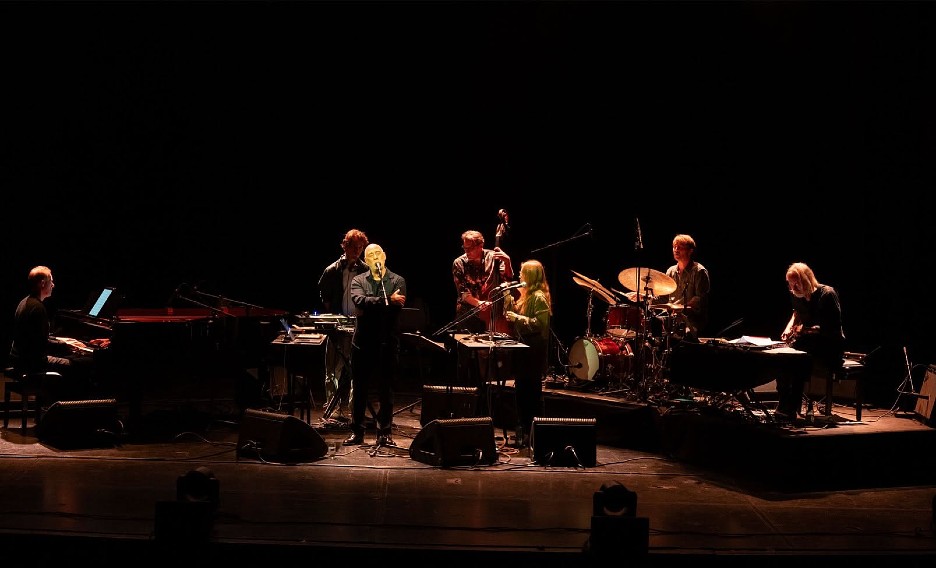
Jan Bang stepped away from his usual live-sampling alchemy to front a brilliant sextet featuring guitarist Eivind Aarset, vocalist Benedikte Kløw Askedalen, bassist Mats Eilertsen, drummer Anders Engen, pianist Ingolv Haaland, and Emanuel Birkeland-Bang on live sampling. Delivering an exquisite and unexpected piece of polished Nordic pop, the arrangements carried subtle, sophisticated dashes of David Sylvian's art-pop melancholy while firmly carving out their own distinct artistic identity. Soft drums and a light electronic drift unfolded with a hypnotic simplicity, soon followed by Mats Eilertsen's grounded bass treatment and Aarset's trembling guitar, placing absolute focus on nuanced vocal delivery and emotional restraint.The stage dynamics shifted into an intimate exchange as Bang shared vocal duties in captivating, moving duets with Askedalen. The material featured lyrics written by Tim Elsenburg of Sweet Billy Pilgrim and Erik Honoré, bridging classic songwriting lines with a frosty, minimalist Scandinavian lens. Though the band frequently blossomed into accessible, luminous beauty, they routinely subverted expectations; Eilertsen's sharp bass interventions introduced vital structural resistance, while underlying shades of British folk textures emerged beneath the surface.
Stripping away dense electronic soundscapes, the performance relied on total sonic balance, profound human warmth, and delicate stylistic subtleties. Both Bang—proving remarkably comfortable carrying the microphone through an entire set—and Askedalen sang with striking grace, demonstrating how restraint and quiet sophistication can wield a remarkably sharp edge.
Remix Session: Erik Honoré and Fredrik Lindseth Nordby
Erik Honoré stepped into a masterclass of sonic alchemy with this brilliant live remix, working alongside the exceptional young double bassist Fredrik Lindseth Nordby. As the set unfolded, Honoré wove spoken-word dispatches from the lyric text "Republic of Traces" into a haunting counter-narrative, folding in ethereal cut-ups and the distinct vocal presence of Jan Bang from deep within the mix.Nordby anchored the expansive electronic soundscapes with a masterful touch on the double bass, supplying both a subtle, slouching momentum and a deep physical gravity that pulled the sprawling ambient textures into sharp focus. Around them, the environment crackled with life: subtle clicks, distant thuds, and ghost-like echoes lingered in the air. You half-wondered if you were catching spectral traces of Eilertsen's bowed strings or Aarset's distant guitar work woven into the digital fabric.
Bugge Wesseltoft, Arild Andersen, and Gard Nilssen
When three distinct generations of Nordic jazz meet on a single stage, the result is never a standard recital. Tonight's performance by Bugge Wesseltoft, Arild Andersen, and Gard Nilssen at the intersection of acoustic tradition and unscripted exploration felt less like a setlist and more like a living, breathing organism.From the opening notes, the interplay between the trio was built on an exquisite, intuitive rapport. Andersen brought his unmistakable, resonant double bass tone—deeply rooted in the history of European jazz yet startlingly immediate—anchoring the room with a woody warmth. Alongside him, Nilssen navigated the drum kit with an elusive, kinetic grace, shaping the airspace with brushwork and pulse rather than sheer volume.
The trio moved as one organism, naturally shifting through moments where the music seemed to risk dissolving entirely before locking back into a collective gravity. They knew precisely when to rock, when to lull, and when to simply breathe.
A striking highlight of the evening arrived during a solo Arild Andersen piece. Leaning into his characteristic double bass tone, Andersen constructed a compelling dialogue with himself, using a live loop pedal to build a rich harmonic foundation before stepping out to improvise soaring, lyrical lines across his own recorded echo. Without missing a beat, the performance dissolved organically into a tender, luminous piano and double bass duet between Andersen and Wesseltoft, stripping the soundscape down to its bare, emotional essentials.
Drawing dynamically from Wesseltoft's introspective album AM Are (Self-released, 2025) alongside older compositions and untamed free improvisation, nothing on stage felt predetermined, yet every sudden turn possessed an absolute, inevitable direction. Wesseltoft's piano playing balanced a melancholic, cinematic downtempo vibe with crystalline clarity, reminding the room why his touch remains singular in contemporary European music.
This was Nordic jazz at its most vital: three master musicians entirely attuned to one another, listening their way forward into the dark, and leaving the room transfixed in their wake.
Day 3: September 5
On the third day of the festival, our planned excursion took us out of Kristiansand to the retreat of Arne Bang, landscape architect and brother of Punkt Festival co-founder Jan Bang. A group of delegates, international promoters, managers, and organizers piled into a car for the scenic 45-minute journey, deeper into the rugged coastline of the southern Norwegian archipelago.The weather was perfect—warm, radiant, and bathed in bright sunlight. When we arrived, the setting proved even more spectacular than promised. In front of Arne's cottage sat a massive, exposed sheet of granite—a natural rock terrace elevated like a cliff over the surrounding landscape, offering direct, unbroken views across a shimmering bay filled with pine-clad islets.
We gathered on the granite plateau right beside the house, where a Norwegian flag fluttered in the soft sea breeze. A dark table reflected the brilliant sky, set with bowls of fresh, ripe strawberries and cold drinks. As we shared a delicious meal, the conversations flowed naturally—insightful, warm exchanges between colleagues and friends against an extraordinary backdrop. The mood was relaxed and joyful, with people lounging on the stone, sharing stories, and even striking playful acrobatic poses on the open rock face.
After finishing our meal, we made our way down to the water's edge. Nestled at the base of a towering granite wall was a classic red boathouse and a long wooden dock. We spent time along the water, watching light glint across the calm, crystal-clear bay as boats bobbed gently at their moorings.
The afternoon culminated in a true "discovery mission" as we scrambled up a nearby granite hill. Clambering up the smooth rock and through birch and pine trees felt like exploring uncharted territory. Reaching the peak offered a breathtaking, panoramic reward: a sweeping, wide-angle view looking down over the cottage tucked into the trees, the sheltered bay below, and a vast maze of green islands stretching toward the open sea. We were on top of the world, and it was spectacular. This journey was the perfect start to the third and last day of the festival; the concerts commenced several hours later.
Henriette Eilertsen Trio
Stepping out of the shadows, the Henriette Eilertsen Trio opened their set in total obscurity, with the piercing, breathy timbre of Eilertsen's flute cutting through the dark before a single light hit the stage.It was a quiet, highly mysterious entrance that quickly gave way to a playful, nimble dynamic. Eilertsen's flute danced across the room, spinning bright, agile melodies over the unusual lower register of Joel Ring's cello and the crisp, rhythmic scaffolding of Øystein Aarnes Vik's drums. Rather than leaning on conventional jazz changes, the trio fearlessly courted the edges of free improvisation and sharp dissonance, threading classical counterpoint and modern textures into a fluid, rhythm-forward language.
Yet, as the set pushed past the midpoint, the momentum began to fray. The initial tension and captivating unpredictability started to slip, losing their razor-sharp focus as the sonic landscape briefly flattened out into a stretch of wandering exploration that lacked the fierce intentionality of the opening movements.
Even with that mid-set dip, the performance offered a compelling glimpse into Eilertsen's singular voice on an instrument too rarely heard in modern jazz—proving that when this trio locked into their blend of acoustic warmth and adventurous, unscripted friction, they were carving out a distinct path all their own.
Remix Session: Jan Bang, Eivind Lønning, and Erik Honoré
The room held its breath as Jan Bang, Eivind Lønning, and Erik Honoré stepped up to the mixing console following Eilertsen's performance, turning the raw, haunting fragments of her trio's music into raw clay. This wasn't just a performance; it was a full-scale alchemical extraction where past ghosts were dragged kicking and screaming into the present digital light.Instantly, the air filled with a massive, swelling gravity. Eivind Lønning's trumpet cut through the shadows like a beacon, while Bang and Honoré wove electronic threads through the wreckage of old melodies. Flute loops from the earlier set reappeared like half-remembered dreams, distorted and magnified until they took on an entirely alien beauty. It was an effortless flight through vast, uncharted sonic horizons, where patience and precision collided.
Then the text arrived. Titled "Insular," the spoken-word delivery hit the room with an unapologetic, heavy blow. Stripped of comfort, it mapped out the brutal architecture of distance, separation, and quiet grief. The words didn't just accompany the music—they dominated it, casting a long, unyielding shadow across the shifting electronic tides.
As the trio finally let the last wave of electronic resonance decay into silence, the collective impact was unmistakable. It was a brilliant, deeply moving work that proved how past creation can be reborn into something entirely new.
Cimota
Standing as the spiritual successor born from the ashes of Atomic —whose lukewarm appearance at the 2011 Skopje Jazz Festival left much to be desired—Cimota delivered a performance that completely eclipsed those past memories. Where that earlier iteration felt distant, tonight's performance was remarkably mature, razor-sharp, and deeply communicative.Operating almost like Atomic in reverse, the ensemble anchored themselves in classical jazz traditions before rapidly fracturing them with repetitive, minimalist patterns that drove the momentum forward. Stepping onto the stage with a subtle, classic ghost of Thelonious Monk hanging in the air, they offered a respectful yet thrilling nod to jazz history. Even for those familiar with their recorded output, hearing them live proved arresting; the ensemble navigated intricate, technically demanding arrangements with an effortless, loose-limbed grace that felt entirely natural.
With trumpeter Eivind Lønning and saxophonist Espen Reinertsen newly integrated into the fold alongside pianist Håvard Wiik, bassist Ingebrigt Håker Flaten, and drummer Hans Hulbækmo, the quintet moved with a fresh, sharp gait. Their playing was fiercely kinetic, defined by an underlying sense of urgency and manic, complex harmonies that kept the room on edge. Wiik and Lønning plunged headfirst into an abstract, contemporary classical dialogue, soon deepened by Flaten lifting his bow to introduce a slow, resonant melancholy, while Hulbækmo locked in with relentless, driving energy.
Built on angular, written frameworks heavily informed by spontaneous improvisation and a mesmerizing, exploratory stretch reminiscent of Streifenjunko, the compositions were nothing short of exceptional. They navigated asymmetrical meters and jagged shifts with a breathless agility—balancing searing, restless turns with cool, melodic streams. For all its technical abstraction and intricate architecture, the music remained warmly inviting, deeply expressive, and profoundly, irresistibly musical.
Remix Session
This radical performance took the acoustic improvisations of Norwegian ensemble Cimota and reshaped them into a brooding electroacoustic monolith. Bathed in a thick haze and menacing crimson light, the musicians manipulated laptops and hardware controllers to dismantle Cimota's sonic DNA in real time. Acoustic timbres—ghostly overtones and bowed resonances—were stretched and pitch-shifted into subterranean drones and granular, shimmering textures. Free from fixed tempos or conventional drum patterns, the soundscape relied on massive sub-bass rumbles and slowly modulating filter sweeps, creating a cavernous atmosphere that physically vibrated through the space.What elevated this set beyond mere technical showmanship was its masterly command of space, tension, and emotional weight. The remixers sculpted each frequency with precision, allowing delicate, glitched high-end harmonics to linger above the dark, oppressive low-end. It was an unsettling, deeply hypnotic journey that encapsulated the core ethos of Punkt: honoring the raw material of the original performance while fearlessly propelling it into an entirely new, haunting domain.
Goran Kajfeš Tropiques
Goran Kajfes brought his Tropiques ensemble to the Punkt stage, transforming the festival space with a performance that married hypnotic, slow-burning minimalism with the pulsing, otherworldly electronics characteristic of Tangerine Dream and the cascading, interlocking structures of Philip Glass.The concert opened with an immersive, ritualistic expanse—not merely ominous Moog drones, but a mesmerizing tapestry where synthesizer arpeggiators pulsed in continuous, geometric loops reminiscent of classic Berlin-school sequencing. Layered tightly against a shimmering string quartet, these kinetic, minimalist patterns created a continuous, rhythmic horizon that hovered somewhere between modern classical, ambient space-rock, and experimental jazz.
Kajfeš soon shifted from synthesizer to trumpet, floating agile acoustic lines above a relentless, cyclical engine of bass and keys. Johan Berthling's acoustic bass locked into hypnotic, repeating figures that kept the momentum driving forward in relentless, Glass-like accumulation, while Alexander Zethson wove shimmering synth layers that evoked the luminous, atmospheric expanses of Tangerine Dream.
The long compositions breathed with patient, deliberate evolution. A striking duet between the violinist and cellist unfolded over a steady, pulsing electronic bed, drawing the room into a quiet world of delicate resonance. When Kajfeš rejoined on the Moog and trumpet, the texture expanded into a massive wave of sound—subtle, trance-inducing, and endlessly engaging. Backed by Johan Holmegard's driving drums, the sextet moved with remarkable unity, balancing exploratory freedom with a hypnotic, perpetual-motion machinery that left the audience rapt.
Remix Session: Bugge Wesseltoft, Ingebrigt Håker Flaten, and Anders Engen
Stepping up as the festival's midnight grand finale, Bugge Wesseltoft, Ingebrigt Håker Flaten, and Anders Engen took command of the stage to live-remix Goran Kajfeš Tropiques' earlier set—completely reimagining that hypnotic, minimalist aesthetic through a muscular, high-energy jazz-rock lens.Instead of a sterile digital breakdown, the trio delivered a fierce, organic confrontation with the residual echoes of Kajfeš's performance. Wesseltoft traded ambient restraint for a driving, electrified punch, seizing fragments of the preceding brass and string motifs and feeding them through heavy, analog synth textures. Flaten anchored the room with massive, overdriven double-bass lines that harnessed the raw, psychedelic heat of the previous set, while Engen injected a relentless, rock-inflected backbeat behind the kit. It was electric, visceral, and unyieldingly heavy—proving that these masters could take a meditative, slow-burning canvas and ignite it into an unforgettable, high-voltage tour de force.
Final Words
As the final frequencies faded from the Kristiansand night, the true magic of Punkt came into sharp focus. It lived in the dramatic coastal landscapes that framed the experience, the brave, razor-edge concept of live remixing that turned performance into a living dialogue, and the audacious spirit of forward-looking musicians who refused to look backward. Meeting kindred spirits among the delegates and the musicians, interviewing Giannouli and Toop, sharing these immersive moments, and absorbing the unique energy of the city transformed the festival into something much larger than a series of concerts—it was a vital space that permanently expanded and enriched your musical horizons and changed the way you hear and experience the world.
 FOLLOW Nenad Georgievski
and get notified whenever a new article published.
FOLLOW Nenad Georgievski
and get notified whenever a new article published.
For as long I can remember music has been a focal point in my life.
About Jan Bang

Tags
PREVIOUS / NEXT
Become a Sustaining Member

Since 1995, All About Jazz has championed jazz as an art form and supported the musicians who create it. Over three decades, it has grown into one of the world's leading jazz resources, serving hundreds of thousands of readers, musicians, presenters and industry professionals each month.
Help Build the Future of All About Jazz
Your support helps us continue building All About Jazz for the next generation—expanding our editorial coverage, preserving jazz history, developing new community features and creating better ways to discover the music and the people behind it.
Become a sustaining member for as little as $20 per year and you'll immediately enjoy an ad-free experience along with access to subscriber features and future articles for a full year.
Together, we're not simply sustaining All About Jazz—we're building its future. Thank you for being part of the journey.