Home » Jazz Articles » Live Review » One Night Only: Vinnie Sperrazza with Alex Laurenzi and ...
One Night Only: Vinnie Sperrazza with Alex Laurenzi and Solomon Gottfried

Wayne Public Library
Wayne, NJ
March 12, 2026
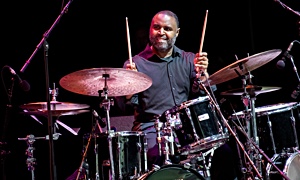
I have long admired drummer Vinnie Sperrazza's musicianship on recordings to the exclusion of experiencing him in live performance. It was a pleasure to review Juxtaposition (2017), his Posi-Tone Records release as a leader, as well as Swing & Soul (2024) and Force & Grace (2025), by the band Blue Moods. Directions & Expressions, perhaps the most eclectic of Blue Moods's discs on Posi-Tone, dropped in April of 2026. Although these records reveal only a portion of his capabilities across a wide expanse of jazz and improvised sounds, they are prime examples of Sperrazza's propulsive and inspiring approaches to the instrument within the flexible parameters of the jazz mainstream.
In a recent concert at the Wayne (NJ) Public Library, Sperrazza joined a trio led by alto saxophonist/composer Alex Laurenzi that featured bassist Solomon Gottfried. His appearance came as a complete surprise because another player was scheduled to occupy the drum chair. It was a kick to hear Sperrazza in person for the first time and, from the vantage point of a second-row seat, observe his sticking and footwork.
This occasion was also the first time Laurenzi and Sperrazza had ever played together. Sometime prior to the performance, Sperrazza was introduced to three of the leader's original compositions, "Claude," "Reflections of Trees," and "La Gare Nouveau," via audio links. Without the benefit of a rehearsal or sheet music on the bandstand, he readily grasped the essence of themes that are more complex than mere blowing vehicles. And he did it in ways that can be summarized by the words, "I'm here to help." Sperrazza's supportive, empathetic approach to the music was evident throughout a seventy-five-minute set that also included selections by Charlie Parker, Billy Strayhorn, John Coltrane, Thelonious Monk, and Bronislaw Kaper.
A video posted on YouTube by reference librarian Patty Slezak, the organizer, curator, and publicist of the library's longtime jazz series, enabled me to relive the performance and gain further insights into Sperrazza's playing and his contributions to the trio's sound.
Laurenzi's measured approach to the saxophone, bass, and drums configuration, in which the arrangements of the songs and improvisational flights were given equal emphasis, did not invite highly confrontational, over-the-top, loud-to-a-fault drumming. To his credit, Sperrazza was not eager to fill up all the space left by the absence of a chordal instrument. Regardless of the tenor of the material, he always struck a balance between assertiveness and self-restraint, complementing the bassist's firm foundation, and never distanced himself from Laurenzi and Gottfried.
The music was enhanced by Sperrazza's novel approaches to the heads and supportive interactions with Laurenzi's and Gottfried's solos. Employing wickedly propulsive accents, sensitive brushwork, light, minimal cymbal touches, stretches of striking the head of his snare drum with his hands, periods of silence, and combinations of implements, all without going overboard, there was an air of absolute certainty in everything he played. In addition to enriching the leader's compositions, he displayed a knowledge of and a willingness to assert himself into the melodies and structures of Charlie Parker's "Red Cross" and "Visa" as well as Thelonious Monk's "Bye Ya." Sperrazza gave the distinct impression that his hands and feet contained an infinite number of ways of improvising on these classic songs.
"Red Cross," the set's opening selection, constituted one instance of Sperrazza's resourceful ways of fusing invention and surefooted swing. At the onset of a head taken at a medium-to-up tempo, instead of initiating straight time, his snare drum strokes and brief hits to the cymbals and bass drum underscored various points of Charlie Parker's melody. In contrast, on the tune's bridge, he laid off the drums, rode one of the top cymbals, and added seasoning via strokes to the bell of the closed hi-hat. All these moves were right on the money, in part because they were made at a spot-on dynamic level with Laurenzi and Gottfried in mind.
Throughout Laurenzi's four-chorus solo, while Sperrazza's ride cymbal cleaved to Gottfried's walking bass line, his left stick conducted a running commentary via snapping accents that constituted a full-fledged voice in the trio. Even more potent because they were not frequent and always came as a surprise, expertly timed fills and relatively brief remarks provided a jolt without breaking the music's deeply swinging momentum. In one instance during the first chorus, he mimicked one of the saxophonist's lines with an ingenious phrase on the snare and bass drum. Near the chorus's end, a few sharp hits to the snare initiated a terse, repeated phrase between the snare and bass drum that overlapped Laurenzi and extended a few bars into the next chorus.
In contrast to the inventive yet basically straight-ahead approach to "Red Cross," throughout "Claude," a pensive, slow-to-medium tempo waltz, Sperrazza displayed other, equally inventive aspects of his skill set. At various points during Gottfried's and Laurenzi's solos, he fell silent, gently tapped rhythms on the snare drum head with his hands, switched to one brush on a cymbal and one hand on the snare, lightly patted the cymbals with the metal rings of the brush handles, struck the edges a cymbal with the shift of a stick, and created distinct patterns between the ride cymbals and the hi-hat cymbal with two sticks. Oftentimes, these and other permutations were executed at low dynamic levels. Throughout all of these changes in implements and emphasis, Sperrazza's drumming never felt random or unnatural, and always remained in the same neighborhood as Laurenzi and Gottfried.
Sperrazza's extended solos and eight-bar exchanges with Laurenzi and Gottfried did not give the impression of a drummer unleashed. Instead of blatant displays of chops and flashy licks, his forte was thematic development. Regardless of their length, the evolution of Sperrazza's improvisations was relatively easy to follow but not obvious or simplistic, and there was frequently an element of unpredictability lurking around the next corner.
Sperrazza's eighths on "Red Cross" and "Reflections of Trees" were stunning in their ingenuity and capacity to stay connected to Laurenzi and Gottfried. During the two-minute-plus solo that opened "La Gare Nouveau," relatively simple phrases between the tom-toms, snare (snares off), and bass drum that sounded like brief melodies were repeated with variations, mutated, and overlapped one another. Not unlike significant portions of most of his solos, it was clear he wanted each component of the kit to ring out in its own space, uncrowded by the next stroke.
It is gratifying to realize that my enthusiastic first impressions of the live performance by Laurenzi's trio held up to the scrutiny of repeated viewings of the video, which yielded a broader, even more satisfying perspective on the music. Although this essay primarily focused on Sperrazza's contributions, exposure to Laurenzi's and Gottfried's talents, too, was a revelation. I look forward to hearing them in the future. And to think that all of these discoveries were made, not at a jazz club, concert hall, or festival, but on a weeknight in a local library! It just goes to show that jazz thrives in a lot of different places.
 FOLLOW David A. Orthmann
and get notified whenever a new article published.
FOLLOW David A. Orthmann
and get notified whenever a new article published.
David hears the melody of "Salt Peanuts" in the voices of wild turkeys walking through his back yard.
About Vinnie Sperrazza

Tags
PREVIOUS / NEXT

Become a Sustaining Member

Since 1995, All About Jazz has championed jazz as an art form and supported the musicians who create it. Over three decades, it has grown into one of the world's leading jazz resources, serving hundreds of thousands of readers, musicians, presenters and industry professionals each month.
Help Build the Future of All About Jazz
Your support helps us continue building All About Jazz for the next generation—expanding our editorial coverage, preserving jazz history, developing new community features and creating better ways to discover the music and the people behind it.
Become a sustaining member for as little as $20 per year and you'll immediately enjoy an ad-free experience along with access to subscriber features and future articles for a full year.
Together, we're not simply sustaining All About Jazz—we're building its future. Thank you for being part of the journey.