Home » Jazz Articles » Interview » Mary Halvorson: About the Ghosts in the Guitar
Mary Halvorson: About the Ghosts in the Guitar
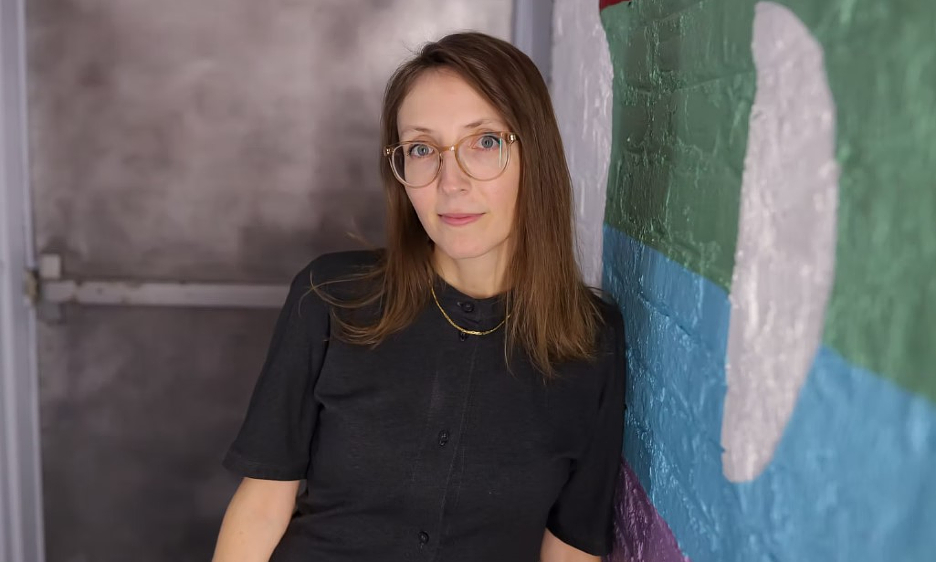
Courtesy Lawrence Miner

When you're writing an album, one of the things that's good to think about is what's missing. What haven't I tried? Or what am I doing too much of? Because you don't want all the music to sound the same.
—Mary Halvorson
The Amaryllis sextet sounds like it's wired the entire studio into a single nervous system: vibraphone murmurs, drums and bass feinting and lunging, horn lines darting between each player while Halvorson offers twitchy guitar scrapes. Grammaticians would think they are trying to finish one another's sentences. What's striking isn't the noise or the density—those were already part of the band's DNA—but the sense of purpose running underneath. This is a deliberate effort, the instruments coloring the edges rather than swallowing the frame, through a downbeat that keeps shifting its center of gravity. Even on the opener, "Full of Neon," which has some of the most delightfully unhinged moments on a record with a whole bunch of them, the band moves with an odd internal logic that could also serve as a description of Halvorson's career, expressive and mercurial.
What is striking about Halvorson is how unpretentious she comes across during an interview. The experimentation she favors is all grounded in the pure love of the music. Despite the knotted structures and tumbling arrangements, there is an ease to the way she plays as well as the way she converses—an undercurrent of humor. It began in earnest for her when the Boston-bred student went to Wesleyan University in Connecticut and met Anthony Braxton at a jazz workshop. Two decades later with scores of albums as leader or guest player to her credit, she is at the forefront when influential modern jazz guitarists are conjured.
On the side, she regularly collaborates in an ongoing duet with Sylvie Courvoisier, their third album, Bone Bells (Pyroclastic Records, 2025), airily intimate and recognizable for its subtle sound paintings and visceral excitement in its whirling crescendos. She toured as a trio in 2024 with Michael Formanek and Fujiwara. She recorded summer 2025 and played dates in Japan with Tomeka Reid for his album, dance! skip! hop! , coming out in February 2026 on Out Of Your Head Records. She plans on touring the U.S. in the spring of 2026 with her quartet Canis Major, featuring Dave Adewumi, Henry Fraser and again Fujiwara.
Her comet is blazing across space and time, hopefully not wearing too thin and crashing into one of Jupiter's moons. Where her earlier recordings conveyed a sense of more impervious spaces, the flurry of notes cooked like spaghetti al dente and angular enough to skin a black cat, the music has become denser, even chaotic, but the rare kind where you can hear the joy within as if the musicians are catching each other in mid-air. All About Jazz was very pleased to catch up with Halvorson while she was on the ground at home in between takeoffs.
All About Jazz: Hi Mary. You were in my hometown of Knoxville at the Big Ears Festival earlier this year.
Mary Halvorson: Actually, I've been there the past two years, and I'm going to be there again it looks like in 2026. So, yeah, I love Knoxville, and that's such a special festival.
AAJ: You will be going on tour after a busy recording schedule.
MH: It's funny, when you're a freelance musician, it seems like you're either completely free or way too busy. Through the end of the year, I'm way too busy, but luckily I've had some time at home in the summer and have been able to recharge.
AAJ: I was wondering if you were to fill in a pie chart, how much of your time would be devoted to practice, composition and recording?
MH: It really depends because every day or week is different. Sometimes I'll get into a period where I'm composing five, six hours a day, but then at other times I'll have six months where I don't compose at all. With composing, that's probably the thing that varies the most just based on, I get almost obsessive about it when I start. Practice is more regular. I like to practice at least two hours a day. If I'm learning music, it'll be more, and if I'm super, super busy, it'll be less. But I think if I can get two hours in to work on stuff, I'll be happy.
AAJ: Do you do all your composing on guitar, and is that instrument the same one you play gigs with?
MH: Actually, I only have two guitars. I know most guitar players are collectors. But I have my Guild Artist Award model, which is the guitar I play mostly when I'm in New York. And then I have a beautiful travel guitar that was built for me, and I love both of those instruments. That's pretty much all I play.
AAJ: Are they both hollow body guitars? What are the differences between the two? Is it the action? Is it tone?
MH: Actually, they look very different, but the luthier who designed my travel guitar built it with a removable neck, which is pretty cool. It was built for ease of travel. He built it to sound and feel very similar to the Guild, so that it wouldn't be weird for me to switch between the two. They actually have the same DeArmond pickup, and the action is pretty similar. The neck feels pretty similar, and I think they actually sound pretty similar. So even though they look different, it doesn't feel different for me to be playing them and switch back and forth seamlessly.
AAJ: I understand you played violin at first before switching to guitar. Was there a guitarist in particular who caught your attention?
MH: Jimi Hendrix was the first one who attracted me to the guitar, which is pretty amazing. If you think about the scope of influence that Jimi Hendrix has had on several consecutive generations of guitarists, I bet if you polled guitarists, maybe 25 percent of them would say they started on guitar because of him. Then I started learning jazz guitar because my teacher in high school was a jazz guitarist, and I think Wes Montgomery was the first jazz guitarist I really got into. And from there just branched out into all different directions.
AAJ: Montgomery's technique of playing octave melodies is so distinctive. It sounds so cool but to imitate it for me would have taken way too much practice.
MH: I love that style. Very unique.
AAJ: Have you ever wished you hadn't left the violin totally behind?
MH: I'm a pretty focused person and have to be focused on one thing, which maybe describes why I don't collect guitars. I think I would have to quit guitar to go back to violin. You know what I mean? But it was really fun. I wrote some string quartets a few years ago, and that was kind of cool. I was trying to visualize what it would feel like to play those parts, almost like air violin, even though I really couldn't play anything on the violin anymore.
AAJ: Laurie Anderson sat in on one of your two 2024 releases, Cloudward. Did you know her very well?
MH: I had met her before, and I've been a fan of hers for such a long time. I think she's just an extraordinary artist. She had asked me to be a part of a performance honoring Lou Reed. It was like a Lou Reed Tai Chi Day thing in Prospect Park (Brooklyn) several years ago. I found her to be just an amazing person, so nice and down to earth and cool. I asked her to play on the record and was lucky she was open to it.
AAJ: Lou Reed was very into t'ai chi, which is how I met him. Like Lou, some of the people who were the counter-culture made the decision to get healthy later in life.
MH: I do yoga about five times a week, hour-long classes. I consider it my main exercise, but I also see it as a way for me to clear my head. I think of it almost like a type of meditation, although I don't do meditation specifically. The breathing and clearing your mind while you're doing yoga is a way to clear out the clutter and calm yourself down.
AAJ: In your discography, I was trying to count up the projects you've been involved in both as leader and side person. It was upwards of 70 before I lost count. Do you have a tendency to take on too much?
MH: I have in the past had that tendency, and then I thought I'd gotten better about not doing that, but then this fall I did it again. I guess sometimes we have to learn the same lesson more than once. Especially as I get older, I can't run around quite as much as I could in my twenties or even my thirties. That means sometimes saying no to things you really want to do, which is hard.
AAJ: When you're choosing musicians or combos to work with, and I'm talking more or less about your projects, not somebody else's, do you try to go with, say, the most talented players or the ones that fit the particular vision you have?
MH: It would be very hard for me to separate those things. I feel very lucky, especially living in New York where there's no shortage of incredibly talented musicians. But for me, it's not only about that. It's kind of a full picture of, obviously, can this person play their instrument, but also do they have a unique sound? Are they a great improviser? Can they do different types of improvising? Can they deal with reading the crazy music I'm going to put in front of them? Are they fun to be around? All of these things are factors when I'm thinking about who I want to work with. But sometimes you're just going with intuition and making a guess. When I put Amaryllis together, not everybody in the group had played with each other. I thought this combination might work, and sometimes you get it right.
AAJ: Well, that's a proper segue into Amaryllis. It's a flower, used for medicinal purposes, malaria and treating Alzheimer's recently. Of course, you don't want to nibble on one since it is poisonous.
MH: I knew it was poisonous but had not heard about the medicinal properties. Anyway, my father's a landscape architect, and he's really into plants and flowers. Sometimes he likes to suggest song titles to me, and sometimes those titles are plants. I started a series of using poisonous flowers for titles—convallaria was another one, lily-of-the-valley. This idea of something that's beautiful, but also poisonous was interesting to me. As a band name, Amaryllis was kind of cool because it is a beautiful flower but at the same time, there's some edge to it or darkness in there.
AAJ: Let's talk about some of the songs. They appear multi-faceted: jazz, modern, even groove-oriented perhaps.
MH: That would be great if people want to dance to them. Something I value for sure is groove and rhythm and energy. I also care about having strong melodies and interesting harmonies, and I care about surprise. So, if I can get all those factors in there, that's cool. And I have a great bassist and drummer, so if that can be the foundation for some grooves and rhythms, then that's something I'm interested in.
AAJ: Let's take it from the top on the About Ghosts album. Start with "Full of Neon." You've supplemented the sextet with alto and tenor saxophone.
MH: That's right. Normally, the band is just a sextet. "Full of Neon" is not only the first song on the record, but it's also the first song I wrote out of all the octet pieces. It kind of felt natural to me that would be the beginning of the record. I mean, the title says it, I guess, but I wanted a lot of color and a lot of three—dimensionality, different things happening and different people kind of popping out. It's a more joyful type of song.
AAJ: The next one is called "Carved From" ... what? And perhaps you could tell me what is a pocket piano, which you also play.
MH: While I was playing around with this one, I wanted to have a horn solely at the beginning and the end that bookmarks the song. I also incorporated a synthesizer for the first time, which is called a pocket piano. It was given to me by my childhood friend Owen Osborne. That's the first piece I've worked on that actually had synthesizer, not as a main part of the piece, but just a little bit of a layer. You can hear it pretty clearly as a weird little tag that happens after the horn thing. The tune is kind of a high energy in three. There's an upward arpeggiated pattern that you hear passed around to different instruments throughout the piece. As for the title, sometimes my titles don't make a lot of sense. A lot of this stuff for me really is just intuition. I like the idea of not finishing a sentence or phrase.
AAJ: It wouldn't presume to ask if that unfinished business ever carried over to composition, so let's move on to "Eventide."
MH: That one would mean of the evening, but I was thinking of this as of a darker mood. It almost has a slow march type of feeling. The horn parts are very low register and almost kind of mournful. It's a type of a ballad. I just wanted to have something super slow and dirge-y with a different type of energy.
AAJ: "Absinthian" sounds like one who is a devotee of the fabled liqueur or perhaps a space alien.
MH: One of my hobbies is mixology, so I make a lot of drinks at home and I probably was thinking about absinthe. But this one is based around a guitar exercise. I wrote a guitar pattern, which throughout the piece you'll hear it translated from four to five to four to five again and then to three. You could almost call it a tutorial. And it's also a very high energy piece. I don't have any experience with it, but absinthe would make one a little bit crazy in theory, and the tune is a little bit crazy. These things aren't precise correlations.
AAJ: The title track, "About Ghosts": Are you a believer?
MH: Possibly. This is probably the most straight up ballad type of tune that I have on the record. The melody shifts around. All four horns have a section where they take the melody: the trumpet first, then an alto saxophone with really dense harmonies underneath, and then there's a guitar solo. Then the trombone takes the melody, and then the tenor. It's this cyclical thing where the melody is passed around, and I wanted to leave little gaps in the music, almost like breaths where the air is sucked out of the room just for a second. That happens at irregular intervals throughout.
AAJ: Next is "Amarinthine." What does it mean to you or represent?
MH: It means everlasting. I'd have to look it up to tell you exactly, but in my head it was everlasting. It's also a purplish-red color, unfading, everlasting. This one is relentless. I'm just playing around with different rhythms at the beginning in the bass and drums, and it's almost like a song within a song. There's a pedal tone that goes through different rhythms, and then a song emerges in the middle with a displaced fast melody in the horns, and then it goes back to the beginning. I almost think of this as two songs stuck together.
AAJ: You make good use of pedals in your playing? For your music, what is the purpose or benefit?
MH: Pedals are the fun part of playing electric guitar. But I consider them extra, using them as ornamentations or accents, things like that, a way to enhance the music. But it's also really important to me to have the acoustic sound of the guitar be really strong, and I want to hear that duality between hearing the natural acoustic sound, and then hearing the pedals almost mess it up. But I also like to think I could play without pedals at all. Sometimes you do a gig and your pedal board just decides to not work that night, and then you're forced to do something different.
AAJ: When I played in a blues band, the only pedal was for reverb. What are your favorite effects?
MH: I try to keep it very simple, and the main reason is because lugging this stuff around my bag gets very heavy. So, if I'm going to add a pedal, I have to really, really want that pedal. I have a pretty minimal pedal set up, just a line six delay pedal, which I use for delays and loops and pitch-bending sounds. Most of the stuff I do is coming from that pedal, and I have a foot pedal which controls it, so I can manipulate it while I'm playing. I'm not reaching down and turning knobs while I'm playing. And then I have a distortion pedal and a volume pedal, and that's it.
AAJ: Okay, back to the album and "Polyhedral."
MH: Many of my songs have multiple sections and a lot going on, and I wanted to write something short, and that song is just over two minutes long. I gave it this weird title. I don't want to say palate cleanser, but just something I felt wasn't yet on the album. That's a polyhedral, meaning multiple sides of a die. Everyone in the band is playing at the same time, but they all have slightly different rhythms that are working against each other. I wanted that to sound like a three-dimensional die. You can think of that tune as just the roll of a dice, and then when it stops spinning the tune is over.
AAJ: Your songs are complex thematically. If they were prog rock songs, you might think of the band Yes.
MH: Totally. When you're writing an album, one of the things that's good to think about is what's missing. What haven't I tried? Or what am I doing too much of? Because you don't want all the music to sound the same. If all the songs are at a fast tempo, let me write something slow or with a lot of sections. Or I could write something simple. It can be a way to challenge yourself, or maybe they're too dense and you want to write something with a little more space. When I think about orchestrating, I don't just think of it within one tune, but also how does the album work as a whole and how can I get the most out of that?
AAJ: Do you conceive an album in a thematic way or a collection of songs?
MH: Usually, I'll write an album in one time period or one sitting. In a way, it's a snapshot of where my head was at in those six months or whenever it was that I was writing music constantly. Of course, you can separate the individual songs, but I do think of it as a whole collection. And I'll also agonize over the order because even though in this day and age, people aren't necessarily listening to it in order or even listening to the whole thing, it's important to me to present it like an album. I imagine someone would just sit down and listen to the whole thing uninterrupted. If you think about some of your favorite albums, part of it is while you're listening, you're also thinking what comes next if you've listened to an album a hundred times, anticipating how it unravels.
AAJ: When you were writing Cloudward, was there anything in particular on your mind or anything you were trying to put forth?
MH: I was writing it in 2021 or 2022. It was when we were starting to come out of the lockdown period when every gig and tour was getting canceled. And I think at that point, I was actually feeling very optimistic because I really loved this band, and we had tours booked that actually weren't getting canceled. That album probably more than any other, came out of a place of optimism that things are moving forward again after so much time of just not really knowing what was going to happen.
AAJ: Let's go with the same question on About Ghosts?
MH: That's a tough question. I can't pinpoint that one to a specific mood or feeling quite as much. But I guess the only thing I would say is it did feel like a burst of inspiration of being one. I still have more I want to say with this particular band. Adding the saxophones provided a lot of inspiration to me and also a new challenge. Less specifically, it was linked to a very intense period of time.
AAJ: We haven't talked about "Endmost," the last song on About Ghosts.
MH: If you have a title like "Endmost," you have to put it last, I would think. It was funny. I was just hearing Brian Settles on it. So, I wrote in the tenor saxophone part later, which is funny because this song ended up being a feature for Brian, even though I wrote it before I knew he was going to be a part of it. I guess this one is the closest to a jazz standard. It has a little intro and outro, which is related to the tune, but also serves as a space at the end for Nick Dunston, the bassist and Tomas Fujiwara, the drummer.
AAJ: Was there a point in time, either in school or when you began recording and playing professionally, when you felt you had definitely found your voice as a guitarist?
MH: I think I'm still always looking for it. There was a point where it became important to me to search for that, and I still am, just trying to get better at the guitar and learn some basics. But because of the teachers I had, namely Anthony Braxton and Joe Morris, they were telling me find your own thing or find your voice, and that became a lifelong goal of mine. That process never stops. One's voice is always evolving and changing, and hopefully you're trying to get better all the time and challenge yourself. Hopefully, you never feel that you've arrived and you can kind of coast on whatever you've figured out.
About Mary Halvorson

Tags
PREVIOUS / NEXT


Mary Halvorson Concerts

Become a Sustaining Member

Since 1995, All About Jazz has championed jazz as an art form and supported the musicians who create it. Over three decades, it has grown into one of the world's leading jazz resources, serving hundreds of thousands of readers, musicians, presenters and industry professionals each month.
Help Build the Future of All About Jazz
Your support helps us continue building All About Jazz for the next generation—expanding our editorial coverage, preserving jazz history, developing new community features and creating better ways to discover the music and the people behind it.
Become a sustaining member for as little as $20 per year and you'll immediately enjoy an ad-free experience along with access to subscriber features and future articles for a full year.
Together, we're not simply sustaining All About Jazz—we're building its future. Thank you for being part of the journey.