Home » Jazz Articles » Interview » Ralph Towner: Unconcerned With What Genre His Music Is Labeled
Ralph Towner: Unconcerned With What Genre His Music Is Labeled
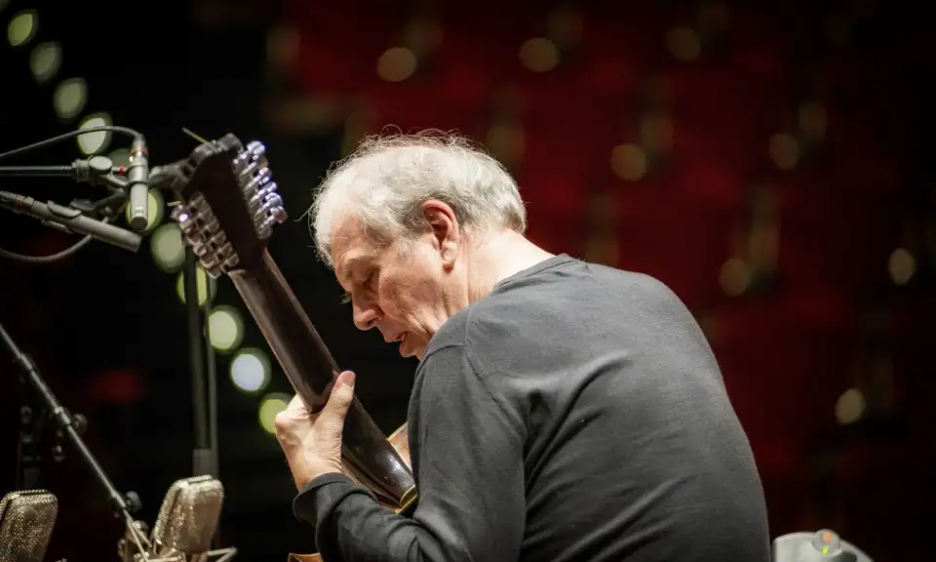
Courtesy Caterina di Perri / courtesy ECM Records
I’m very disciplined about writing. I won’t settle for just anything. It’s never just alright or okay or maybe. It’s really a piece that has a direction or identity, from that original idea you discovered. You have to follow that.
—Ralph Towner
You'll excuse Ralph Towner if he's not particularly interested in debates over genres and how to define them.
The guitarist grew up playing swing jazz on trumpet, then studied classical piano in college, discovered guitar at age 22 and studied in Vienna before moving to New York City in the late 1960s and co-founding pioneering world music combo Oregon—and then was signed to the still-young European avant-jazz label ECM for his solo recordings.
Oh, and there was that one gig with folk icon Tim Hardin, too:
"The funny thing about Oregon is Oregon is a New York City group! It was named Oregon by the horn player who was from Pennsylvania. We started around 9th Avenue, down in the meat market district. The drummer had a little apartment where we practiced. We all lived in the Village, so everything that was happening in New York City then was fuel for a lot of groups—we all interacted a lot.
"There was a lot of folk music!," he remembered "There were some folk musicians who would hire jazz musicians. Arlo Guthrie hired Paul Motian, Bill Evans' drummer.
"Tim Hardin hired Glen Moore and I to play at this little folk festival in 1969. This little folk festival turned out to be Woodstock. ... I was just assuming it was going to be this little folk festival, and then it turned out we had to be airlifted by helicopter to get to the stage. And I'm looking down and seeing 450,000 people! And then running like hell to get backstage. It was an amazing experience, the actual event. That band and the music were so horrible, though, and the drummer froze up, so I don't believe any of that was ever released.
"We ended up doing a recording with him that he had trouble finishing, called Bird On a Wire, but the other half was completed with Tim singing with Weather Report, if you can believe that."
After growing up playing swing and Dixieland, discovering Bill Evans while in college and learning piano, then studying classical composition and guitar in college, Towner said the label "World Music" seemed to be a nice fit for what Oregon was doing because they were all bringing different backgrounds to the band.
Yet, when asked about saxophonist Dave Liebman's observation that the ubiquity of the Internet likely spells the end of geographically based genres because young people around the world grow up being exposed to music from all corners, Towner said he thinks Liebman is spot on.
"One of the nicest compliments I ever got was in Korea. After the concert a lot of people who were fans came up and said, 'Oh, you must be Korean—your music really touches us!' People hear music in a way that's personal to them. It turns out that this language of music is related to everyone.
"Music hopefully is a language that transcends religion and politics—it has something to say that comes directly from a person's soul. The real juice of music is that almost pure emotion and the way it shows another way a human being can speak.
Discussing his album My Foolish Heart (on ECM) led to a thoughtful exchange on techniques both musical and technological. It was pointed out to Towner that the incidental squeaks of fingers on strings are clearly audible on this solo recording (Towner plays classical and 12-string folk acoustic guitars almost exclusively)—and he was asked if this was intentional, the way that classical great Andrés Segovia insisted on leaving these noises in his recordings.
Towner first inquired as to whether the squeaks seemed excessive (your loyal correspondent did not find them to be so), and then explained that ECM founder and still owner Manfred Eicher has a philosophy of recording that requires artists to stay in the moment—and not really have time to worry about things like finger squeaks.
"All the recordings we do with ECM, you're limited to two days of recording," Towner said. Most of the tracks on the new album were done on the first take, he explained.
Working on a two-day schedule, "You don't spend a lot of time trying to think about fixing your errors, your playing errors. It's a little closer to the truth in the way you play and you have to be very decisive when you're playing in a way that keeps you in the present. You don't get into this trap of saying, 'I can fix this later' as you're playing.
"Basically, if you're playing music, it moves so quickly, yo have to decide very quickly. Just keeping your train of thought in musical language is really a test of concentration. If you have a verbal thought enter your head, even self—congratulatory, then immediately I get punished for losing track for where I am!" he laughed.
Signed to ECM in the early 1970s (his first ECM recording was released in 1973, just four years after the label's founding), Towner said the two-day studio rule was a product of the lack of funds available to a start-up label.
"It was a matter of, in the very beginning of ECM, that Eicher would take a train from Munich to Oslo, and he would carry the original 2-inch tapes—usually no more than two or three, just enough to fill a recording. There wasn't even room for a lot of outtakes. This was to keep expenses down. All the money was put into the quality of the recording: the studios, and the quality of the pressings—the vinyl.
"It was done to the quality of the classical recordings—there was always a piano tuner on site at the recordings in case the piano got even just a little out of tune.
"This was the classical standard of recording and pressing, applied to jazz.
"Eicher chose musicians who were able to play without making glaring errors, and accepted the music they were playing. Musicians who were very good improvisers and didn't need a lot of repairs or thinking in that way of trying to re-record and take several takes until you got a good take.
"Almost always you find when you're in the right mood, the first take is the best take, really."
Having been recording for ECM from nearly the beginning of his career, Towner said that philosophy about getting the most out of the time spent in studio has shaped his playing ever since.
"You don't step so far out of character trying to play some particular lick you've been saving up. You don't get into that headpsace. You listen to what you're playing more carefully.
"That approach stuck with me, I think. And I can accept a few sqeaks, too!" he laughed.
Towner did expand on the issue of finger squeaks—which he said some fans dislike.
"Your fingers on the wound strings are what will make noise. You can avoid it. There are three strings that aren't wound on a nylon guitar. I noticed, too, that this particular recording, the pieces are quite tricky, and it did make a little more noise than normal.
"It's part of playing the instrument. Part of playing the instrument is also learning how to avoid a lot of that sound. A lot of the pieces I wrote on this particular recording involve a lot of sliding on those wound strings, and you have to be very fast to keep it to a minimum when you move from one position to another. The quicker you are, the less of a squeak it's going to be."
Towner said that as he's gotten older, he's found there are benefits and challenges. One drawback is that he is less limber than he used to be.
"At my age, I find I practice MORE than I did five years ago. The older you get, the more time it takes to get your muscles warmed up and anything happening. I'm back to practicing a lot longer, a lot more than I did five year sago when everything came a lot easier. I'm practicing a minimum of two hours per day, sometimes three."
But he said the creative process of improvising during performance has become less frightening.
"As far as music, a certain feeling of time that you have, a little more time. Things seem to move more easily, not as much panic when you play—your choices don't seem to rush by as fast.
"It's like with athletes: They say the game slows down after they get past their initial rookie season. Things seem less harried. Things seem to be a little more calm."
He also said that while growing older hasn't made composing new music any easier, it has given him deeper perspective on the process.
"I'm very disciplined about writing. I won't settle for just anything. It's never just alright or okay or maybe. It's really a piece that has a direction or identity, from that original idea you discovered. You have to follow that. Usually the longer the beast becomes, the more obvious it is to you what notes should follow. Everything leads to another place in the music, another cadence."
But while he is disciplined in the writing out of a new piece, Towner said inspiration for the original germ of an idea remains critical to the process.
"I won't write something if it's not born from something that really attracts me. I can sit down and write something from cue, but it might not be good. So I won't usually write something until it fascinates me.
"The discipline for me is maintaining that feeling of fascination throughout that piece so it sounds like it couldn't have been anything else!
"I'm not worried about being original—I'm playing what is a summation of what I like to hear, and what I want to hear. It's pretty simple that way. I would assume everyone composes what they want to hear.
"I don't think there's much choice—I'm such a slow writer," laughing to finish the thought.
When he gets writer's block while composing a new song, Towner said he's learned through the years to take a break from it—to get away from the piano or guitar where he is working, and take a walk and think it through in his head.
"Usually I find the answer in what's already there, earlier in the piece.
"The more you do it, the less fear you have about not being able to write ever again. You have enough music pieces, you find it a little less frightening—you know you'll always come up with an idea eventually.
"I don't get as frightened when I have long dry spells."
 FOLLOW Jim Trageser
and get notified whenever a new article published.
FOLLOW Jim Trageser
and get notified whenever a new article published.
I am a San Diego-based music journalist, mostly covering jazz and blues.
About Ralph Towner

Tags
PREVIOUS / NEXT

Become a Sustaining Member

Since 1995, All About Jazz has championed jazz as an art form and supported the musicians who create it. Over three decades, it has grown into one of the world's leading jazz resources, serving hundreds of thousands of readers, musicians, presenters and industry professionals each month.
Help Build the Future of All About Jazz
Your support helps us continue building All About Jazz for the next generation—expanding our editorial coverage, preserving jazz history, developing new community features and creating better ways to discover the music and the people behind it.
Become a sustaining member for as little as $20 per year and you'll immediately enjoy an ad-free experience along with access to subscriber features and future articles for a full year.
Together, we're not simply sustaining All About Jazz—we're building its future. Thank you for being part of the journey.