Home » Jazz Articles » Live Review » Marshall Allen, Trae Crudup, Black Cherry, and DoYeon Ki...
Marshall Allen, Trae Crudup, Black Cherry, and DoYeon Kim At Vision Festival 2026
Abrons Arts Center
Vision Festival
June 26, 2026
Creative music (in William Parker's words, "so-called jazz") is an old scene in New York City. Ornette Coleman at least nominally birthed the "free jazz" movement in the '60s, and ever since, the genre has planted its tenterhooks into the city's artistic landscape. If there are any major throughlines in that history, there is of course innovation and musical rigor, but equally, the history of New York creative music is one of neglect. When the major Lower East Side clubs refused to give free-jazz musicians gigs, the musicians started their own clubs. When those clubs went bankrupt, they held concerts in their apartments and other residential spaces, in what is commonly known as the "Loft Era." When rent began to hike, the focus shifted to education and public forums, and so on and so forth. Eventually, that (already none too substantial) money, wherever it may come from, runs out, the groups become disorganized, and no one is left to pick up the tab. There is no wonder under such conditions that in any given event the sets are far outnumbered by the number of memorials.
Vision Festival is no exception. Just a few nights before the first set, visual artist Jeff Schlanger, a frequent collaborator and patron of the festival, passed on. Vision Festival 30 was the first iteration without his participation. Arts for Art is also heavy with the loss of James Blood Ulmer, who participated in the 2024 show. But unique to the Vision Festival is a rather infectious hope, no more prevalent than on the fourth night, not only because of the generational breadth of the performers, but their common spirit.
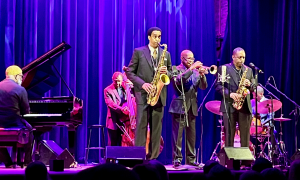
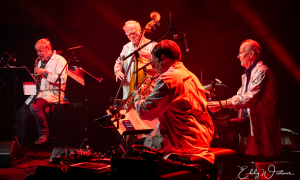
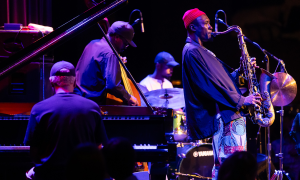
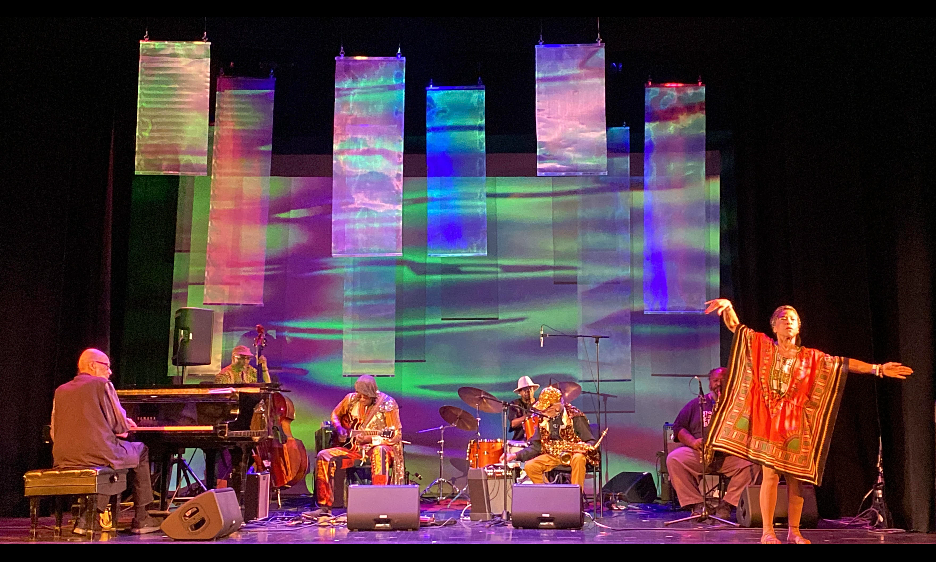
The undoubtable draw of the night was the 102-year-old Marshall Allen's Cosmic Future Ensemble. Allen came decked out in a gold-crested, shining vest and cap, along with guitarist David Hotep Middleton in full Arkestra regalia, along with Darius Jones on saxophone, Andrew Cyrille on drums, William Parker on bass, and Dave Burrell on piano. By Allen's opening bite on his saxophone, the whole audience was immediately transported to Sun Ra's cosmic experiments. It was no small wonder, of course, that Allen managed to run a herculean performance throughout the set; that signature electricity in his fingering was alive and well. He played a trenchant, heavily textured casio as well, furthering the corrosive belts of Jones into subterranean fits and jolts. Burrell was especially blues-drenched. His rhythms always managed to find a saccharine melancholy no matter their complexity, that Parker and Cyrille were quick to latch on to.
But the Cosmic Future Ensemble is not the Arkestra, and the group of luminaries preferred to take the familiar sonic abrasions to new dimensions. Cyrille, especially, was the quiet mastermind of the set. Though he had no discernible solo, his patient intensity and unrelenting kit control guided Burrell and Allen into a section of meditative eeriness, and with a few quick cymbal pushes exacerbated Burrell into a bop-esque panoply, quickly caught on by Parker and formulated into an explosive rush of polyrhythms. At first glance, Cyrille was subdued and consistent the whole set, but his granular approach to improvisation is more boisterous and effective because of his subtlety.
After Allen's set came up-and-coming percussion luminary Trae Crudup, with a memorial performance for the late Milford Graves. Crudup began with a full kit mirroring one of Graves' most iconic set-ups: the bongos stretched over the kick drum and a gong suspended across from the cymbal. For the duration of the set, Crudup performed an almost forty-minute long solo, exceedingly ambitious in both complexity and sheer power, only stopping around half-way through to change his shirt.
One by one, the other players filtered in. First, vocalist Shara Lunon performed an impassioned reading of an 18th-century South Carolina legislation banning enslaved peoples from using the drums or other loud instruments. Her voice was ferocious, inventive, often keeping up with Crudup's cymbal flares. Then, bassist Gervis Myles deepened the inner tension in Lunon's vocal modulations, before Alfredo Colón on alto saxophone roared on to the scene. The saxophonist had that same inexhaustible quality of David S. Ware, phrases toppling onto phrases until an entire polyphony is born from a single instrument. As the piece came to a crescendo, once again the other musicians left the stage one by one, slowly decoupling until the drums were left once more for a final standoff. Crudup's creative management recalled a phrase by Cooper-Moore: "in any my band, it's all about the drums." This was not meant as a reductive ultimatum, but as a lesson in group construction. In the percussionist, as Cyrille showcased in the last set, is the driving force behind all other improvisations happening on the stage. One can say the drum is not a ship's captain, but the ocean waves, the storm above, the hungry waters grasping into shore. Crudup (and by extension, Graves) were forces of denatured energy and intellect, not a force of nature, but nature itself.
Parker joined percussionist Hamid Drake and multi-instrumentalist Joshua Abrams for "Black Cherry," a single-piece meditation organized around Parker's poetry. Drake played an expansive hand-drum while Abrams played gimbre, a traditional three-string instrument with a strong, wistful sound, while Parker changed between his doson ghoni and traditional flutes. The result was an intelligent and witty improvisation between three masters of the form, never lapsing into the ambient but always with a signature, hypnotic logic that seemed to envelop even the smallest sounds in the space. Case in point: a child in the audience began to cry, first in short, half-whimpered starts, then in earnest. Rather than attempt to draw focus inwardly, the trio incorporated the low whining into the fabric of their improvisations. Hamid's drumline softened to a heartbeat, Parker's notes rose to starry chimes; against all odds, the piece became a sort of lullaby. It was unclear whether the child was rushed out by its parents or if it simply fell asleep.
The last set of the night was also the most surprising. DoYeon Kim played the first and third nights of the festival, with the Joe Morris Octet and Ingrid Laubrock respectively, always as an askew, original voice on the gayageum. As leader of her group Wellspring she was revelatory. With drummer Tom Rainey, bassist Henry Fraser and flautist Laura Cocks, she performed four obtuse compositions around her own Korean poetry.
Rainey, in common theme of exceptional drummers, exhibited superhuman tonal control against the strange incantations from Kim's half-screamed, half-ululated vocals and Cocks' winding contrabass. The compositions were tense, quick and mean, often relying on the gayageum's sudden interval switches resulting in an arresting listen. Kim had a bottomless energy, often intimidating in her unpredictable vocal techniques, but also distinctly rooted in Korean folk traditions. It is rare to see such overwhelming focus in a band and its audience, the impression of something truly new conjured before their eyes. Between old and new players this Vision Festival, there was a lot of that feeling going around. It was difficult to hear Allen's vibrant saxophone and Kim's anachronistic gayageum in the same night and feel anything but an admiration for the living aspects of this music the city clings to and is constantly rejuvenating, even as times get darker and resources slim. The Vision Festival instills that essential impulse to gather hope as few other events are able to.
 FOLLOW Fran Kursztejn
and get notified whenever a new article published.
FOLLOW Fran Kursztejn
and get notified whenever a new article published.
Southern writer, filmmaker, & jazz freak.
About Marshall Allen

Tags
PREVIOUS / NEXT

Become a Sustaining Member

Since 1995, All About Jazz has championed jazz as an art form and supported the musicians who create it. Over three decades, it has grown into one of the world's leading jazz resources, serving hundreds of thousands of readers, musicians, presenters and industry professionals each month.
Help Build the Future of All About Jazz
Your support helps us continue building All About Jazz for the next generation—expanding our editorial coverage, preserving jazz history, developing new community features and creating better ways to discover the music and the people behind it.
Become a sustaining member for as little as $20 per year and you'll immediately enjoy an ad-free experience along with access to subscriber features and future articles for a full year.
Together, we're not simply sustaining All About Jazz—we're building its future. Thank you for being part of the journey.