Home » Jazz Articles » Live Review » Kenny Garrett at Ronnie Scott’s: The Ancestors in the Room
Kenny Garrett at Ronnie Scott’s: The Ancestors in the Room
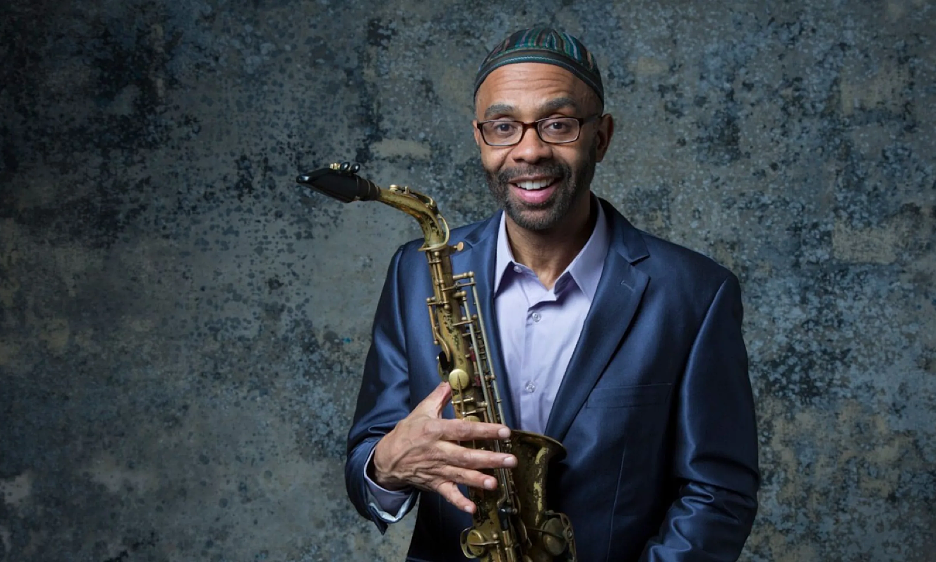
Garrett has said the current album examines the West African roots beneath jazz, gospel, Motown, and hip-hop. On Frith Street he did something better than examine them. He put them to work.
Ronnie Scott's
London
July 17, 2026
There are jazz clubs and there is the basement on Frith Street. Kenny Garrett, whom Miles Davis heard and hired nearly forty years ago, is back, and at the first notes of 'Haynes Here' the room understood this would be not a night of repertory, but where the repertory comes from.
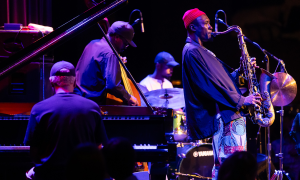
The band is worth naming slowly, a lesson in transmission before a note sounds. At the piano, Keith Brown, son of Donald Brown, The Jazz Messengers pianist who produces Garrett's records, and a leader whose latest trio album is aptly called African Ripples (Space Time Records, 2021). On bass, Eric Wheeler, out of Washington's Duke Ellington School of the Arts. On drums, Michael Ode , who learned from watching the church praise team before Oberlin College—Finney Chapel and Billy Hart got hold of him. And at the percussion table, Rudy Bird, Garrett's collaborator of more than thirty years, whose batá drums and Yoruba liturgy were inside this band long before the album made them explicit.
The album is Sounds From The Ancestors (Mack Avenue Records, 2021), and it anchored the evening. What lifted the night beyond an album set was the singing. At the centre Bird raised the chants, and the names he sang were not for colour but in liturgy. On the record the chants are carried by guests; here Bird raised them himself. Afterwards he told me what they were: invocations of Ṣangó, Ògún, Ọṣun, Yemoja, the Yoruba deities whose worship crossed the Atlantic with the enslaved and survives in Cuba's Regla de Ocha and Haitian vodou. Nothing was being reconstructed. Bird was singing a living repertoire, carried in the nineteenth century from the Yoruba country to Havana and into this band. I said to Bird, half joking, that he had inherited Ralph MacDonald's mantle, and he liked that. MacDonald, the Harlem-born son of a Trinidadian calypsonian, was Bird's shape exactly: a Caribbean rhythm carried into American music without ever letting go of its source. Garrett's is the Caribbean's Africa: the chants reach him by way of Cuba, routed through the islands where the old religions were kept alive.
Across the set the shape held. Garrett, half-turned from the room, opened with 'Haynes Here,' a posture out of the Miles Davis playbook, and closed it so prayerfully that the basement did something rare: it held a complete silence, about 52 seconds, before anyone dared clap. Then the counter-movement, repeated all night: Garrett turned outward, drawing the room into hand-claps and call-and-response. 'When the Days Were Different' became a rapping, cheering homage to the African American church; on 'Hargrove,' for the late trumpeter, he sang "thank you John Coltrane" over and over until the audience answered with the 'A Love Supreme' refrain; and 'For Art's Sake,' the Art Blakey-and-Tony Allen tribute, carried the Afrobeat propulsion, the American beat that went to Lagos and came home. Threaded through it all, a few bars at a time, went 'Tutu,' Marcus Miller's anthem for Archbishop Tutu, and Sonny Rollins's Caribbean calypso 'St. Thomas'—with the Coltrane refrain, three roads by which Africa reached this music. The man who had begun with his back half-turned ended, on 'Happy People,' with the whole basement on its feet.
The Oldest Device in the Room
The hand-claps and call-and-response are not mere showmanship. Call-and-response is the oldest African survival in this music, older than the blue note and the swing. It comes out of the ring shout, the counterclockwise sacred circle that the enslaved carried from Central and West Africa, in which a leader's call was answered by the ring, the singing directed, as Sterling Stuckey wrote, to the ancestors and the gods. Samuel Floyd put it plainly: all of the defining elements of African music are present in the ring, and call-and-response is chief among them. From the circle it passed into the field holler and the work song, where, in the Igbo sala, the response could be a word of assent close to an "amen"; and from there into the spiritual, gospel, the blues, and every idiom of jazz. That lineage has its sceptics—Kofi Agawu foremost, who warns that crowning any single trait 'the African essence' over-simplifies a heterogeneous continent. The caution holds; but on the stand the line we heard was specific and alive.So when Garrett set the room clapping and answering, he was reactivating the ring—the turned back playing inward to the ancestors, the turn outward opening the circle to the room. What looked like stagecraft was the most ancient thing he did all night.
And then there was the silence. Garrett is a famously physical player, yet the deepest passages were the quietest, and the quiet came after them. At the close of certain tunes the basement held its breath, a stillness that felt less like the end of a performance than the last beat of a prayer. Garrett uses silence as part of the music, the way his church would have used it as he was growing up. Afterwards both Wheeler and Bird, unprompted, told me the evening had turned spiritual: the silence was what they kept returning to. In that shared stillness the line between stage and room dissolves—that, more than any single chant, was where the ancestors seemed closest. Across from me all evening was the alto saxophonist Camilla George, British-Nigerian and born in Eket, whose 'Journey Across the Sea,' with its Senegalese kora, traces the route of the enslaved home. We talked at length between sets, and it seemed right that she, of all people, was in the room to hear this music, a rising voice tracing the same descent by the direct African line that Garrett reaches through the Caribbean. I will be interested to see where she goes.
A word with Garrett
I caught Garrett only briefly between sets, and put to him the question that has driven all of this: inheritance or re-creation? It was a hard question, he said, because it was a bit of both. Then he reached for a chain of named hands: Louis Armstrong to Miles, Miles to players like himself. He said he wanted to think about it properly and would call me; I hope he does.But the unfinished answer is itself the answer. Asked to divide what he does into the inherited and the invented, Garrett rejected the distinction and reached for descent, the line of hands through which the inheritance is passed. The line he named ran from Armstrong past Miles to his own generation. He could not say where inheritance ends and re-creation begins, because the effect of the playing is seamless. That is not evasion. It is the best description of how the music moves, and why an evening like this is not nostalgia. The chain is still extending. Garrett, and Bird beside him, are two of its current links.
The twice-silent room was by the end standing. What stays is the sense of a band in which nothing regarding its inheritance is theoretical. The pianist's father produced the records. The drummer learned in church. The percussionist can tell you exactly which deities he sang to. Garrett has said the current album examines the West African roots beneath jazz, gospel, Motown, and hip-hop. On Frith Street he did something better than examine them. He put them to work.
 FOLLOW Kofi Adjepong-Boateng
and get notified whenever a new article published.
FOLLOW Kofi Adjepong-Boateng
and get notified whenever a new article published.
I grew up to Louis Armstrong, which says it all.
About Kenny Garrett

Tags
PREVIOUS / NEXT

Kenny Garrett Concerts
Become a Sustaining Member

Since 1995, All About Jazz has championed jazz as an art form and supported the musicians who create it. Over three decades, it has grown into one of the world's leading jazz resources, serving hundreds of thousands of readers, musicians, presenters and industry professionals each month.
Help Build the Future of All About Jazz
Your support helps us continue building All About Jazz for the next generation—expanding our editorial coverage, preserving jazz history, developing new community features and creating better ways to discover the music and the people behind it.
Become a sustaining member for as little as $20 per year and you'll immediately enjoy an ad-free experience along with access to subscriber features and future articles for a full year.
Together, we're not simply sustaining All About Jazz—we're building its future. Thank you for being part of the journey.