Home » Jazz Articles » Interview » Crouching Pop, Hidden Jazz: A Conversation with Johnny M...
Crouching Pop, Hidden Jazz: A Conversation with Johnny Manchild from Johnny Manchild and the Poor Bastards

Courtesy Tori Gowland
...the aural skills and the harmonic skills and understanding of harmony that you gain through jazz music, as well as the improvisational skills, allows you to move in different directions where you can sort of sneak these things in and hide them—I think that is so interesting to see in pop music.
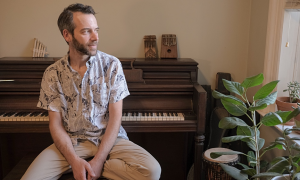
Johnny Manchild has an unusual background for a pop musician—he is a multi-instrumentalist singer/songwriter/producer who has a jazz degree from the University of Central Oklahoma and honed his craft in the Army, playing in jazz groups during his five years in the military. He utilized social media technology to build a following online during COVID and is now touring to support his new recording Side Effects (Self-Produced, 2026) and joined All About Jazz for a conversation about his career, his future, and the unique role that his jazz training influenced his development as an up-and-coming pop musician.
All About Jazz: To start off, tell us about your background. How did you get here?
Johnny Manchild: Sure—I'll give a summarized version, but yeah, I started this band in college while I was doing my bachelor's in jazz percussion. And I ended up just falling in love with piano, which I'd already played, but I fell way deeper into it while I was in college. The guys that I started this band with, well, I had a bunch of songs that I wanted to play, and so I just started trying to recruit people, like giving them charts and stuff, and I eventually got things going. But yeah, I've been in the army, I performed in the jazz band with the army for five years or so, throughout college and a little bit after, before COVID.
AAJ: So, in the army, you played piano and percussion primarily?
JM: I played piano, guitar, bass, and drums in different bands in the army and I've also done a lot of arranging. In addition, I have also done some film and video game scoring as well, and jazz has always been, especially in this band, an element of all of it. And you know, I grew up on grunge and punk and a lot of other things, so there's obviously that element there, but I've always enjoyed horns. In the beginning, a lot of people mistook what I did for ska, and I've always said it's really not. You go back to the '70s, and even before that, like go back to Motown, and then you go into the glam rock era, like Bowie and T-Rex and stuff, and there's so much good stuff with horns that kind of mixes this in. It's not "jazz," but I like that a lot, and I think I'd call it closer to that. And then there are some tracks that are just straight-up jazz ballads, with full jazz-ensemble horn sections, and I love that stuff. On my new recording Side Effects, "All I Can Do" is one of those with a full ensemble horn section in the arrangement.
AAJ: You prominently feature full-sized horn section in many of your tunes, but I didn't hear any ska, I heard a lot of '60s, '70s Motown and R&B and what came out of that.
JM: [Smiling] It's sort of, I mean no disrespect when I say this, but to the average listener, horns in rock music is ska. A lot of people just see that and they think it must be ska. I don't wanna be like "to the untrained ear" or whatever, but I do understand how people arrive there.
AAJ: You have serious musical training in jazz, including a university degree from the University of Central Oklahoma and five years playing in military jazz bands, both of which, I think it is safe to say, are rather unusual bullet points for a pop musician. Were you already kind of interested in pop music and leaning that way, while using jazz as a source for harmonic, melodic and rhythmic ideas to bring into pop music?
JM: Well, so I was a recording engineer before I ever got into jazz. I really started when I was 13—I was already collecting gear, and I've always enjoyed producing music. And when I was 17, we opened the Wasted Space Studio, and I continued with that for over a decade—running that studio, upgrading it, and making records. And so I've always loved making music. But in that specific vein or how jazz music plays into it, I've always been a Quincy Jones fan. I didn't know him personally, but when he passed away, I was very saddened to lose him. Quincy Jones to me is like the epitome of integrating jazz harmony into pop. Michael Jackson's Thriller (Epic, 1982) is still the highest-selling record of all time! (Taylor Swift hasn't beaten that yet, I don't think.) That's just one of Quincy Jones' productions—there are many, many more and they have some very interesting stuff going on. I'm not gonna say that any of it is jazz, however, the aural skills and the harmonic skills and understanding of harmony that you gain through jazz music, as well as the improvisational skills, allows you to move in different directions where you can sort of sneak these things in and hide them—I think that is so interesting to see in pop music.
AAJ: I think that pulling elements from other genres is how music grows. Most people don't know that Quincy Jones was a jazz trumpet player who played with Count Basie! So, everything he did was infused with a deep knowledge of jazz that informed all of the pop music he produced to some degree.
JM: I think it makes the music better. To me, that's what I've always tried to do with this band. And I'm not perfect at it, I'm always trying to get better, but what can I get away with that is interesting to me as a musician, but is digestible to people that aren't music nerds? How can we toe the line? And for this record, it got a lot heavier. I love rock music, I love the guitar, but there are a little crunchy here and there, and it's not the jazziest record I've ever done, that's for sure, but I think it's fun integrating those harmonic choices into it. I think jazz is just a great place to come from and incorporate it into other genres.
AAJ: As I listened to your music, I did hear some spots that I'd like to highlight. First, the piano figure in "Give Me a Reason" sounds very much like a varied version of Bill Evans' piano figure in Miles Davis' "All Blues"—it's in the same key, and it's the same time signature and tempo. Second, "Medicine Dance" has some of Gene Krupa's "Sing, Sing, Sing" in it. These aren't direct quotes, but you can tell where the influence comes from if you know jazz well enough. Is that intentional?
JM: Hmm... "Give Me a Reason" wasn't exactly intentional. But I hear it. I understand the connection. I think it was one of those subconscious things that rests on those slight chromatic movements with the G pedal tone underneath. That wasn't so much a conscious choice. However, "Sing, Sing, Sing," 100% yes! I was like, "I want that. I wanna use that." But it's not exactly the same, it just uses that groove and that vibe. And I love Gene Krupa. I take Krupa over Buddy Rich—that's just me.
AAJ: Some of those clavé rhythms from the Caribbean that were played by early jazz—those rhythms are so pleasing and infectious that they show up over and over again. [Claps the Second Line clavé rhythm.]
JM: Yea, those rhythms are everywhere. When I was in the School of Music for the Army, Sergeant Chen was my percussion instructor. She was really good. And my focus, there's that, her and Sergeant Quinones, who was the leader of, in the Army, you have things called MPTs, Musical Performance Teams. They have acronyms for everything. And both in the army and in college, I took a pretty intense interest in hand percussion and Latin music, like the pandero and timbales and conga and all that stuff. I was obsessed with getting my conga slap down! But all that to say, Latin percussion to me is the number one way to infuse some groove into a song. In pop music especially, a fundamental understanding of Latin rhythms can take you into whole other places. In "Medicine Dance," we layered a lot of Latin-influenced figures into the percussion that make it really fun to play.
AAJ: Your fans are very committed to you. Who are they? How did they find you? How did you find them? And what do you think it is about your music that pulls them in and makes them so committed?
JM: In the beginning, there was a collaboration I did that brought in a lot of people from YouTube, and it's grown since then. I think a lot of it has been word of mouth. We had a big fan base online before I was ever able to tour. And I think COVID had a lot to do with it, because we were all stuck inside, touring died, and the playing field was leveled for what we were able to do online. And I went to Twitch and Patreon, doing live streams and all this online interaction, and I think the community got to know each other in a little bit more of a personal way. And part of my brand became transparency. This has always been a very personal project. There's not really a "character" being portrayed as part of my marketing. Almost in the opposite way, whatever character Johnny Manchild might have been was so informed by meeting the fan base that it became more me than whatever I was before.
Coming out of the army, I was more of a character in everyday life because I didn't really know myself yet. I wasn't really allowed to go certain ways because of that career [in the Army] at the time. I think there was a back-and-forth education about who I was and who the fan base was, and that transparency and communication just made it a radical thing. And people are just supportive. They wanna support anything when they see radical enthusiasm bordering on obsession, which is me. I obsess over this, and I care about it so much, and almost to a fault, I want it to be what I want it to be. And I think there's a certain group of people that that speaks to. And also a big part of it is I speak a lot about my own mental health and issues I've had, substance abuse, and dealing with and overcoming those issues. I think that level of transparency has spoken to people. And I've been lucky that 99% of the fans I've made don't seem to have that strange parasocial aspect. Everyone's been very respectful, even as radical as they are. Overall, I'm very lucky to have the fan base I do.
AAJ: That's interesting. So kind of forged in the crucible of COVID and got to be a really personal relationship? So do you feel like the fan base is influencing your writing and your direction as well?
JM: Indirectly. A large portion of my fan base is LGBTQ, and I'm a part of that community as well, but it's been an education back and forth. The more that I've found these fans and interacted with them, especially on tour, the more I realized how comfortable I am in these spaces. And so I won't say they haven't influenced the music in a way that I'm like "fans like this so I wanna do this thing." It's not that. It's more just this is such a big part of my life that it changes my life, and as a result, it changes the music. But I've told people that there are always two life cycles to a song. The first part is for me—this is my thing, I'm gonna make what I want, and the moment it's released, it's not mine anymore, it's everybody else's. Because there are songs we've heard that connect with us on such a deep level to specific memories that it really doesn't matter what they were initially about anymore. It's about the moment when we heard it, and that's how that relationship with the song grows and becomes so personal.
AAJ: As I was listening to your music, I was struck by kind of what you said earlier. There's a passion and an authenticity there in every tune, but you have such a variety of different songs. You've got some heavier stuff that almost sounds metal, like "Youngblood"" from your new album, Side Effects and "Pretty Penny" from your first recording, Valencia (Self-Produced, 2017). And then there are others like we mentioned before with R&B influences and robust horn arrangements that harken back to the '70s and '60s, modernized of course, like "Bleeding Heart." There are also ballads like "Lucky to Have You," and then, of course, some fun pop music like "Windfall" and "Stacks," and others. I'm listening to one tune and then all of a sudden there's this really heavy metal guitar with a Phrygian hook in it that was totally surprising. So how do you cover that range of territory and keep it together and unified?
JM: I think there are two things. This isn't really a big one to me, but I think it might have something to do with it. I am bipolar. I experience things very heavily sometimes. But taking that out of the equation, because I don't really believe that that has that much to do with it. I'm well medicated now. I'm still writing. I've fallen away from the tortured artist idea. I don't believe in it so much anymore. Maybe it's an important stepping stone, but it's not a place to stay. But as far as the genres go, I am a recording engineer and a producer, and a few years ago I realized that if there was a genre that I didn't like, that is now my problem. I think it's important for me as my career to find the good in every genre. And so there's that, but with the metal music and grunge and punk and all this, I grew up with that. I was in that before I ever found jazz. I think it was as a teenager before I ever really started getting into jazz. And so there is an inherent love for just noise, like "New Noise" by The Refused, honestly every Queens of the Stone Age record, those gross dirty guitar riff songs. I love that stuff. So that's part of it. The other thing for me, doing only one genre of music is like trying to decide what emotion you're gonna stick with for the rest of your life. I feel different on different days, and certain things, sometimes you feel awesome and you wanna just groove, and you do something really percussive and big and boisterous, and other stuff is a little more complicated. I've never found it difficult writing in different genres. I feel lucky that people seem to perceive some thread of DNA that ties everything together. That I don't know, because sometimes these things feel so far apart to me, but there's something that seems to be a common thread. So I think it's just luck.
That said, we do have a lot of music and music theater nerds in our fan base and we love them all!. I used to do this series called "Let's Have a Complete Breakdown," where I would do a complete theory breakdown of the entire song, which is a lot of work, so I haven't done it in a while. But there's a song I have called "Alright," which is unique in that the melody uses every note in the chromatic scale, all 12 of them, and I had to break down why that works.
AAJ: Okay, so it's Johnny Manchild's twelve-tone row—channeling Arnold Schoenberg in a pop song?
JM: [Laughs] Sort of, but the thing I've always found interesting about that song is you have people that are borderline tone deaf that can sing that very chromatic melody back to me, and that blows my mind.
AAJ: Tell us about the horn section—do you bring the full section with you on the tour?
JM: We have five shows in this tour that will feature a full horn section, so if fans want to hear that, come to our concerts in Oklahoma City, New York, Chicago, Los Angeles, or Seattle. The other dates have two horn players—I would love to have the whole section with us the entire time, but that gets very expensive.
AAJ: So you've got charts and you just hire local players? Do you do all of the arrangements yourself?
JM: Yeah, I do all of the arrangements myself and we hire local players to augment the horns, which is much more affordable. My college jazz training in music theory and arranging is really helpful in this part of it.
AAJ: What about your voice? You have a great range, and you're comfortable in a lot of different styles. How did you study any voice or did you just have a good voice? Did you sing in choirs as a kid? Where did that come from?
JM: See, I actually think I'm uncomfortable in every style. I was never in choir, I never did anything like that. I was the bassist, guitarist and drummer for other bands forever, and then I had my own songs, and I was like, "Well, I guess I'm gonna sing." So I just did. And I've practiced, I've tried to hone in techniques a little bit, but I still feel so amateur as a vocalist. But I think the thing that people latch onto, there is some character in my voice that shines through, and that I think is what's carrying me, 'cause I'm not a good singer. But I've gotten better, but I know I am not a trained vocalist at all. I'm just trying my best.
AAJ: Yeah, it's challenging though when you're out on the road, right? That muscle, you have to treat it well, you have to take care of it, and it takes its toll.
JM: Yeah, you know, sometimes it's just easier live because I see Thom Yorke from Radiohead, he's always moving around. I'm of the mind that that is a practical movement, because when you loosen up and you're moving, your diaphragm loosens, your breath control is better. And it's why if you see me in the studio now, I look like a freak when I'm recording my vocals, because I move around and I have hand movements. I find it easier to sing on the road. That being said, I do have to drink so much water. But the softer stuff is a challenge, that's just the truth of it. It's hard to do.
AAJ: Yeah, I think you're right there about the movement. You know, if you look at a lot of jazz musicians like Thelonious Monk or Keith Jarrett, or even classical musicians like Glenn Gould who moved a lot while playing. It's just part of the expression that loosens you up, rather than trying to sit there motionless and emotionless.
JM: Yea, letting the body help to express the music is really important. Whenever I'm engineering, if I'm working with a vocalist, I tell them two things: Hands above your chest and open up your lungs, and I want you to throw your voice out—the bigger the emotion, the bigger the throw—use your hands to pull your voice out. And I swear every time it makes them sound better. It works. It's just involving your body in the movement, which is a natural thing to do.
AAJ: So what's life like on the road? Tell us a little bit about your tour.
JM: Been everywhere, going everywhere. We're starting with the East Coast. We started at the beginning of July after a few weeks of rehearsals in Oklahoma. I won't be back home for four months. We'll go through Texas, down around the southeast, up the coast, hitting all the major cities pretty much. We're missing Tennessee and Florida this time, but we'll be back. And then once we go down the coast, a few weeks off, and then we hit the West, and we'll be done near the end of September. Life is generally just bouncing from hotel to hotel and green room to green room, and every once in a while we get to see what a city looks like.
AAJ: Yeah, I guess that's typical for being on the road.
JM: Yeah. We're lucky to have off days. I like going to music shops and seeing if I can find anything cool. Maybe I'll buy a cymbal or some weird pedal or something. And coffee and food. My side quest in life is finding great food, which tour is such a good place to do that.
AAJ: So what are your plans going forward now that the new recording is out?
JM: Yeah, so we'll do the tour, album comes out, hopefully everyone will buy 500,000 copies, and then I've actually got a few other records I've gotta make for other artists over the winter. But no, I've already started writing the next record. I've got 15-20 songs that I'm picking through.
I'd like to do a solo piano tour next year in the spring. It's something I've wanted to do for a while, letting the audience at each show pick the setlist for the night. And more of an improvisational thing with just me and a piano, and find venues with grand pianos and go around and have a different kind of show. I'd love to do it. There's an idea I've been playing with, a "tourathon," where basically I'd have two to three weeks of shows booked, and then coordinate with fans with a series of DIY venues and basically make it to where if anyone is up to host a show, I will keep touring until people stop buying tickets. And I just wanted to hop in the van with me and a piano and play all the tiny towns in between major cities doing solo shows. So we'll see if that's viable, but I really am just looking for an excuse to travel more.
AAJ: Thanks for sitting down to talk to us here at AAJ. We wish you the best on the tour and with the new recording.
JM: Thanks for having me—this was fun and I really appreciate it.
 FOLLOW Kurt Ellenberger
and get notified whenever a new article published.
FOLLOW Kurt Ellenberger
and get notified whenever a new article published.
Kurt Ellenberger is a pianist/composer/author who enjoys listening to a wide variety of music while making his own excellent wine, and tending to his small flock of sheep.
About Johnny Manchild

Tags
PREVIOUS / NEXT


Become a Sustaining Member

Since 1995, All About Jazz has championed jazz as an art form and supported the musicians who create it. Over three decades, it has grown into one of the world's leading jazz resources, serving hundreds of thousands of readers, musicians, presenters and industry professionals each month.
Help Build the Future of All About Jazz
Your support helps us continue building All About Jazz for the next generation—expanding our editorial coverage, preserving jazz history, developing new community features and creating better ways to discover the music and the people behind it.
Become a sustaining member for as little as $20 per year and you'll immediately enjoy an ad-free experience along with access to subscriber features and future articles for a full year.
Together, we're not simply sustaining All About Jazz—we're building its future. Thank you for being part of the journey.