Home » Jazz Articles » Profile » The Discreet Charm of Tete Montoliu
The Discreet Charm of Tete Montoliu
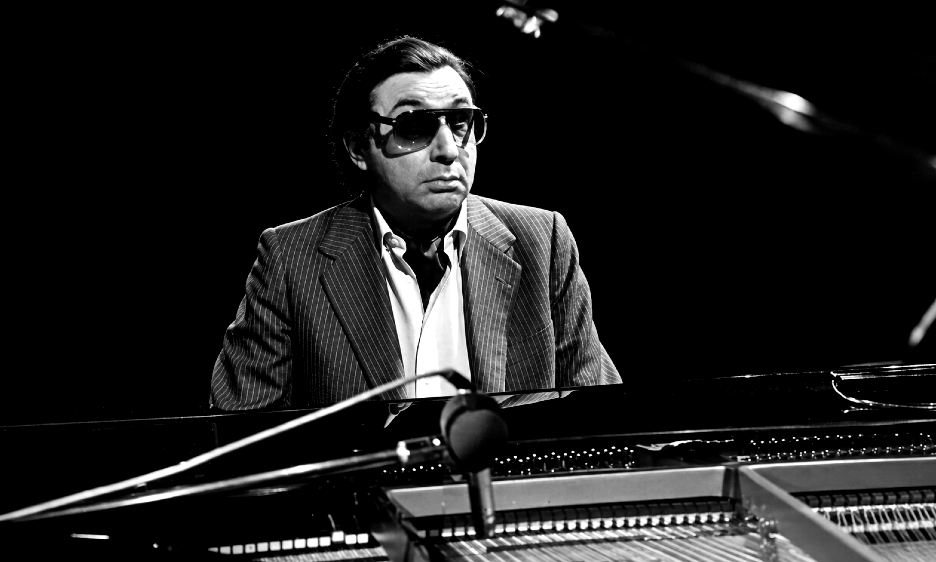
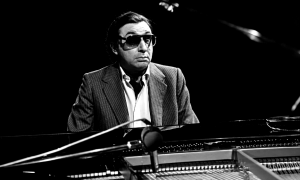
Among the musicians who participated in these after-hour sessions to cleanse their palates of sweet music aftertaste was a youthful pianist who was exposed to greater jeopardy for staying out late than his older colleagues. Vicenç Montoliu i Massana, who would come to be known as "Tete" Montoliu, was only fourteen when he held his own in these highly competitive sessions, a fact that was all the more remarkable because he was blind from birth.
Montoliu was born in 1933 in Catalonia, in the northeastern Iberian Peninsula. Montoliu's father was a symphonic oboist, and Tete learned to read musical notation in Braille when he was seven. He would play intermittently with Byas from that first engagement until Byas died a quarter century later, although they made only one album together. Montoliu would say that Byas "encouraged me a lot and let me accompany him on the piano on many occasions. He never said it was terrible to play with me, although this surely must have been the case." The two became close enough that Montoliu taught Catalan, a language native to the region where he grew up, to Byas, who was an omnivorous student of foreign tongues.
Montoliu would go on to study music in Barcelona and jam with jazz musicians in that city's clubs. He was noticed by Lionel Hampton one night in 1956 playing in a pub, and joined Hampton's band as it toured through Spain and France; this engagement resulted in Montoliu's first record date, playing a duet with Hampton on "Tenderly" that can be heard on the album Jazz Flamenco. He did not record as a leader until 1958, when his 7" EP with a quartet comprised of alto sax, bass, drums and vibraphone was released on a Spanish record label.
Montoliu did not leave Spain to perform until that same year, when he appeared at a jazz festival in Cannes, France, with bassist Doug Watkins and drummer Art Taylor. In 1961 he played with Byas at Spain's First World Festival of Jazz, where the two worked with a local drummer and bassist whose playing was described by one critic as "pudding-stirring drumming and uninspired bass playing," while the pianist apparently satisfied his high standards.
In 1963 Montoliu began to work in Copenhagen where he played with Archie Shepp; when he became the house pianist at the Montmarte club there that year he accompanied Rahsaan Roland Kirk, Dexter Gordon, Benny Golson, Kenny Dorham, Ben Webster and Lucky Thompson, among others. He toured with Kirk, Dorham, Gordon, Webster and Thompson from the mid-'60s into the seventies, worked solo at New York's Top of the Gate in 1967, and then went into a lengthy residency at Madrid's Whiskey Jazz. Beginning in the mid-1970s Montoliu's reputation grew from a series of albums he made with bassists Niels-Henning Orsted Pedersen and George Mraz, and drummers Albert Tootie Heath and Al Foster, and from tours of Europe.
Montoliu has passed largely unnoticed in jazz directories; he is not mentioned in John Chilton's Who's Who of Jazz, Leonard Feather's Encyclopedia of Jazz, or Alyn Shipton's A New History of Jazz. These omissions can be traced to the fact that Montoliu remained in Spain for most of his life; one rare session in America was the 1979 Lunch in L.A., a piano-only outing recorded in Los Angeles and Berkeley, on which he is joined by Chick Corea on one number. He recorded for the Danish SteepleChase label from 1971 to 1980, before signing with first Soul Note, and finally Concord Jazz. Montoliu's style bridges the swing and bop eras, but he will on occasion add a touch of free jazz chaos to a solo in a manner that recalls the way musicians of an earlier day would quote a trite pop tune, more as a nod to a knowing audience than a theme he thinks worth pursuing at length. In 1974 he recorded two albums of standards titled "In the Tradition" with Anthony Braxton that take off from familiar melodies such as "Body and Soul" and "Donna Lee" fueled by Braxton's abstract improvisations, resulting in "much less interaction between the trio (Montoliu, Tootie Heath and Niels-Henning Ørsted Pederson) than one would hope," in the words of Scott Yanow's AllMusic review.
None of us wants to be judged by our worst day, but Montoliu was sufficiently talented—and perhaps oblivious to recording session conflicts because of his blindness—that he performs at a high level on what some consider to be a bad album—Ben Webster Meets Don Byas. In early 1968 the two tenors went into a German studio to record an album that had been planned before their relationship descended into one of their occasional feuds. Webster complained to a jazz writer on hand that Byas was "trying to beat me with his quick notes," and the session pushed the two further apart, rather than bringing them together. After a few numbers Webster refused to play with Byas, and they each recorded a solo piece to fill out the album. "That record? Disgraceful!" said jazz writer Michiel de Ruyter. "They were both drunk as skunks and produced nothing at all." Montoliu's play on the record is, by contrast, lyrical and precise.
Montoliu's final outing with Byas took place on March 3, 1972, when the two played a club in the Netherlands. Bassist Henk Haverhoek described the final scene as a convivial affair that was darkened because Byas was dying of lung cancer:
Tete and [Don] were happy to be together again. I think some alcohol was consumed, but not excessively... That day I met Don for the first time and, unfortunately, also for the last. I was 25 years old and wasn't aware of him having lung cancer.
The group played standards along with a Byas composition titled "Orgasm." Montoliu, playing with a splint on the broken little finger of his right hand, was unsatisfied with his technique and refused to allow the tape to be released. He would continue to record until 1991, but died of cancer in 1997 after performing for the last time in Zaragoza, Spain.
 FOLLOW Con Chapman
and get notified whenever a new article published.
FOLLOW Con Chapman
and get notified whenever a new article published.
Con Chapman is the author of “Rabbit’s Blues: The Life and Music of Johnny Hodges,” and “Don Byas: Sax Expatriate,” due out in 2024 from University Press of Mississippi.
About Tete Montoliu

Tags
PREVIOUS / NEXT

Become a Sustaining Member

Since 1995, All About Jazz has championed jazz as an art form and supported the musicians who create it. Over three decades, it has grown into one of the world's leading jazz resources, serving hundreds of thousands of readers, musicians, presenters and industry professionals each month.
Help Build the Future of All About Jazz
Your support helps us continue building All About Jazz for the next generation—expanding our editorial coverage, preserving jazz history, developing new community features and creating better ways to discover the music and the people behind it.
Become a sustaining member for as little as $20 per year and you'll immediately enjoy an ad-free experience along with access to subscriber features and future articles for a full year.
Together, we're not simply sustaining All About Jazz—we're building its future. Thank you for being part of the journey.