Home » Jazz Articles » Profile » Mark Turner & Fly
Mark Turner & Fly
Multiplicity is presented under an unassuming hat. In other words, we are working toward saying it all without saying it all, expressing complexity by simplicity.
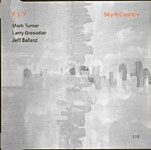
 From the first authoritative notes of Sky & Country, the trio Fly's new release on ECM records, saxophonist Mark Turner lays out a conundrum. Over the ambling underpinnings of bassist FLY and drummer Jeff Ballard, the saxophonist conjures a sense of ease while unleashing a stream of ideas that take him from the middle to the stratospheric heights of his instrument's range. It's a technique that frequently draws gasps from live audiences and has become a hallmark of Turner's playing in his 15-year recording career.
The wiry saxophonist's penchant for precise lines and Zen-like concentration carry over into his compositions—melodic, often cerebral exercises that leave ample room for freewheeling improvisations—but in no way detract from their emotional impact. In Fly, the saxophonist has brilliant foils in Grenadier and Ballard and the breathing room that the group's challenging compositions require.
On "Anandananda," from Sky & Country, Turner begins with a two-minute solo, establishing the plaintive mood in ringing arpeggios before he's joined by Grenadier. The ten-minute composition ebbs and flows through sections, building to brief, unexpected climaxes, while maintaining a harmonic ambiguity. It's a concept that Turner vocalized in a 2002 interview with Jazz Weekly just before Fly's formation, "I like the simplicity of it. It is just three people... There is no, how can I put it... harmonic middleman." The saxophonist went further in an email message last month, responding to the quote: "I want to see how much I can get out of two voices, while still making the harmony sound. This restricts the melody to some extent and puts more emphasis on the bass melody relationship." This relationship is the crux that binds elastic melody and harmony with the sinuous propulsion that Ballard brings to Fly.
Born in Ohio and raised in Cerritos and Palos Verdes, California, outside Los Angeles, Turner began on the clarinet before switching to alto and finally tenor saxophone in high school. Initially drawn to illustration and design, Turner enrolled at Long Beach State University as an art major, before moving to Boston in the late '80s to attend Berklee College of Music. While at Berklee, the young saxophonist met many of the musicians that would, and continue to, factor heavily into his playing. Turner gained a reputation for diligent practicing while in Boston and began to develop a style through careful study and assimilation. "I was fairly methodical," Turner related to The New York Times' Ben Ratliff in 2002, referring to his days at Berklee. "I almost always wrote out Coltrane's solo and I'd have a lot of notes on the side."
Moving to New York in 1990, Turner immersed himself in an active scene and began recording with Delfeayo Marsalis, Vincent Herring, Brad Mehldau and Joshua Redman, among many others. A de facto member of the so-called "Young Lions," Turner never gained the widespread notoriety enjoyed by some of his peers, notably Joshua Redman, despite a recording contract with Warner Brothers that resulted in four critically acclaimed albums. Turner's reticence— personally, not as a performer—has played a large part in the lack of public awareness that has dogged him, regardless of critical praise. Despite this, the saxophonist has carved a niche for himself in New York, toured successfully throughout the world and found like minds in his Fly partners.
"Fly is progressively bringing together many musical elements, traditions, histories and mysteries," says Turner. "Multiplicity is presented under an unassuming hat. In other words, we are working toward saying it all without saying it all, expressing complexity by simplicity. Musically speaking, we are creating songs that can be heard on a number of levels and from a variety of different viewpoints." With Fly, Turner, along with Grenadier and Ballard, hit on a concept that would reveal the improvising trio in a new light. Grenadier expressed it similarly, remarking, "What the three of us have learned by being sidemen is an understanding of a band's common good. All for one! We write with this in mind and interact on the bandstand with the understanding that we are three voices coming together as one."
On Sky & Country, that collective ethic is palpable as the trio volley melodies back and forth between rigorous solos. The album's nine tracks abound with spontaneity and it is another step closer towards collective freedom. "Sky & Country shows our growth in this regard," remarked Grenadier. "I feel it is an even more 'democratic' record than the first [Fly, Savoy Jazz] in that our group sound trumps the individual personalities."
 The group faced a major set back last November, when Turner seriously injured two of his fingers in an accident with a power saw. Word of the incident flew through the international jazz community via online message boards, print and online media and radio stations and fans held their breath. Fortunately, Turner has made a swift recovery and has just finished a European tour with Fly in support of Sky & Country.
"I did rehab for four months which included visits to an occupational therapist one to two times per week," recalled Turner. "He gave me various exercises to do. This began the day after surgery. About two months later, I began playing for about five minutes every few days—which was all I could do—gradually adding time as the hand became stronger. I also went to an acupuncturist which was helpful. As my fingers are not the way they used to be [restricted movement, lack of sensation] I have had to relearn some parts of the horn, various passages etc... particularly the altissimo. Presently I'm still working with it and am exceedingly happy."
Recommended Listening:
Mark Turner, Yam Yam (Criss Cross, 1994)
Mark Turner, Eponymous (Warner Bros., 1995)
Mark Turner, In This World (Warner Bros., 1998)
Kurt Rosenwinkel, The Next Step (Verve, 2000)
Mark Turner, Dharma Days (Warner Bros., 2001)
Fly, Sky & Country (ECM, 2008)
Photo Credit
Lourdes Delgado
FOLLOW Matthew Miller
and get notified whenever a new article published.
About Mark Turner

Tags
PREVIOUS / NEXT

Mark Turner Concerts
Become a Sustaining Member

Since 1995, All About Jazz has championed jazz as an art form and supported the musicians who create it. Over three decades, it has grown into one of the world's leading jazz resources, serving hundreds of thousands of readers, musicians, presenters and industry professionals each month.
Help Build the Future of All About Jazz
Your support helps us continue building All About Jazz for the next generation—expanding our editorial coverage, preserving jazz history, developing new community features and creating better ways to discover the music and the people behind it.
Become a sustaining member for as little as $20 per year and you'll immediately enjoy an ad-free experience along with access to subscriber features and future articles for a full year.
Together, we're not simply sustaining All About Jazz—we're building its future. Thank you for being part of the journey.