Home » Jazz Articles » Live Review » Mark Dresser / Myra Melford / Michael Dessen: San Diego:...
Mark Dresser / Myra Melford / Michael Dessen: San Diego: April 17, 2011
UC San Diego, UC Irvine
San Diego, CA
April 17, 2011
The University of California has been heavily involved in the advancement of "telematic" performances now for over 10 years. Utilizing the Internet2 (a not-for-profit advanced networking consortium) and super high-speed bandwidth networks, as well as state-of-the-art video and audio connections, telematic events feature musicians in different co-locations, interacting with each other and the audience in absolute real-time. The technology responsible for this (both hardware and software) is five years ahead of what is currently available on the market, and takes a small army of highly specialized technicians at each location to pull these events together.
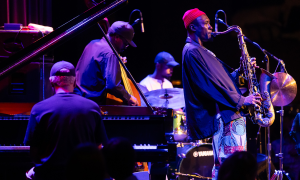
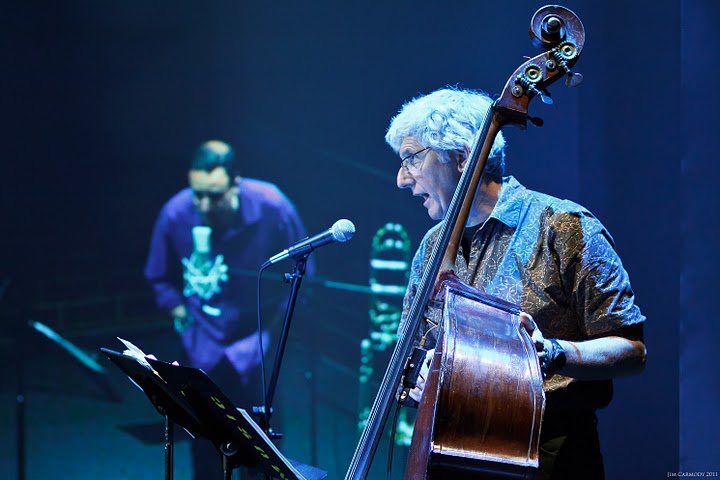
But what all this meant to the concert audience at the event was this: in San Diego, contrabassist Mark Dresser and pianist Myra Melford played together with trombone wizard Michael Dessen, who was being streamed live from UC Irvine 90 miles away, forming a trio.
For all intents, the three artists were in the same room. Dessen's image was super-imposed on a large screen between Melford and Dresser, and the sound was super high fidelity at both locations, via very close microphone usage and detailed audio mixing. Dresser described the experience as being something between a recording studio and a very pristine performance space.
In addition to the virtual reality of it all, that reality was altered dramatically by the intriguing set design of Victoria Petrovich, whose transparent curtains mounted around the space provided alternate canvases to direct both the images of the musicians, and several abstract artworks by painter Don Reich. These paintings were also used as sources of free improvisation between compositions by each member of the trio.
The video images were mixed, super-imposed and fed to various locations in the theater by Johnny Crawford, who interacted with image and music in an improvisational capacity with the musicians.
The concert was organized into four parts. Each one contained three compositions which were a mix of original written material and music composed spontaneously, based on interpretation of the images on screen.
Part one began with Dresser's intriguing "Rasa" a piece dedicated to sitar master Kartik Seshadri. Utilzing a freely improvised introduction, Dresser highlighted his nimble pizzicato while Melford pounded out energetic, disjointed fragments, and Dessen entered with rapid fire staccato bursts and moaning howls. Suddenly they arrived at the longing, modal melody in lockstep. Dessen soloed aggressively, using glissandi to approach target notes and putting a burred edge on the held tones. Melford's solo began with a heady lyricism, and advanced to knotty, jagged expositions. They wound down the melody together, eventually vamping to a whisper.
One of the image improvisations, "Red Beach," followed, beginning with Dessen shooting pure blasts of air through his trombone over Dresser's eerie arco harmonics. This trio has been working together for years and it showed, with the telepathic way they used dynamics—a roar could become a whisper within seconds. Incredibly, the three musicians went straight from the free improv into Dessen's "Threads and Promises," a ballad in the ECM vein that featured a probing bass ostinato from Dresser.
"Telemotives," by the bassist, began the second group of pieces, with Melford's prepared piano (she had placed alnico magnets at strategic locations inside the instrument) hammering out a distinctly marimba type groove. The trombone entered with chortling, gurgling statements, and Dresser held it all together by eliciting multiple plucked pulsations from his instrument. The energy ratcheted up to a high degree—building a wall of tension that slowly dissipated with Melford's left-hand rumblings.
Part three of the proceedings included two free improvisations played over the highly abstract paintings which were sent spinning around the room, while the musicians interacted with each other so seamlessly that the divide between written and improvised material became inconsequential. Throughout all of this was the mastery that these three players have developed on their respective instruments. Dresser's arco and pizzicato work is so fiendishly dexterous it's very difficult to acknowledge what the eye is seeing. He used the bow in every conceivable fashion, and his pizzicato often seemed to be performed by a man with three hands. Melford's piano work was likewise astonishing: she can navigate from the purely lyrical a la Keith Jarrett to the serious pounding of someone like Don Pullen (who she studied with). Add to all of that her very creative use of prepared piano, and it's hard to imagine she's under anybody's radar.
The final set of music again featured two totally improvised pieces based on the artwork of Don Reich, "Piano Music" and "Deep Forest." The first began with Melford tossing out Monk-ish, chromatic intervals. Meanwhile, Dresser injected an abstract, but palpable, swing-time aesthetic. The pianist responded with nervous declaratives and Dessen invented his own real-time melody that perfectly circumnavigated the efforts of his associates. The energy kept dialing up—soon Melford was in Cecil Taylor territory, a space that Dessen and Dresser were only too willing to occupy. Finally, the piano and bass dropped out and Dessen let loose with a show-stopping cadenza that sounded like hornets being blown out of the trombone bell.
Dresser opened "Deep Forest" with his own solo tour-de-force. Using both hands to tap independent lines that moved in opposite directions, the bassist seemed transfixed in the beautiful world he was creating. Dessen added his touches, exploiting the tonal range of his horn: sometimes with a golden, dipped-in-honey timbre, sometimes followed by huge, fat discourses that threatened to warp his horn. Melford got in a short, powerful turn, then it was a gradual diminuendo on pedal tones to close out the improvisation.
The wild, multidimensional affair drew to a close with an original by the trombonist, "Quark Charms." This was the perfect piece to end with, as it served as a most logical bookend to the opener, with a similar modal, call-and-response melody and pensive, thoughtful soloing.
Kudos to the University of California for funding this marriage of state-of-the-art technology with the absolute cutting edge of adventurous music. Much respect to Dresser, Melford and Dessen for taking the leap into the brave new world of telematic performance.
Photo Credit
Jim Carmody
 FOLLOW Robert Bush
and get notified whenever a new article published.
FOLLOW Robert Bush
and get notified whenever a new article published.
Robert Bush has been involved with Jazz as a musician, listener and supporter for over 30 years.
About Mark Dresser
Tags
PREVIOUS / NEXT

Become a Sustaining Member

Since 1995, All About Jazz has championed jazz as an art form and supported the musicians who create it. Over three decades, it has grown into one of the world's leading jazz resources, serving hundreds of thousands of readers, musicians, presenters and industry professionals each month.
Help Build the Future of All About Jazz
Your support helps us continue building All About Jazz for the next generation—expanding our editorial coverage, preserving jazz history, developing new community features and creating better ways to discover the music and the people behind it.
Become a sustaining member for as little as $20 per year and you'll immediately enjoy an ad-free experience along with access to subscriber features and future articles for a full year.
Together, we're not simply sustaining All About Jazz—we're building its future. Thank you for being part of the journey.