Home » Jazz Articles » Interview » Jussi Reijonen: Memory and Consciousness Not Visited Before
Jussi Reijonen: Memory and Consciousness Not Visited Before
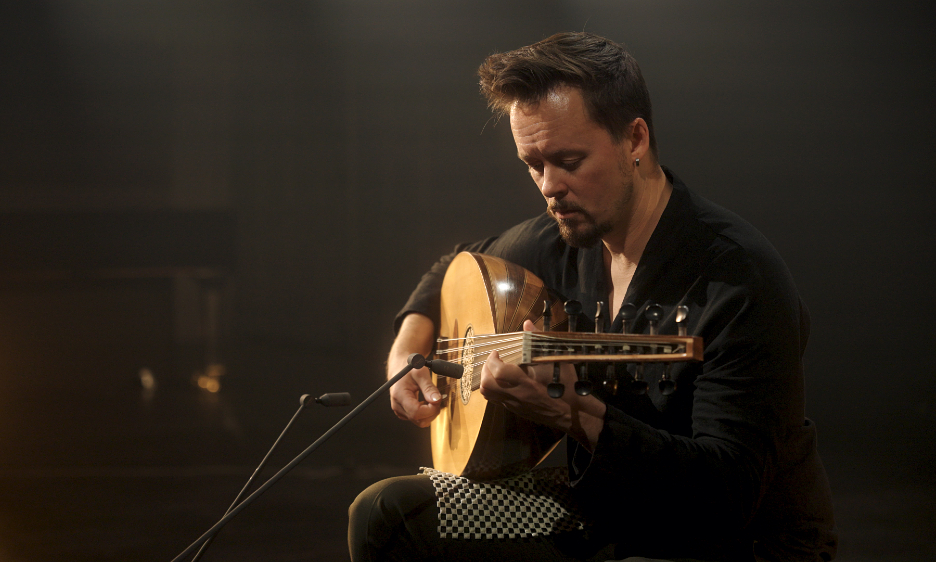
Courtesy Ville Tanttu

The experience of playing this guitar reminded me of the 'memory palace,' or method of loci, a technique of mnemonic recall that goes back to the ancient Romans and Greeks.
—Jussi Reijonen
The studio album makes a strong case for nominal determinism. It is an elastic, wandering record that is captivating and the result is, in fact, magic, complementary sonic experiments, each one resisting strict definition. That element of play, though, doesn't take away from the intelligence of sayr. Reijonen's guitar is plucked through various melodic patterns, modulating up and down, as he pitches first the "Q" and then the "A," sometimes playing overlapping snippets of sound, sometimes echoing himself.
There is a pleasing sensibility to much of Reijonen's artistry, as elements come together noticeably in leisurely fashion without passing you by, moving through hypnotic shapes of sound. The sound never stands still; it moves without hurrying, making you aware of time while also readying you to disregard it. Why not? The music isn't in a rush, and neither are we. Far easier and more pleasurable to sit back and let the sounds wash over us in all their glory as the notes swirl and twinkle, the entirety of his music devoid of confusion but swollen with angst, expressed through the hypnotic gestures unfounded in the beautiful affectations.
Born in Rovaniemi, a small town on the Arctic Circle in Finnish Lapland, and having grown up in Finland, Jordan, Tanzania, Oman and Lebanon before spending much of his adulthood in the United States, Reijonen has lived a life soaking up sounds, sights, scents and shades of Nordic, Arabic, East African and North American aesthetics and expression, all of which are reflected in his creative work as composer, improviser and performer. In the following interview, he provides us with insight into how the magic emanates from finding touchstones during visits to a "memory palace," which is in a way akin to the character Rand al-Thor in the television series Wheel of Time entering the ancient uninhabited city of Rhuidean, where glass columns are touchstones for past and future memories.
All About Jazz: How did the idea for sayr come about?
Jussi Reijonen: salt | thirst is the first of a series of solo releases under the sayr umbrella where I explore the blurry lines between improvising and composing in real time. At the time I recorded it, something in the sound and feel of a late-1940s Gibson LG-2 steel-string acoustic that I was generously given as a gift by a former student kept awakening vivid sonic, sensory and personal memories from my life that led me to think about and explore the connection between sounds and memory—how one can provoke the appearance of the other.
AAJ: What do you mean by the term "memory palace?"
JR: The experience of playing this guitar reminded me of the "memory palace," or method of loci, a technique of mnemonic recall that goes back to the ancient Romans and Greeks. In its common application, if one wants to be able to remember particular things in a particular order, one imagines a palace with different rooms in as vivid detail as possible, and then places imagines—or mental representations of what one wants to remember—into very particular, detailed locations called loci in the memory palace. One then mentally "walks" through the palace, always visiting the loci in the same order, with the idea that revisiting each locus would then provoke the imagines—the things one wants to recall—in the desired order.
AAJ: As a youth, did you grow up around music?
JR: Because I lived such a transient childhood moving between countries and cultures, I've processed so much of my life—emotions, experiences, environments—through music. I began asking myself if in doing so, might I have subconsciously constructed a "memory palace" of sound that, in a way, had stored or mapped experiences and memories (imagines) onto particular sounds (loci), for processing and maybe understanding later, that then resurfaced through encountering particular sounds on this guitar?
I began exploring what kinds of sonic or personal memories might appear if I started to improvise with gestural cells that don't have pre-decided musical content per se: octave, vary left hand pressure, speech-like, etc. In my still-developing concept, I thought of these cells as my musical loci, and as I visited them through improvisation, musical imagines—melodies, themes, rhythms, etc—that reflected my experiences, references and sources started to appear. When I started to weave a musical form from these materials, a pathway through the loci started to reveal itself. This reminded me of sayr, a word referring to pathway, course or motion through a maqam—a melodic mode—in Arabic music. That pathway through my memory palace, then, became the concept of sayr as an ever—evolving musical work that is never performed the same way twice.
AAJ: You recorded sayr in only two tracks as suites. It takes repeated listening to determine where the parts are separated.
JR: One Sunday afternoon in March 2025, I was exploring some musical gestures that didn't yet have any content, recording in my home studio over a cup of coffee, hoping to capture some ideas, and all of a sudden, this music—this whole album—came completely out of the blue in one take, the 40 minutes or so that it took to play it. It was as close to what I would imagine a flow state might be in that I didn't second-guess myself a single time, but somehow managed to just allow an unfolding to happen. I was lucky to have the recording on, running one condenser mic into Logic Pro X. There are no edits, except the removal of me sneezing once, and the splitting of the entire arc into two parts as on two sides of a vinyl LP.
AAJ: You have drawn from a wide and varied range of influences incorporated into a singular style.
JR: When I listen back to it now, I hear Finnish Lapland, where I was born, but also Jordan, Tanzania, Oman and Lebanon, where I grew up. I hear guitar, oud, kora, guembri, kantele. I hear echoes of Hamza el Din, Munir Bashir and Farid al Atrash. I hear Mahmoud Guinia. I hear my mentor Ran Blake's left hand and his tone clusters. I hear Fairuz, Umm Kulthum, Camarón de la Isla. I hear Paco de Lucia, Ali Farka Toure and Lightnin' Hopkins.
AAJ: Besides the dual release, is the live album connected to the studio record?
JR: Every sayr concert I perform is the next evolution of an ever-growing archive of gestural materials, in this spirit of composition-in—the-moment in front of an audience. I record each concert for possible later release, to be mixed and mastered without fixes or edits as part of the series. It's been an invaluable way to commit to ideas, and to discover and develop musical seeds for even future compositions. Some of these may end up in some form on the next ensemble album I'm currently sketching— who knows?
AAJ: Would you go through the individual tracks on the albums and provide our readers some insight into what's going on inside these pieces? Let's start with the sayr studio album.
JR: "Salt" really captures the intimate, raw energy and childlike joy of discovery in the moment, which is why this whole album is so precious to me. I was in a rare headspace that was completely free of being self-conscious. Something in this old Gibson acoustic brought up all these memory references to sounds, places and people from my journey. I had never played quite like that; it felt like the music just played itself on this wise, old instrument.
I definitely hear myself figuring out how to execute the ideas as I go, since some of the playing is less than technically perfect. Then again, in this age of editing—Instagram filters, Photoshop, pitch correction and rhythmic quantization—I feel that its very honesty and rawness is also its charm. It's quite the contrast to the through-composed detail and production of Three Seconds | Kolme Toista with our nonet from 2022.
Although "Salt" is 17 minutes long, I felt that dividing it into shorter tracks would impact a listener's perception of musical form and discourage people from listening to a longer journey. I left it as one arc, with "sola," "sarvi," "sae" and "keinu" as four chapters that for me reflect its musical narrative. This time, it felt intuitively important that the chapters were all single words in Finnish. Where each chapter begins and ends is up to the listener.
AAJ: The other piece is titled "Thirst," which is a typical reaction to using salt.
JR: From its first notes, "Thirst," to me, sounds a little brighter in color than "Salt," which made for a natural split into two contrasting sides of an LP. Again, although the track itself is 23 minutes long, I hear it in seven chapters— "koto," "kuori," "kaarna," "säe," "kiedo," "aina" and "ennen." Where "Salt" leans perhaps more towards the Arabic and Finnish chapters of my story, there's more blues and West African references in "Thirst"—often in combinations that I hadn't discovered before in my own playing.
Some motifs also appeared towards the final third of "Thirst" that I've then developed further in the concert performances I've done of sayr, where each concert is a new exploration, development and expansion of my memory palace. You can hear some of the musical materials from salt | thirst in different guises also on the live album.
AAJ: To my ears the playing on the live album, sayr: kaiho could easily be mistaken for a studio effort until you begin to notice a certain vibrancy that is intrinsic with a performance.
JR: This live album is a document of the concert premiere of sayr last fall, and as with salt: thirst, there are no edits. Somehow, everything that night fell into place: the sound, the lights, the mood, the energy of the audience. I'm very glad we captured it in full in both audio and video form.
"Halla"—which means "frost" in Finnish—is the longest of the three arcs I performed, and is I think a good example of the memory palace evolving. I hear deepening connections between the loci and imagines developing, where to my ears I seem somehow to get closer to an organic emulsion of my influences than on salt | thirst— often even within single phrases.
An excerpt, "halla: suisto," was released as one of the two digital singles—and videos—from the album. It captures some of my blues influences, perhaps with a touch of Shakti's "A Handful of Beauty" thrown in. Echoes of Paco de Lucia and Camarón de la Isla are also quite present in places.
AAJ: I was curious in a playful way about the next title, "fes." Does this refer to a city in Morocco or the traditional red hat?
JR: "fes" is an homage to the city in northern Morocco where I bought my first oud in 2003—an event that changed my life in more ways than one. For this concert, I wanted to expand the memory palace concept to include the oud, which is such an expressive instrument. Mine is a 1946 Léon Istanbouli, also with a very resonant, old school sound that both pairs and contrasts beautifully with my Gibson.
This is not a traditional Arabic taqsim improvisation in form, but more like a composition in the moment that combines Levantine and Moroccan-inspired ideas with an aesthetic of space inspired by Munir Bashir from the Iraqi school of maqam performance. Some interesting microtonal resonances in there.
AAJ: And we come to the conclusion with the last track on the album.
JR: I had originally planned to play just two arcs in the concert— one with guitar and one with oud—, but when the oud had said what it had to say that night with "fes," I felt the concert still needed a coda. I spontaneously went back to the guitar, and "vielä," which means "still" or "yet" in Finnish, came out. Although it's by far the shortest of the three arcs on the album, I think it balances out the concert and album form nicely.
AAJ: No encore but thank you for speaking with All About Jazz.
About Jussi Reijonen

Tags
PREVIOUS / NEXT

Become a Sustaining Member

Since 1995, All About Jazz has championed jazz as an art form and supported the musicians who create it. Over three decades, it has grown into one of the world's leading jazz resources, serving hundreds of thousands of readers, musicians, presenters and industry professionals each month.
Help Build the Future of All About Jazz
Your support helps us continue building All About Jazz for the next generation—expanding our editorial coverage, preserving jazz history, developing new community features and creating better ways to discover the music and the people behind it.
Become a sustaining member for as little as $20 per year and you'll immediately enjoy an ad-free experience along with access to subscriber features and future articles for a full year.
Together, we're not simply sustaining All About Jazz—we're building its future. Thank you for being part of the journey.