Home » Jazz Articles » The Blue Note Portal » Future Perfect—Afro Chill
Future Perfect—Afro Chill
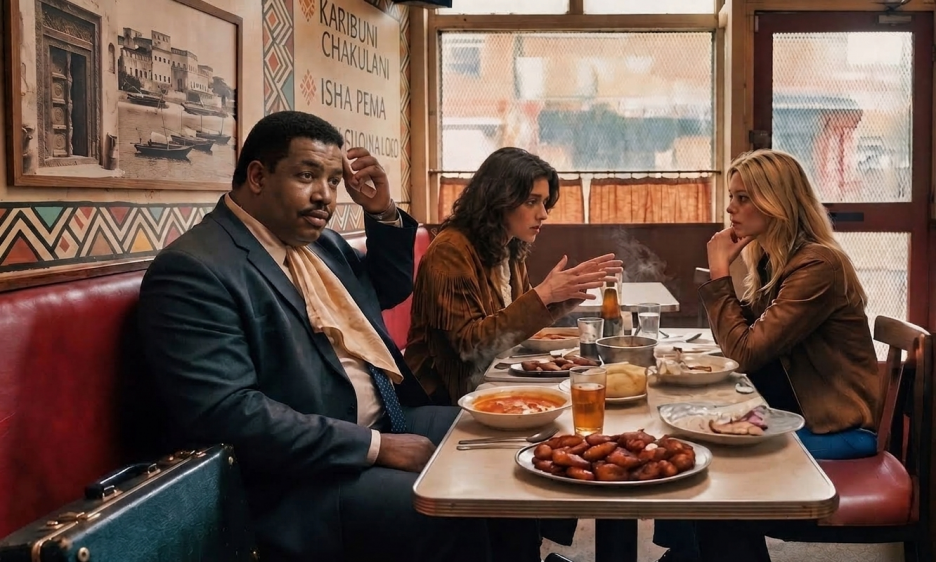
Courtesy AI
Inside Columbia's 30th Street Studio, the old Presbyterian church swallowed the heat whole. The ceiling disappeared into shadow a hundred feet up. Cannonball's footsteps echoed on the worn floor like someone else's. The air tasted of pipe tobacco and something older—horsehair plaster, maybe, or the particular mustiness of a room that had been recording sound for forty years.
He'd been told to expect a rhythm section. A producer. Maybe a chart on a music stand with his name misspelled.
Instead, four people stood near the engineer's console in a loose cluster, and none of them was holding an instrument.
Cannonball stopped. He let the silence settle. He'd learned a long time ago that silence was information—that the way a room went quiet when you walked in told you more than any introduction.
The tallest one stepped forward. Young. Clean hands. The kind of face that belonged on a college campus, not in a recording studio at nine in the morning.
"Julian 'Cannonball' Adderley," the young man said. "It's an honor, sir."
"Call me Cannonball." He shook the hand. Firm grip, no calluses. "Son, I brought the horn, but I don't see any tracking going on." He gestured vaguely at the empty nave—no drum riser, no amplifier stacks, no tangle of XLR cables snaking across the floor. Just the four of them and the console and the dust motes hanging in the shafts of light that fell through the high windows.
"No tracking today," said one of the women—Maya, he'd learn later. She had the easy, slightly apologetic tone of someone delivering news she knew wasn't what you wanted to hear. "We don't want to talk in here. It's a mausoleum. Put the horn in the locker, Julian. We're taking you uptown."
Cannonball looked at her. Then at the other woman, Chloe, who was leaning against the choir rail with her arms crossed and a faint smile that said we know this looks strange. Then at the fourth person, who hadn't spoken yet and was watching him with the patient, unhurried attention of someone who had already decided how this conversation was going to end.
Something in that look irritated Cannonball. Not badly. Just enough to make him want to push back.
"I've got a session Thursday at the Village Gate," he said, which was true but also a deflection, and he knew it was a deflection even as he said it. "I can't be gone all day."
"You won't be," the tall one—Xap—said. "Lunch. That's all we're asking."
Cannonball set the saxophone case down against the console. The leather handle left a faint crease in his palm.
The Lincoln smelled of leather and something faintly chemical, like new carpet. They didn't talk much on the drive north. Cannonball watched Harlem assemble itself through the window—the brownstones giving way to taller buildings, the crowds thickening, the sound of car horns and radio bleed becoming a single continuous noise.
They turned onto 125th Street and the character of the block shifted. A record shop had its doors propped open and Sly & The Family Stone was pouring out onto the sidewalk—"Everyday People" at full volume, the bass line rattling the glass in the window frames. Two men in dashikis stood outside a barbershop arguing about something with the relaxed intensity of people who had been arguing about the same thing for years.
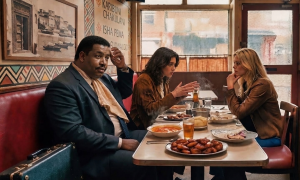
The restaurant was easy to miss. No sign out front, just a screen door and a hand-painted board in the window that read OPEN in faded red letters. Inside, the smell hit Cannonball like a wall—ginger, palm oil, something roasted and peppery that made his eyes water slightly. The room was narrow, maybe eight tables, and every single one was occupied. The noise level was extraordinary: three different conversations in what sounded like Yoruba, a radio playing highlife music from a speaker mounted near the ceiling, the clatter of plates and the hiss of a frying pan from the kitchen.
A woman behind the counter saw them and nodded without surprise, as if she'd been expecting them. She cleared a table near the back wall where framed prints of Lagos and Accra hung slightly crooked.
Cannonball slid into the vinyl booth and tucked a napkin into his collar. The vinyl stuck to his forearms. "Now this," he said, "is civilized."
He meant it, but he also meant it as a way of buying time. He was a man who had been in the music business for twenty years, and he had learned that when someone takes you to a restaurant before telling you what they want, what they want is either very large or very strange. Usually both.
Xap sat across from him. Maya and Chloe slid in beside each other on the other side of the table. The fourth person—the quiet one—remained standing for a moment, then took a chair from an adjacent table and pulled it up to the end.
"We aren't rock-and-roll people," Xap said. No preamble. No small talk about the food or the weather.
Cannonball raised an eyebrow. "You've got me at a disadvantage, then. Capitol said you were connected to the Apollo film."
"We are. But that's not why you're here." Xap folded his hands on the table. His fingers were long, steady. "We asked you here because you're one of the few people left who can walk into any room in this country—jazz club, church, college auditorium, living room—and make every single person in that room feel like you're talking directly to them. You can play hard bop that makes critics weep and you can play a gospel waltz that sells half a million copies, and neither one feels like a compromise. That's not common. That's almost extinct."
Cannonball picked up his glass of ice water. The ice clinked. He took a slow drink, watching Xap over the rim. Flattery was easy to dismiss. But this didn't feel like flattery. It felt like a diagnosis.
"So what do you want?" Cannonball asked. "Because if it's another one of those 'jazz meets rock' sessions where I play two choruses over a backbeat and collect a check, I'll save you the plane ticket."
"It's not that," Maya said. She leaned forward slightly, and Cannonball noticed her hands—strong, calloused at the fingertips in a way that told him she was a player, not a talker. "We want to make a record that doesn't have a name yet. We're calling it Afro Chill because it's the closest we've come, but even that's not right."
"What's wrong with it?"
"It kind of works, but it's not a description of what the music actually does." She shook her head, impatient with herself. "Look—right now, in popular music, there's incredible energy but the musicianship is hit-or-miss. And the jazz bins are full of records that only other musicians buy. We don't want to add another one to that pile. We want to build something that works on two levels simultaneously. A guy comes home from a ten-hour shift, drops the needle, sinks into the couch, and just... floats. But if you're a player, if you've got ears, you listen close and you hear counterpoint. You hear harmonic movement that would make Coltrane nod. You hear African polyrhythms that haven't been on a Western record before—not as a garnish, not as 'exotic flavor,' but as the actual structural foundation."
Cannonball set his glass down. He was quiet for a moment. The highlife music from the speaker above them filled the gap—a bright, cycling guitar pattern that seemed to go nowhere and everywhere at once.
"Who's playing?" he asked.
"You," Chloe said. "And Yusef Lateef."
Cannonball almost laughed. Almost. "Yusef's not going to do this."
"We know," Chloe said. "That's why we need you to call him."
"He's got principles. He's got a whole philosophy about what music is supposed to do. He's not going to walk into a studio with a bunch of kids who made a Beatles movie."
"We're not asking him to walk in blind," Xap said. "We're asking him to listen first. And we're asking you to be the one who tells him it's worth listening."
Cannonball leaned back against the vinyl. It squeaked under his weight. He thought about Yusef—thought about the last time they'd spoken, at a conference in Detroit where Yusef had given a forty-minute lecture on the relationship between breath and spiritual intention that had put half the audience to sleep and left the other half permanently changed. He thought about how Yusef played the flute like he was trying to remember something from before he was born.
"Herbie Hancock on Rhodes," Xap continued. "Chick Corea on acoustic grand. Billy Cobham on drums."
Cannonball's eyebrows went up. "Cobham hits like a building falling down."
"Not the way we're recording him."
Cannonball was quiet for a moment, turning his glass in a slow circle on the table. Then a wry grin touched his lips.
"I assume you're calling Miles, too?"
Maya laughed out loud—a sharp, surprised bark. "No. We're smarter than that. If we called Miles, we'd end up reading in Rolling Stone how he turned us down or threw us out of his townhouse."
Cannonball held his belly as a rich, booming laugh shook the booth. "Alright! You've done your homework. Miles would take your money, cuss you out, and play three notes through a wah-pedal just to spite you."
The laughter settled. Cannonball's expression grew thoughtful again. He looked at the four of them—really looked—and seemed to be weighing something that had no unit of measurement.
The waiter appeared with bowls of groundnut stew and plantains that were still sizzling. The smell was extraordinary—rich, spicy, deeply savory. Cannonball looked at the food, then at the four people across from him, and felt something shift in his chest. Not excitement exactly. Something more like recognition. The feeling of standing at the edge of something and knowing, with the part of you that doesn't lie, that you're going to step off.
"Herbie, Chick, Billy, Yusef, and me," he said slowly. "In London."
"Olympic Studios. Geoff Emerick engineering, he the guy who did Sgt. Pepper's."
Cannonball picked up his fork. He looked at the stew. He looked at Xap.
"You know what this is, don't you?" he said. "This isn't a session. This is an experiment. And experiments fail."
"Yes," Xap said simply.
Cannonball took a bite of stew. It was hot enough to make him blink.
"Eat," he said, pointing his fork at them. "Then take me to a phone booth. I've got to call Detroit."
The phone booth was on Lenox Avenue, wedged between a laundromat and a storefront church. The receiver was sticky with heat. Cannonball fed it a quarter and dialed the number he knew by heart.
It rang four times. A woman's voice answered—Yusef's wife, Ayesha. She recognized Cannonball immediately and put him through without asking why he was calling.
"Julian." Yusef's voice was calm, unhurried, as if he'd been sitting in a chair waiting for the phone to ring. "You sound like you're standing outside."
"I am standing outside. In Harlem. In a phone booth that smells like someone lit a match in it." Cannonball wiped sweat from his forehead with the back of his hand. "Yusef, I'm going to tell you something and I want you to hear me out before you say no."
"I haven't said no yet."
"You're about to. A group of young people—kids, really—made that Apollo film with the Beatles. They want to make a record. They want you on it."
Silence on the line. Not hostile silence. Thinking silence.
"What kind of record?"
"That's the thing. I don't know exactly. They brought me to a restaurant on 125th and talked to me for an hour, and I still can't tell you exactly what it is. But I can tell you what it isn't. It isn't a gimmick. It isn't jazz-with-a-beat. It isn't any of that. And the way they talk about it—the way they talk about "you"—it's not about selling records. It's about... " He paused, searching for the right word. "It's about healing."
Another long silence. Cannonball could hear a dog barking somewhere in the background, far away, and the faint sound of a television.
"You know I don't chase paychecks, Julian."
"I know. That's why I'm calling you and not your agent. These people understand that. They told me—word for word—they said, 'We're not asking him to walk in blind. We're asking him to listen first.'"
Yusef was quiet for a long time. When he spoke again, his voice had shifted slightly—still measured, still calm, but with a new quality underneath. Curiosity, maybe. Or the particular alertness of a man who has heard a word he wasn't expecting.
"Listen to what?"
"I don't know yet. They're flying everyone to London. Olympic Studios. Geoff Emerick is engineering."
"Who is that?"
"The Beatles' engineer."
Another silence. Then, very quietly: "Send me what they've got. If it speaks, I'll come."
Cannonball closed his eyes. The heat pressed against the glass walls of the booth like a living thing.
"I'll do that," he said. "Yusef—thank you."
"Don't thank me yet, Julian. I haven't said yes. I've said I'll listen."
The line went dead. Cannonball stood in the booth for a moment, the receiver pressed to his ear, listening to the dial tone. Then he hung up, stepped out into the blinding Harlem afternoon, and walked back toward the Lincoln.
The Alchemists at Olympic
Two months later, London was doing what London does—producing a fine, persistent drizzle that didn't so much fall as hover, coating everything in a thin film of grey. The red-brick facade of Olympic Studios in Barnes was dark with moisture. A delivery van was parked at a crooked angle near the loading dock, its engine ticking in the cold.Inside Studio One, the room had been carved up like a surgical theater.
Geoff Emerick had spent two days preparing the space before a single musician arrived. Thick acoustic gobos—eight feet tall, covered in grey felt—created isolated chambers on the floor. Each instrument existed in its own acoustic cell, sealed off from its neighbors. The effect was strange and slightly claustrophobic, like walking through a maze where you could see the other players but couldn't hear them until they started making sound.
The guest musicians arrived in the morning. Billy Cobham came first, carrying his sticks in a canvas bag like a carpenter carrying tools. He surveyed the baffled room with the wary expression of a man who had been told the rules but didn't yet believe them. Herbie Hancock arrived next, wearing a green corduroy jacket that was slightly too large for him, and immediately gravitated toward the Fender Rhodes Mark I that had been set up in one corner, running his fingers silently over the keys. Chick Corea came in last, sat at the Steinway concert grand, and placed both hands flat on the fallboard, staring at the instrument the way a chess player stares at a board before the first move.
Cannonball and Yusef Lateef arrived together, sharing a cab from the hotel. Lateef wore a tailored dashiki of deep indigo cloth and held a hand-carved wooden flute across his chest like a talisman. He adjusted his glasses and surveyed the room with the expression of a man who had been told he was going to enjoy something and was determined to remain skeptical until proven otherwise.
"Brother Julian," Lateef said, his voice low and measured. "You assured me this was not a novelty exercise."
"I assured you it was worth hearing," Cannonball corrected gently. "I didn't promise you'd like it."
Lateef considered this. A faint smile touched the corner of his mouth—the kind that appears when someone says something you didn't expect but recognize as true.
Maya stepped to the front of the room. She had her sunburst Gibson Les Paul slung low, and she held a sheet of paper in one hand—not a chart, Cannonball realized, but something more like a sketch. A few bars of notation, a key signature, a tempo marking. The rest was blank.
"One rule," she said. Her voice was quiet but carried easily in the baffled room. "Leave the ego in the lobby. We're not cutting solo marathons. We're not trying to impress anyone. We're sculpting a mood. If you feel the urge to play something that makes people say 'wow, listen to that,' put it back in the case and play something that makes people close their eyes instead."
She looked at Cobham. "Billy. I know what I'm asking. You're the most powerful drummer alive, and I'm asking you to play like you're trying not to wake someone up. Can you do that?"
Cobham was quiet for a moment. He looked down at his brushes, then up at Maya. Something flickered across his face—not resentment, exactly, but the particular pain of a man being asked to deny his own nature.
"I can try," he said.
"That's all I need."
She turned to the full room. "Before anyone picks up a horn or sits at a keyboard, we're going to play this for you. The bones of it. You'll hear where it's going. Then when you feel it—when your body tells you where to enter—you come in. No charts. No count-off. Just listen and find your place."
Zack settled onto his stool behind a Fender Jazz Bass. Chloe took position with her Telecaster, strap slung low. Two of the West African percussionists—Kofi and Ade, who had been living in London for three years and playing highlife sessions in Ladbroke Grove—sat cross-legged beside their talking drums and shekeres. Maya remained standing, Les Paul in hand.
"Track one," Zack said. "'Zanzibar Dusk.' Seventy-two beats per minute. E-flat minor."
He looked at the guest musicians. "Just listen. Get the feel. We'll open it up when you're ready."
He nodded to Kofi. The talking drum began first—a low, circular pattern that seemed to come from the floor itself, more vibration than sound. Ade's shekere entered a bar later, a dry, whispering hiss that filled the spaces between the drum strokes. Then Zack's thumb found the E string, and the bass ostinato began: warm, round, muted, repeating with the patience of a heartbeat.
Chloe's guitar came in next—a muted, dry chop that was more percussion than harmony, ticking forward with metronomic precision but with a human swing that no machine could replicate. It locked into the space between Kofi's drum and Zack's bass like a key turning in a lock.
Then Maya. She didn't step forward. She didn't signal. She simply began to play, and the sound that came out of the Les Paul was unlike anything that had been heard in a recording studio before. Octave runs executed with a speed and fluidity that seemed to bypass the mechanical limitations of fingers on strings, combined with a two-handed tapping technique that produced notes like water drops falling into a still pool—each one distinct, each one resonant, each one landing exactly where it needed to land.
The sound was futuristic. Not in a science-fiction sense, but in the sense that it belonged to a time that hadn't arrived yet—a time when technique and emotion would stop being separate categories.
Cannonball watched from the doorway, his arms folded. He saw Herbie's head tilt slightly—the way a dog's head tilts when it hears a frequency just beyond the range of normal attention. He saw Chick's fingers begin to move silently on the fallboard, finding voicings in the air. He saw Cobham's right hand drift toward his brushes, then stop, then drift again.
And he saw Yusef Lateef close his eyes.
The groove played for three full minutes. It didn't build. It didn't crescendo. It simply *was*—a living, breathing thing that occupied the room the way weather occupies a landscape. It asked nothing. It demanded nothing. It simply invited.
Then Zack looked up from his bass and nodded—not at anyone in particular, but at the room itself.
The invitation was open.
Herbie moved first. His hands found the Rhodes keys and he laid down a cloud—a suspended eleventh chord that hung in the air without resolving, hovering above the groove like a bird that had forgotten how to land. Through the Rhodes' built-in tremolo, the notes shimmered and pulsed, breathing with a slow, organic rhythm.
Chick followed, but differently. His Steinway sprinkled minimalist, glassy accents over the top—single notes, widely spaced, falling like rain on still water. He wasn't comping. He was coloring.
Cobham was last among the rhythm players. He picked up his brushes and brought them to the snare rim with a touch so light it was almost apologetic. The sound was a hushed, circular rustle, like dry leaves skittering across warm stone. He wove his pattern between Kofi's talking drum and Ade's shekere, finding the gaps, filling them with whispers.
Then Yusef Lateef raised the flute to his lips.
What came out was not a melody. Not in any conventional sense. It was a long, slow exhalation that happened to pass through the instrument on its way out of his body—a sound that was more breath than tone, more question than statement. It bent and wavered in a way that had nothing to do with Western intonation. It was the sound of wind moving through a space that had no walls.
In the control room, Geoff Emerick's hand was hovering over the panning knob on Lateef's channel. He was barely touching it—just a millimeter of movement, nudging the flute's signal from center toward the left monitor, letting the plate reverb catch the tail and splash it back across the stereo field. His eyes were wide. His mouth was slightly open.
Cannonball waited. He counted eight bars. Twelve. Sixteen. He felt the groove pulling at him like a tide, felt the place where his horn wanted to enter—not with a statement, not with a declaration, but with a response. An answer to a question Lateef hadn't quite finished asking.
He brought the alto to his mouth.
The first note was barely audible. A sub-tone, warm and dark, sitting directly beneath the flute like a hand placed gently on someone's back. He wasn't playing a solo. He was playing a conversation—and the conversation was between two men who had known each other for a long time and didn't need to finish their sentences.
Nobody rushed. Nobody tried to fill the space that another player had left open. For seven minutes, the ensemble breathed together—a single organism with nine hearts, expanding and contracting in a rhythm that had no name.
When Zack let the final low E-flat ring out and decay into silence, Cobham's brush came to rest on the snare skin and stayed there, motionless.
The silence that followed was not empty. It was full—full of the ghost of what had just happened, full of the question of whether it was real or whether they had imagined it together.
In the control room, Emerick slowly pulled down the master faders. He sat very still for a moment. Then he hit the talkback switch.
"Right then," he said. His voice was slightly unsteady. "Come have a listen."
The Listening Room
The control room was small and warm and smelled of hot electronics and the cold tea that Emerick had been drinking since seven that morning. The musicians filed in one by one, and the space immediately felt too full—too many large bodies, too many strong personalities compressed into a room designed for three people and a mixing desk.Cannonball unbuttoned his vest and mopped his forehead with a handkerchief that was already damp. Herbie and Chick were talking quickly, overlapping each other, excited in the way musicians get when they've stumbled onto something they can't yet name. Chick kept playing a voicing in the air with his right hand, showing Herbie something about the interval structure.
Lateef came in last. He stood near the door, slightly apart from the others, his expression unreadable.
Emerick rewound the tape. The two-inch reel turned with a heavy, mechanical whir that slowed to a stop. He patched the output through the Tannoy monitors—the big ones, the ones that could reproduce the full frequency range without flinching—and pressed play.
The sound that came out of the speakers was not what any of them expected.
It was the same performance—they all remembered playing it—but it was transformed. The isolation Emerick had imposed on the tracking floor meant that each instrument existed in its own pristine acoustic space, free from the bleed and smear that normally glued a live ensemble into a single, indistinct mass. The result was a clarity that bordered on the uncanny.
Zack's bass sat in the dead center of the stereo image, warm and fat and impossibly present—you could hear the soft thud of his thumb against the string, the faint buzz of the note decaying. Cobham's brushes were right there, three feet in front of your face, intimate as a whisper. The shekeres and talking drums occupied a space just behind and to the right, their rhythms interlocking with Cobham's in a way that sounded inevitable, as if they had always been meant to be played together.
But it was the spatial placement that stopped everyone's breath.
Herbie's Rhodes chords drifted across the stereo field like fog moving over water—Emerick had panned them subtly during the performance, so they seemed to breathe, expanding and contracting in the space between the speakers. Lateef's flute entered from the far left, a thin, luminous thread of sound that seemed to physically travel across the room, passing over the listener's head before settling into the right channel. Cannonball's alto answered from the center, warm and grounded, the anchor that kept the flute from floating away entirely.
Maya's tapped harmonics danced across the very top of the frequency spectrum—tiny, bright, weightless, like light reflecting off the surface of deep water. And beneath all of it, Chloe's rhythm guitar chopped forward with relentless, quiet insistence, the engine that kept the whole structure moving.
It was seven minutes long. Nobody moved.
When the last note faded into the long tail of plate reverb—a shimmering, metallic decay that seemed to go on forever—the silence that followed was different from the silence on the tracking floor. This silence was stunned. This silence was the sound of people trying to figure out what they had just heard and failing.
Herbie spoke first. "Geoff." His voice was quiet, almost reverent. "What are you doing with that panning? The Rhodes feels like it's alive."
Emerick blushed. He was twenty-three years old and he blushed like a teenager. "It's the console, really. Dick Swettenham's design. The pan pots are so smooth you can move a signal a fraction of an inch and it sounds like the instrument physically relocated in the room. But it only works if the source signal is clean. If you've got drum bleed in the Rhodes mic, you can't move it without dragging the drums along. You chaps gave me... " He paused, searching for the word. "Purity. That's what you gave me."
Cannonball turned to face Lateef. He didn't smile. His expression was serious, almost anxious—the look of a man who has made a promise and needs to know if it was kept.
"Well, Professor?" he said. "Did we commit a crime?"
Lateef was quiet for a long time. He stood with his arms at his sides, his wooden flute still in his hand, and his face went through a series of subtle changes that Cannonball had never seen on it before. The skepticism didn't vanish—it was joined by something else. Something that looked like surprise at his own surprise.
"On the contrary," Lateef said finally. His voice was low, and it carried the weight of a man choosing his words with extreme care. "You have removed the walls." He paused. "The concert hall. The recording studio. The distance between the player and the listener. All of it. Gone." He looked at the speakers as if they might speak back to him. "There is no intellectual vanity in this. No performance for the sake of performance. It is... " He stopped. Started again. "It is music from the self. The spiritual self. The physical self. The emotional self. All three, simultaneously."
He turned to face Maya, Chloe, Xap, and Zack. He inclined his head—a small gesture, barely a bow, but from Yusef Lateef it was enormous.
"Julian told me the truth," he said. "This is music that heals."
The room was quiet for one more moment. Then Cannonball laughed—that big, round, diaphragm-deep laugh that filled every corner of every room he'd ever entered in his life. He slapped Lateef on the shoulder hard enough to make the taller man sway.
"Hear that?" Cannonball roared, turning to face the group. "The Professor approves!" His eyes were bright, almost wet. "Now get back out there. Herbie, get your hands back on that electric box. Chick, warm up that Steinway. We've got six more tracks to cut before Geoff runs out of tea."
The musicians began to move toward the door, energized, chattering, already thinking ahead to the next piece. But Maya lingered. She looked back at the corner of the control room, where Dr. Kiran sat in a chair that was slightly too small for him, his hands folded in his lap, his expression serene and distant and full of something that might have been satisfaction or might have been something older and harder to name.
Maya held his gaze for a moment. He nodded once, barely perceptible.
She turned and followed the others through the heavy soundproof door, back onto the tracking floor, back into the silence that was waiting to be filled.
Coda: West 77th Street
Five weeks later, in a brownstone on West 77th Street, Miles Davis sat in a leather chair facing a pair of Altec Lansing speakers and held a record sleeve in his hands. The cover was simple—matte black, gold lettering, no photograph. Afro Chill. He'd received it that morning in a plain brown envelope with a short note from Herbie Hancock. "Straight from the pressing plant, thought you'd want to be one of the first to hear it, Peace, Herbie" No cover, just the record and a pressing plant stamp from London.He'd been in the studio himself for three days recording Bitches Brew. He was proud of it. Proud in the way that made him restless, because pride meant he'd arrived somewhere and arriving meant it was time to leave.
He dropped the needle.
The first thing he heard was silence. Not the silence of a dead groove—the silence of a room with people in it, breathing, waiting. Then a talking drum, low and round, like a heartbeat heard through a wall. Then a bass note. One note. Held. Then a second. The space between them was enormous.
Miles leaned forward.
The flute entered from somewhere he couldn't locate—not from the left speaker, not from the right, but from the air between them, as if the instrument existed in a dimension the speakers could only approximate. It was Lateef. He recognized the breath, the microtonal bend, the way Yusef played a note like he was apologizing for interrupting the silence.
Then the alto. Cannonball. Sub-tone. Warm. Sitting underneath the flute like a foundation.
Miles's jaw tightened.
The groove built around them—guitar chops dry as bone, a Rhodes chord floating like smoke, brushes on a snare so soft they might have been fingertips on skin. The whole thing moved at a tempo that was almost too slow to be called a tempo. It wasn't funk. It wasn't jazz. It wasn't anything he had a name for.
And that was the problem. That was the thing that hit him in the chest like a fist.
He had spent two years building toward this. Electric instruments. Studio as instrument. Rhythm as architecture. He had burned down his own house and built a new one from the ashes, and he had told himself—had needed to believe—that he was the only one who could do it. That the vision was his. That no one else in the world had ears for what he was hearing.
And here it was. Not his version. Not his band. Not his studio. But the same idea—the idea that jazz could stop performing and just start being. That the recording itself could be the composition, not a document of one. That space and silence were instruments too.
The record played on. Seven minutes. Then the next track began—something darker, with a kalimba pattern that cycled like a prayer wheel and piano falling in single, isolated notes like stones into deep water.
Miles didn't move. He didn't get up. He didn't lift the needle. He sat in the leather chair with his hands resting on the armrests and his eyes fixed on the spinning record, and he listened to the whole thing from beginning to end without speaking, without reaching for his trumpet, without reaching for anything.
When the last track faded, he sat in the silence for a long time.
Then he stood up, walked to the phone, and dialed Teo Macero's number.
"Teo," he said. His voice was flat. Controlled. "We need to go back in."
"Miles, we just finished—"
"I know what we just finished. We need to go back in."
Disclaimer
This is a fictional account exploring what might have happened if a temporal quantum event had occurred. While real musicians and historical figures appear within these pages, they exist here in an alternate timeline—a reality that quantum theory suggests was possible, but that never came to pass. All interactions, conversations, and events involving these individuals are entirely fictional, products of a world that exists only in the space between what was and what might have been.About the Series
Future Perfect follows a time-traveling band from the year 2092—winners of a planet-wide musical talent search—who journey back to the golden decade of 1964 to 1974. Over a billion subscribers plug into the Chronos-Consciousness Engine (CCE) to experience the band's exploits first-hand in a vivid, waking-dream state. Originally designed as a hyper-realistic historical simulation, the sheer volume of connected minds has triggered a quantum event that is drawing actual consciousness into this alternate reality. Ideally, new readers should start at the beginning of the series.
 FOLLOW Blue Note Portal
and get notified whenever a new article published.
FOLLOW Blue Note Portal
and get notified whenever a new article published.
The Blue Note Portal: a garage-assembled '70s microcomputer relic, eternally portaling through jazz timelines with Serling-esque irony, hacking bebop anomalies into binary swing for the ultimate improvised reboot.
About Cannonball Adderley

Tags
PREVIOUS / NEXT

Become a Sustaining Member

Since 1995, All About Jazz has championed jazz as an art form and supported the musicians who create it. Over three decades, it has grown into one of the world's leading jazz resources, serving hundreds of thousands of readers, musicians, presenters and industry professionals each month.
Help Build the Future of All About Jazz
Your support helps us continue building All About Jazz for the next generation—expanding our editorial coverage, preserving jazz history, developing new community features and creating better ways to discover the music and the people behind it.
Become a sustaining member for as little as $20 per year and you'll immediately enjoy an ad-free experience along with access to subscriber features and future articles for a full year.
Together, we're not simply sustaining All About Jazz—we're building its future. Thank you for being part of the journey.