Home » Jazz Articles » Interview » Donald Brown: Delaney Inspirations
Donald Brown: Delaney Inspirations
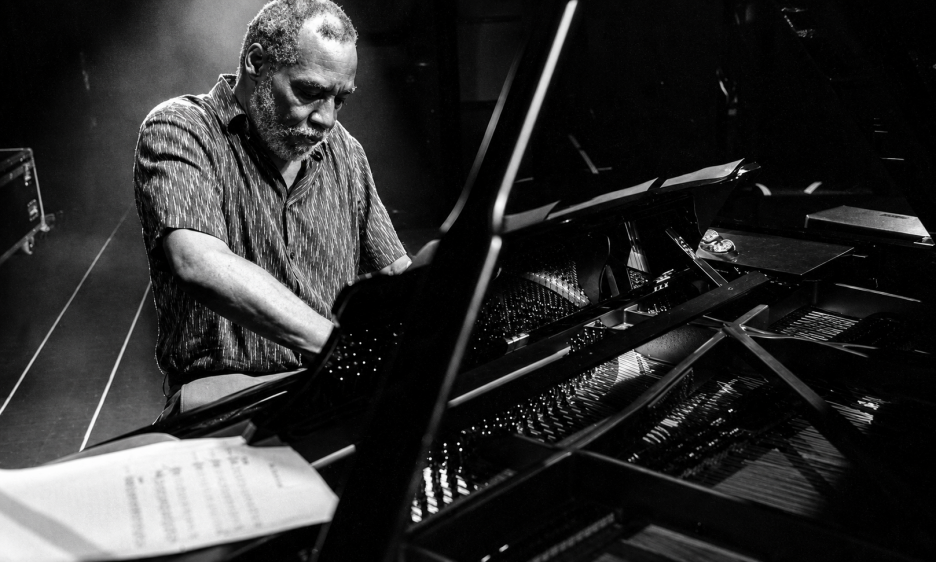
Courtesy Michel Vasset

This is probably in the top three or four sessions I’ve been involved with, maybe it’s because it came out of such a struggle for me. Listening to it, it’s like, 'Well, yeah, you can still create.'
—Donald Brown
All About Jazz: There is really a lot in the new record. It's essentially a double album and full of variety.
Donald Brown: Yeah, I probably shouldn't have done so much because I'm having problems with my hands. I can't use my right hand, and it's difficult to write with it. Luckily, I had Emily Mathis to help me write out the parts, but we did pretty much all of it on FaceTime, and that made it take more time. Throughout I was having this kind of pain and discomfort in my hands, to the point that I kept thinking about giving up on the whole thing. My wife encouraged me to keep going, and a few friends like Scott Moore. I originally did two songs, and after Scott kept saying, "Man, y'all are gonna make it a whole album," I kept going.
AAJ: Where did you start?
DB: Originally, I wrote three songs: a song for Beauford's mother, a song for James Baldwin, and one called "A Five Dollar Blues for Beauford Delaney." After I decided to try to make a record, I knew I didn't have the time to write enough material. The thing that made the most sense was, I had great players on the record and great composers, so I asked anyone who had a song they wanted to submit to send it to me.
AAJ: I notice that fellow Memphis musician Marcel Holman is in there...
DB: Marcel Holman—well, we go back to 1972 or something and have played together so much. I was really knocked out by the piece he came up with. Then Taber Gable had a song he had recorded earlier, but he said it was a tribute to Beauford Delaney. At the last minute I convinced my son Keith Brown to write something, and he came up with what he did at the last minute. The thing is, I was trying to make sure there was a thread going through not just the titles, but I felt the music reflected different periods of Beauford's life, as well as the music he probably heard, and even into the futuristic stuff like Margherita Fava's piece. Taber's and Will Boyd's pieces are more modern jazz. So there was a balance there. I definitely felt there had to be a blues presence. The piece for his mother I heard as a little bit more ethereal, trying to capture her getting up early in the morning, the twilight of the day. And, just thinking, you know, having to be this strong Black woman too... I'm not even sure if Beauford Delaney had come out, you know, as gay at the time, but, but just being Black in this area, Knoxville and surrounding areas, it had to be a struggle. There was a race war that took place.
I got to read some of his letters. Chris Durman (from the University of Tennessee George F. DeVine Library) loaned me a book that was written about him. The pictures really helped shape the music a lot.
AAJ: On the track "A Letter from James Baldwin"—how did you come up with that title and work the music around that?
DB: Well, like most music I've composed over the years, I usually have a title first and then try to paint the music around that title from what I'm envisioning. I felt there was a certain era in the music that needed to be captured. The introduction, to me, really sets the stage for what's to come. This, to me, is really beautiful and in a major key of sorts, but when the real main melody comes in, it's more serious. It's more of a minor sound, but it's still trying to capture the beauty from pictures of James Baldwin and the little I read of his poetry or his books. I feel there were definitely a lot of trials and tribulations he experienced. It was interesting that I saw James Baldwin once, and I wish I had the technology that they have today, because I'm introverted by nature, but I've never been shy about going up to people and introducing myself. There was this club in New York called Mikell's that, when we were on the road with Art Blakey, was like our home base. But this particular time, when the Marsalis group was playing there, I went to hear them, and I look in the club and all of a sudden I see this young, short Black guy come in, and I realize it was James Baldwin. It wasn't until probably the last 15 to 20 years that I made the connection that the club, Mikell's, where we were playing, was run by James Baldwin's brother. There's a documentary that we did with Art Blakey that I posted on YouTube. It shows the band in transition, us going from Wynton and Branford leaving the band to when Wallace Roney and Kenny Garrett joined the band. There's a scene of us down in the basement of the club, and Wallace and Art and I are talking and joking around and stuff. When I look at the quick picture of his brother, you can really see the resemblance. But otherwise, for years I never knew why James Baldwin was coming in there.
AAJ: One of the things I love about this record is that it is so Knoxville. You've got a lot of local people on it, all the way from Mimi Terry to Mark Boling to Greg Tardy, Will Boyd, Taber Gable, Margherita Fava and so many others. How were those sessions?
DB: We did it in—one day, maybe two days. But I'm glad to hear you say that, because that was the thing. Like I said, before I accepted anybody's songs, I just wanted to make sure it fit the soundscape in terms of capturing what I thought of Knoxville in the past and then, like I said, the future. I wish my son Keith had been here.
But otherwise, like you say, man, to have Mimi on it, all the way up to Taber, Greg. That's why I put Knoxville in the title, because I'm hoping it's something 60 years from now musicians on the scene can see as a gift to Knoxville, representing the past and the present of what the musicians were on the scene at the time. And Margherita—like I say, Emily Mathis helping me with the charts, Margherita helping me play some of the parts at my house. I was blown away with her as well as Mimi, because that intro to "Soundtrack for Beauford's Mom Delia" I could play, but I didn't know how to write it out. Later I found out recently from Geoffrey Keezer that Holly Moriarity was one of his students. He sent me this e-mail all excited about the record, and he told me he couldn't figure out the time signature for the intro. He said Holly figured it out—it's in 9/4. So I'm going to get Margherita to write it out for me. The thing was, I just taught it to her, and she had it memorized. Then I taught Mimi it too, so Mimi's doubling it on synthesizer. It was kind of a rough period for me mentally and physically, because my physical health affects me mentally and vice versa. My confidence in myself was kind of low because I'm not writing a lot, and I'm not playing, other than playing left-hand synth bass, and that's not much of a thrill for me. But just to see the musicians rally around me, with nobody looking at their clock, and nobody asking about the money—because I could never pay these guys what they were worth—that meant a lot.
So that was probably the most touching and moving part for me in being involved with this. And Chris Durman is a sweetheart; he was really supportive, and so were the staff at UT. But yeah, the musicians. I'm thinking about the city of Knoxville, but I'm thinking about the musicians as well. Hopefully it's something that generations from now, when they hear the music, they get an idea. Man, we had some really bad musicians on the scene at that time. So that's what really brought the joy to me in doing it—this record.
AAJ: I'm glad you brought up "Soundtrack for Beauford's Mom Delia" song. That's one of my favorite compositions of yours, period. It has so many different things going on melodically. How do you feel about that as a finished piece?
DB: You know, I love it. Sometimes—there's a pop side to me as a composer, and I obviously listen to a lot of world music and Latin music, so it came pretty easy for me. Hopefully the melody sounds pretty to the average listener's ears. To me there's a story there, and you can easily envision words being put to the melody. Geoffrey Keezer told me it's his favorite song and I've heard quite a few people tell me that. So yeah, it's a good feeling. When I tell people it's probably in the top three or four sessions I've been involved with, maybe it's because it came out of such a struggle for me. Listening to it, it's like, "Well, yeah, you can still create."
AAJ: Another favorite is "A Five Dollar Blues for Beauford Delaney," and there are so many things I love about that one. First of all, the parts are really great, and the drumming—I guess that's Ken Brown on there—he's just swinging so hard on it. Then you've got all these spoken things that sound like they were improvised, and they're really something else.
DB: Well, I love it because I love the blues. I was trying to capture a Dixieland vibe for the first part. You can hear Kenny playing almost a secondline thing, and then it evolves into a juke joint kind of blues, and then a taste of, well, not modern blues, but something beyond a juke joint sound. I played a lot of those kinds of places growing up in Memphis, so I know what that vibe is like. For me it was fine. You've probably heard some of my other records where I'm doing some spoken word or BSing around. You know Scott who talks on that one—do you know Scott Moore? If you look in the dictionary under "redneck," you'll see Scott's picture there. And you're talking about one of the most soulful, giving people. He loves music. He got to play some r&b. He's about three years older than me or something, so he grew up around Knoxville and Johnson City and played in r&b bands.
AAJ: Yeah. I think it turned out great, and it's a real adventure. Listening from start to finish, I feel like I've gone on an adventure, like a Beauford Delaney painting. It's very impressionistic and enjoyable. What was your takeaway about Beauford Delaney after doing this project?
DB: Well, he was a deep and virtuous soul. From the pictures, even the photos I saw of him with his mother and kids when they were young, I got an idea of the family and of him. He must have been pretty charismatic, in the sense that I later found out he had friends like Count Basie and Lena Horne, and there were some other major celebrities out there. You ask yourself, how did he meet them, and what made him fascinating to them, to take him into their world? It sounds like that's what he wanted; he drew people around him. I get the impression that his art was almost an afterthought—not that he didn't take it seriously, but it seemed like something he could just do. It was like breathing; it came so easy for him. Just to see how he was embraced by the French people tells me he was a special kind of soul. I can't even remember to what degree he was educated, but between his personality and his art, it took him a lot of places.
About Donald Brown

Tags
PREVIOUS / NEXT

Become a Sustaining Member

Since 1995, All About Jazz has championed jazz as an art form and supported the musicians who create it. Over three decades, it has grown into one of the world's leading jazz resources, serving hundreds of thousands of readers, musicians, presenters and industry professionals each month.
Help Build the Future of All About Jazz
Your support helps us continue building All About Jazz for the next generation—expanding our editorial coverage, preserving jazz history, developing new community features and creating better ways to discover the music and the people behind it.
Become a sustaining member for as little as $20 per year and you'll immediately enjoy an ad-free experience along with access to subscriber features and future articles for a full year.
Together, we're not simply sustaining All About Jazz—we're building its future. Thank you for being part of the journey.