Home » Jazz Articles » Album Review » Bill Evans: At The BBC 1965
Bill Evans: At The BBC 1965

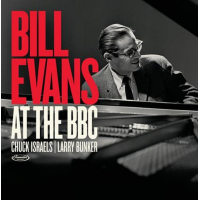
The BBC session itself remains available on YouTube—some footage even colorized. It was filmed at the BBC Television Theatre in Shepherd's Bush, London, while the trio was in residence at Ronnie Scott's Club. The broadcast formed part of Jazz 625, the BBC's groundbreaking series that featured artists such as Clark Terry, Duke Ellington, Art Farmer, Dave Brubeck, Art Blakey, The Modern Jazz Quartet, Thelonious Monk, Erroll Garner and Dizzy Gillespie}. Hosted with improviser-friendly wit by Humphrey Lyttelton, the program was recorded on 35mm film and split into two half-hour segments. The studio atmosphere was hushed and reverential.
"We were damn near perfect at the BBC," Chuck Israels remembered. "We were playing music that was deeply familiar, which was freeing and comforting." He explained that the trio's repertoire included about 25 to 30 pieces performed nightly, offering them full confidence in their interplay.
By 1965, Evans had completely internalized the harmonic vocabulary of Sunday at the Village Vanguard (Riverside, 1961). Here, though, he refines it into something leaner and more classical in poise. His left-hand voicings remain firm and distinctive, yet his phrasing has become more decisive and less rhapsodic than in his early 1960s work.
The BBC versions of "My Foolish Heart" and "Nardis" are revelations. In the former, Evans shapes the melody in overlapping, half-whispered lines that convey both fragility and control, underpinned by harmonies that feel inevitable yet never formulaic. "Nardis," by contrast, breathes more freely than the powerful Village Vanguard version; the tempo relaxes, allowing the minor key color to shimmer, with Evans tracing descending inner voices as Israels shadows each harmonic shift like an echo.
This was Evans's second working trio, they recorded the Trio '65 sessions for Verve earlier that year. In the notes to the BBC album, Israels confessed that he was not close to Evans personally—he feared Evans's addiction and isolation. Evans, he recalled, spent most of his downtime secluded in his hotel room with his wife Elaine, who struggled with similar demons.
Though often overlooked, and compared unfavourably to Scott LaFaro, Israels emerges here as a profoundly sensitive partner, his bass lines balancing propulsion and melodic grace. In "Re: Person I Knew" and "Israel," he sustains the trio's contrapuntal equilibrium with remarkable clarity. Larry Bunker, for his part, brings nuance: his brushwork on ballads such as "My Foolish Heart" and "How Deep Is the Ocean?" He imparts a muted, nocturnal shimmer that still feels startlingly modern more than fifty years later.
"How My Heart Sings" and "Who Can I Turn To?" were both drawn from the trio's recent Verve album. Evans was fond of the Anthony Newley song, crafting space for Israels' bass voice within its shape. "My Foolish Heart," whose lyrical message surely resonated with Evans, is played with unguarded sincerity—the gentleness that permeates the performance is quintessential Evans.
The British pianist Jamie Cullum contributes insightful liner notes situating the recording within Evans's wider career. James Pearson, artistic director of Ronnie Scott's Club, describes the logistical challenges of sourcing a Steinway piano for Evans's club residency.
Above all, this is a trio that rewards careful listening. With Bill Evans, less truly is more.
Track Listing
Set 1: Intro by Humphrey Lyttelton into Five (Theme); Elsa; Summertime; Come Rain or Come Shine; My Foolish Heart; Re: Person I Knew; Israel; Five (Theme). Set 2: Intro by Humphrey Lyttelton Into Five (Theme); How My Heart Sings; Nardis; Who Can I Turn To?; Someday My Prince Will Come; How Deep Is the Ocean?; Waltz for Debby; Five (Closing Theme).
Personnel


Album information
Title: At the BBC | Year Released: 2026 | Record Label: Elemental Music
About Bill Evans
Tags
PREVIOUS / NEXT

Become a Sustaining Member

Since 1995, All About Jazz has championed jazz as an art form and supported the musicians who create it. Over three decades, it has grown into one of the world's leading jazz resources, serving hundreds of thousands of readers, musicians, presenters and industry professionals each month.
Help Build the Future of All About Jazz
Your support helps us continue building All About Jazz for the next generation—expanding our editorial coverage, preserving jazz history, developing new community features and creating better ways to discover the music and the people behind it.
Become a sustaining member for as little as $20 per year and you'll immediately enjoy an ad-free experience along with access to subscriber features and future articles for a full year.
Together, we're not simply sustaining All About Jazz—we're building its future. Thank you for being part of the journey.