Home » Jazz Articles » Interview » Ava Preston And Moises Borges Play And Sing Across Borders
Ava Preston And Moises Borges Play And Sing Across Borders
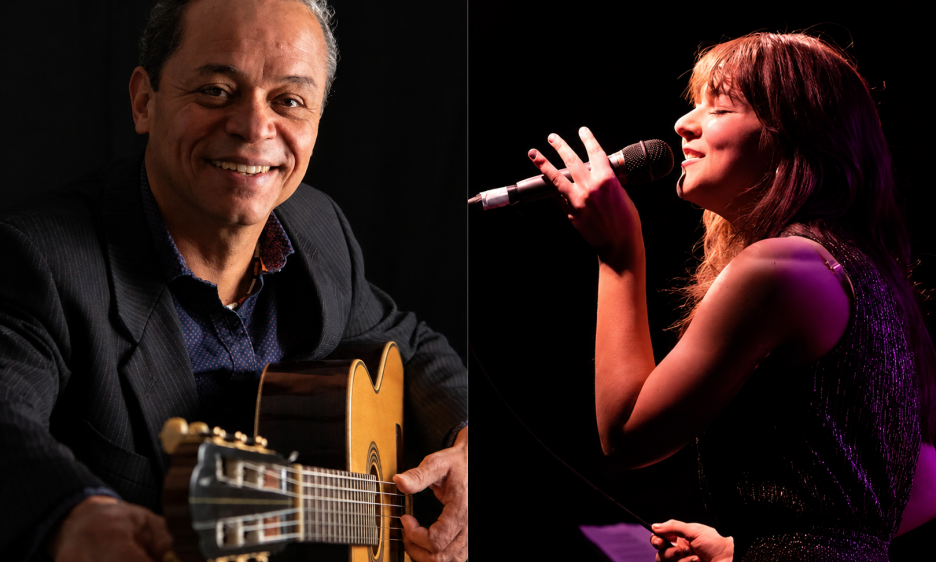
What I love about music and about Brazilian music and about jazz in general: there's so much rhythm, there's so much language, but it can always transform into something else too.
—Ava Preston
Though Preston was just 21 when this interview was conducted, the duo had been together for more than six years, honing a distinctive musical personality and building a loyal and grateful audience. In advance of a series of concerts in northeast Ohio, Borges, from his home in Cleveland, and Preston, from hers in New York City, traced the trajectory of their collaboration on a joint video call.
All About Jazz: How did the two of you come together in this musical partnership that's been going on for a couple of years right now?
Moises Borges: Yes, probably four years, right, Ava?
Ava Preston: Yeah, I think maybe even longer because it was probably a year before COVID, right?
MB: That's right. I was practicing guitar with a friend near a place where Ava was performing with a band. After the top practice session, we both got hungry, and I asked him, Is there any place around here with live music? He said, yes, let's go to this place, and then we went there for dinner. And there she was singing. I was so like, Wow, this girl can do it! Really nice. After she finished singing, we talked and realized that we could actually work on something together. And I think I knew some of her friends and that's how we started getting connected. Ava has more details on that. What do you remember about it, Ava?
AP: I was at a restaurant or an outdoor concert venue. I remember I was playing a gig and, yeah, we had some mutual friends, and they introduced me to you. And then we started just jamming together for bossa nova things. You called me for a couple of shows, and then I remember us getting very locked in when COVID hit and we started doing all those outdoor concerts. You taught me a lot of the lesser known bossa nova standards. I would sing them in English, and you would sing them in Portuguese, and it would just be a great time. I mean, I'd be soloing, you'd be soloing. We'd do the "mouth trumpet" thing. I remember that during COVID, we did so many outdoor concerts.
MB: That was really nice. And that summer, during COVID, also there was one thing: all the musicians were available. So we could have any band we want. That was nice.
AAJ: How did you rehearse during COVID? Did you do it via Zoom or did you just wing it on the stand when you had a live gig?
AP: I don't remember rehearsing, do you? I think maybe when we did gigs right before COVID, we may have rehearsed a couple times. But during it, during the outdoor concert season, you'd send me a couple links for songs and then I'd show up and we'd just kind of wing it on the gig. It'd be so much fun. It would change every time. And then we settled on the forms that we liked.
MB: It was an informal concert. We called it the Front Lawn Concert Series. It was pretty much like a community event because the host of the house would get together with a couple of neighbors to put a little money down and invite other friends and neighbors where everybody's supposed to tip in. And that's how we did it. We would invite some musicians and go to the front lawns and ask them to put their lawn chairs six feet apart from each other. We'd bring a tip jar, and that was pretty much how it happened.
Probably during the first summer of COVID, Dylan [Moffit], the drummer that played with me, said we played about 70 gigs the first summer of COVID and about 80 the second summer. All we needed was a sunny day because everybody wants live music. Then the TV station started coming in and showing the community what we were doing, which was great because of two things. Other musicians also started doing it, which was generating income, especially for musicians—they are the first ones to get fired when there's a crisis. And secondly, we were bringing joy to the neighborhoods because when you play in neighborhoods, many people that do not go to jazz concerts could see the shows. Ladies with an IV would be brought out by a caregiver on and sit on their front lawn, and next door, another woman comes out with six kids behind her trying to see what's going on.
AP: What I really liked about that is that it would connect everyone. I love doing community engagement projects like that. It was a really fun thing.
MB: On the other hand, neighbors could hang out, because usually, sometimes they don't. They don't even know their neighbors. So we helped them to meet each other. That was good.
AAJ: No one should feel nostalgia for the COVID years, Still, it seems that for many reasons, a lot of creativity and a lot of wonderful things have come out of that dark interval. You mentioned how people came together during that time and had positive experiences. Once restrictions eased, were you approached by anybody who came to a performance of yours and said, "You know, I heard you for the first time on my neighbor's front lawn and you're so wonderful. I'm happy to hear you again." Did anybody remember you and thank you for those performances?
AP: I think I do remember a couple people saying, "I remember when you were at our house party or "It's nice to hear you in the club at BLU Jazz+ or at Bop Stop. Yeah, it happened a couple of times.
AAJ: Oh that's great. And did you have bands then, or did the two of you just do concerts in a duo setting because you couldn't rehearse with a rhythm section?
AP: I remember we'd do a lot of duo gigs, at least the ones that I was on, but there were band gigs too, it just depended on the day.
MB: The band already played with me, so they knew the drill, and it was easy to work with Ava because she had such a facility. She easily learns the songs and the lyrics and improvises over it; she just grabs it and throws back her way. So that made it easy because the band could play anything I was playing. They were familiar with the tunes, otherwise they would learn on the fly. And Ava pretty much just had to get aware of a couple of songs that she was not aware of yet. We use the bossa nova songs that have an English version. So that makes it easy for the American audience to, you know, even sing along. Like "The Girl From Ipanema," for example. Most of the Americans will be able to sing along with the English lyrics.
AAJ: Ms. Preston, you probably learned a lot of Brazilian material, and the Brazilian Portuguese language is a most beautiful language to sing in. Still, there's a particular kind of rhythmic approach and over-the-bar approach that can be subtle, but necessary in this music. Do you find you've now gained a little more ease and facility with that kind of rhythmic conception? And what are some of your favorite new songs that Senhor Borges introduced you to that you really love to sing that maybe you didn't know before?
AP: Oh, I think definitely one of my favorites to sing is "Manha de Carnaval," ("A Day Tn The Life Of A Fool." I love that one so much. Moises knows that's my favorite one, or one of mine at least, but I also like "So Danço Samba." "Summer Samba" is very cool, and then, "No More Blues" and "Triste."
In terms of the rhythmic approaches, a lot of what I did in Brazilian music was very clavé-based, the basic rhythms. Then when I started working with Moises, I would hear from his singing, and from his improvisation both on guitar and vocally, a lot of that over-the—bar motion, a lot of laying back. It wasn't extremely on the beat or very formulaic, and it's more of a feeling where you need to find what works in the moment. It's not always going to be, "This works." It can completely transform into something else, which is what I love about music and about Brazilian music and about jazz in general. There's so much rhythm, there's so much language, but it can always transform into something else too.
AAJ: Have you sung forró or the Nordestinho kind of patter songs with the very fast, very precise syllabic stuff that just rushes by?
MB: Oh, I don't think that we've done that together. Yeah, there's only one song that I bring in that, which is "Cora Coralina." The original rhythm of the recording actually has four rhythms: it has forró, samba, coco or maracatú and also samba de breque, which is a slightly different accent of samba. We recorded with four different rhythms, and we did change the instrumentation accordingly when we changed the rhythm, but for live performances, the percussionists also do that. They change the percussion and everything in the rhythm throughout the song. But that one song, I do not perform on a show with Ava because it does have some parts that are very fast Portuguese, and we do not have an English translation that makes sense for that.
AAJ: Ms. Preston, are you singing in Portuguese now?
AP: I do, but not with Moises, because he sings the Portuguese. I sing the English.
AAJ: You must have had to dabble in Brazilian music when you were at Juilliard. Did your experience with Moises help prepare you for that?
AP: Yes, definitely. There was an audition requirement for Juilliard where we would have to learn a song from the Brazilian tradition in Portuguese. [to Borges] I think I remember asking you what the lyric of "The Influence of Jazz" ["Influência do Jazz"] meant. I remember asking you, and you were telling me about how it's about the importance of the samba or the importance of Brazilian music. And it was a very deep song.
When I started doing some studies at Juilliard and they were bringing up Brazilian music and all these different rhythms, I remembered learning these things from Moises, and it was great to come in with that basis of knowledge already. It made it a lot more fun, too, when we'd be asked to sing in Portuguese or when we'd be asked to do a sort of rhythm that I was familiar with and maybe didn't know by name but was very comfortable with because I've been doing it for so long with Moises. But yeah, I just had a blast, and it was nice to talk about these things in class too. We even had a discussion about capoeira once. And I knew the history of this because you taught a class on capoeira in my high school.
MB: Oh, that's right. That's right.
AP: So I learned about Brazilian culture as well, and I've learned so much about that from you and about Bahia and about your family. It was great to come into Juilliard with that deep level of knowledge already and then build and expand upon that, because there's so many things that I still don't know.
MB: That song, "The Influence of Jazz," it's a very interesting one, because it's a song by Carlos Lyra. At that time, they were building the city of Brasilia, which is now the capital. There was a lot of innovation in the culture. People were happy and getting new technology. That is reflected in the bossa nova, which was a more elaborate type of music that reflected the mindset of the Brazilians through the '60s. There was an incentive from the government to modernize.
Carlos Lyra, along with other composers and authors, felt that something was being lost and disconnected from the culture, because the bossa nova composers were writing songs about modernity, about the city, the urban life, and the beaches and beautiful things, but the reality of the rest of Brazil was not being translated because there was also a lot of migration, a lot of turmoil in politics, and there was a lot of poverty, and [the bossa nova composers] did not find a way to actually put that reality in the music because that music, which was just painting the beautiful parts of the Brazilian melodies, and everything blended with jazz. So he wrote that song, "The Influence of Jazz" using jazz rhythms to criticize jazz influence on Brazilian music using jazz-style chord progressions with extensions on the chords. That was one of the songs that actually introduced Lyra to new audiences.
AAJ: Ms. Preston, a lot has happened from your spring break until this moment. Can you tell us about it a little bit?
AP: Yes, I'm very honored and humbled to announce that I won the 2026 Ella Fitzgerald competition. That was an amazing experience.
It's always such an honor to perform the work of Ella Fitzgerald, and I did my own arrangements for this competition. I submitted these arrangements of Gershwin tunes, because they were celebrating George and Ira Gershwin this year. I sort of made these arrangements that I was hearing in my head for these songs, asking myself, what if I do something different with these tunes, like taking a ballad like "I've Got A Crush On You" and making it a bossa. I put in a little bit of rhythm; it's not quite a samba because it's too slow to be a samba. I made it really fast and put a bunch of hits in there. I made it totally like hard-driving swing thing. For "How Long Has This Been Going On?" I left that as it was originally performed, a ballad with a little solo in the middle and then singing the head or the bridge out.
I had an excellent experience. I was able to perform at Blues Alley for the award ceremony. I was able to perform with Sachal Vasandani, and I love him so much, I appreciate his artistry so much. I love listening to his music, and working with him was such an incredible experience.
And I learned so much. We did a whole press conference talking about the history of Ella's music and how much she brings to the world of jazz and the world of music in general and how much her voice has transcended—I don't want to say the ravages of time—her voice has transcended many, many years and is still relevant. We had about an hour-long press conference on it and that was very informative, learning from Sachal, learning from the owner, Harry Schnipper [of Blues Alley]. It was just an incredible experience, and I'm so honored. And I also graduated from Juilliard in May. So it was a big, it was a big year for me.
AAJ: And you're all of, what, like 17 years old? [laughs]
AP: I'm 21.
AAJ: So you can actually buy a drink in the places where you have a gig.
AP: Yes. Now I can buy a drink in the bars that I perform in.
AAJ: Are you coming back home to Cleveland or do you plan to stay in New York?
AP: I'm staying in New York and trying to book some more shows for the fall. Trying to write the perfect booking email is my new challenge. I always want to improve from the last booking email.
AAJ: Are you self booking?
AP: Yeah. As singers, we're very rarely called as sidemen. So a lot of it is via social media and a lot of it is also, I guess, who you know. The other side of it is that I'm always the bandleader. So I have to have the responsibility of wearing all these different hats.
AAJ: Fun, huh?
AP: Yep, but you know, it's definitely good education though. It's been actually really fun learning all this—or not even learning all this stuff, but starting over, because I was doing so much of it in Ohio. I mean, I was booking my own gigs, maybe 80 to 100 gigs a year.
AAJ: This was when you were a teenager, right?
AP: Yeah, I was a teenager.
AAJ: You were in high school when you were doing this, right?
AP: Yeah, but here there's so many people. There's a lot of talent. There's a lot of clubs too, but it's different to start from a place where nobody really knows you. So yeah, I've had to forge my own thing again.
AAJ: Whether in New York or in Cleveland, you two have a special musical chemistry. It was wonderful to be with you today. Thanks so much.
MB: Thank you. It was nice that you could have some time to host us.
AP: Thank you for having us.
About Moises Borges

Tags
PREVIOUS / NEXT


Become a Sustaining Member

Since 1995, All About Jazz has championed jazz as an art form and supported the musicians who create it. Over three decades, it has grown into one of the world's leading jazz resources, serving hundreds of thousands of readers, musicians, presenters and industry professionals each month.
Help Build the Future of All About Jazz
Your support helps us continue building All About Jazz for the next generation—expanding our editorial coverage, preserving jazz history, developing new community features and creating better ways to discover the music and the people behind it.
Become a sustaining member for as little as $20 per year and you'll immediately enjoy an ad-free experience along with access to subscriber features and future articles for a full year.
Together, we're not simply sustaining All About Jazz—we're building its future. Thank you for being part of the journey.