Home » Jazz Articles » Catching Up With » Tyler Soifer: The Art of Audio
Tyler Soifer: The Art of Audio

Courtesy Tyler Soifer
After long contemplation of the masterful performance, a thought lingered; the audio design was simple, subtle, and effective. In what ways did the sound design achieve clarity and even coverage without drawing attention to itself or overpowering the performance?
Tyler Soifer, who managed the tour's audio technology, provided insight into the technical and artistic decisions behind the system.
All About Jazz: The production demonstrates a careful balance between amplification and reinforcement, with the technology enhancing natural sound of the performers. What is your approach to maintaining that balance, and how do you adapt it as the tour moves between venues with different acoustics and technical requirements?
Tyler Soifer: My approach is to ensure everyone's notes are heard, emphasizing the detail. In a situation like the one at The McCarter—an acoustic band in a concert hall—I took the loudest source, drums, and tried to bring all the other instruments to an equal volume so they could be heard over the drums—while maintaining a pleasurable tone. My process for doing this in a different setting every day starts with taking measurements of the PA and room and trying to make the PA sound as "flat" as possible for consistency.
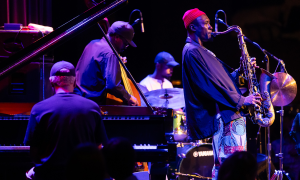
AAJ: From a house-left seat in the fifth row, the microphone placement was noticeable, including a shared microphone positioned between the saxophone and piano and a dedicated microphone for the lead saxophonist. The resulting mix preserved not only the instruments' balance but also the subtle ambient sounds of the performance—breathing, footwork, string resonance, and natural stage bleed—that contribute to the immediacy of live jazz. Could you describe the microphone strategy behind the production and explain how those choices were intended to capture both musical clarity and the organic character of the performance?
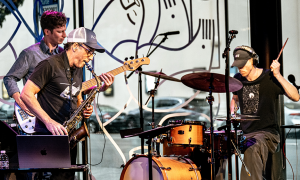
TS: For microphones, pretty much everything on stage gets at least one. Each component of the drum set—bass drum, snare, toms, cymbals)—a DI and a mic on the upright bass, 4 mics on the piano, 2 sax mics, and a flute mic. I do this to ensure I have options for the tone and feel of whatever space I'm in that day.
AAJ: Jazz, particularly the work of John Coltrane, presents unique challenges for sound design through its complex harmonic relationships, spontaneous improvisation, shifting tempos and keys, and the ways instruments respond to changing performance environments. How did these musical characteristics shape the design of the audio system, and what level of familiarity with the score and performance practice was necessary before the tour began?
TS: Luckily I used to play the saxophone, so I knew Coltrane's music well. I have also been listening to and working with jazz for over 20 years, which plays a big part in knowing how to balance the microphones. I don't think knowing the music would necessarily make or break someone's ability to mix this material, but it does help!
AAJ: Automated mixing has become increasingly common in live sound production, yet many engineers continue to prefer a more active approach. For this production, how much of the mix is predetermined, and how much relies on continuous real-time adjustments during the performance?
TS: Non-stop futzing and fiddling!
Overall, audio engineers concur that mixing jazz presents a distinct set of challenges because it is a genre which incorporates nuance, spontaneity, and dynamic interaction rather than consistency and volume. Unlike many contemporary genres that rely on fixed arrangements, backing tracks, and tightly controlled dynamics, jazz performances are built around subtle shifts in tempo and intensity, and constant musical dialogue among the performers.
Engineers must preserve the natural timbre of acoustic instruments while capturing delicate details such as breath, articulation, and room ambience without sacrificing clarity. Truly, the goal is not to amplify the instruments, but to reinforce it so transparently that the audience experiences the performance as if no technology were present at all.
 FOLLOW Kitty Kalriess
and get notified whenever a new article published.
FOLLOW Kitty Kalriess
and get notified whenever a new article published.
Collector and Selector of Soul, Jazz, World Music, and More
About John Coltrane

Tags
PREVIOUS / NEXT


Become a Sustaining Member

Since 1995, All About Jazz has championed jazz as an art form and supported the musicians who create it. Over three decades, it has grown into one of the world's leading jazz resources, serving hundreds of thousands of readers, musicians, presenters and industry professionals each month.
Help Build the Future of All About Jazz
Your support helps us continue building All About Jazz for the next generation—expanding our editorial coverage, preserving jazz history, developing new community features and creating better ways to discover the music and the people behind it.
Become a sustaining member for as little as $20 per year and you'll immediately enjoy an ad-free experience along with access to subscriber features and future articles for a full year.
Together, we're not simply sustaining All About Jazz—we're building its future. Thank you for being part of the journey.