Home » Jazz Articles » Live Review » Tallinn Music Week 2026
Tallinn Music Week 2026
Courtesy Tallinn Music Week

Various Venues
April 9-12 2026
It is desired to prepare in advance. There are so many artists performing at Tallinn Music Week, so many venues taken over by record labels, promoters and/or festivals, that an attendee's valuable shape-shifting time will be preserved wisely by giving as many acts an advance Bandcamp spin as possible. Over several years of visiting TMW, it becomes possible to anticipate which stages will offer the most exciting sounds, based on the personal taste of the harried consumer. Therefore, we might be more likely to descend on spaces devoted to jazz, global-folk, electronics, weirdo rock or moderne classical, thus avoiding the more mainstream choices involving pop or diluted soul, funk and hip-hop. Each festival-goer can select a personal trajectory that will be like no other, over these three intense nights of performance (the daytimes feature a packed conference programme).
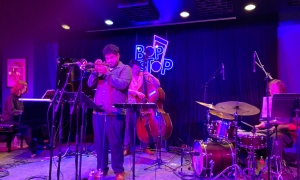
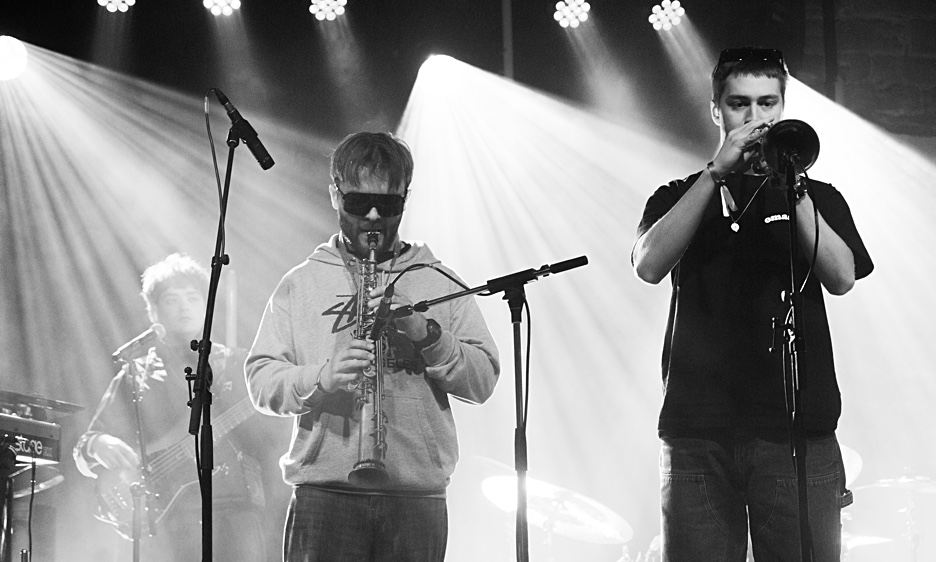
This year there were two nights of Jazz Stage activity (run by Jazz Estonia), in the Fotografiska gallery ground floor café area, doubling the usual quota. An abundance of indigenous Estonian bands were in place, but as is often the case, some of the most arresting outfits arrived from elsewhere. The youthful Kraków quintet Omasta literally climaxed on the middle Friday night, as late as the witching hour. Their line-up bristled with trumpet, soprano saxophone, Roland piano, electric bass and drums, in the name of modernised fusion, although not so much to the point of delving deeply into their already-apparent hip-hop side, and even finding room for some acoustic piano solos. Funky runs fled yelping from the horns, those players wearing shades for midnight. At this late hour Fotografiska was still rammed with a crowd. A soprano solo wrestled forth, cracking around its edges, although the drumming sometimes erred towards the leaden, a touch too metronomic. The bass tended to wander more, in an exploratory heat-seeking state. A flute was brandished, and then an extended trumpet solo provided a fitting climax.
Next door at the larger Von Krahl, we were still caught up in the Polish lands, with the foursome of Hajdu Banda, appearing close to the end of the Viljandi Folk Music Festival's presentation. This cross-border combo has been gigging a lot lately, turning up at several festivals, and offering an unusual amalgamation of styles from Poland and Belarus. Now together for five years, their roster of violin, hammered dulcimer, three-row button accordion and large frame drum is relatively idiosyncratic. Hajdu Banda combine folk scholarship with a trouncing dance motion. The dulcimer is very close in nature to the cimbalom, the accordion pumps vigorously, the fiddle frequently flies freely, and this band is also prone to ensemble vocals. The percussionist wears big leather boots, topped off with a Mohican cut (his head, not the boots). The dulcimer player adds deep vocals, complementing the high-voice mobility of the fiddler. The Viljandi session is, of course, one of TMW's essential stop-offs.
Just across the square, Roheline Saal (the Green Room) hosted the Heavy Music Band Battle, where six finalist acts competed for the most weighty status. Your scribe only caught the first band, but felt firmly that Griefgod (already winners in Lithuania, from Vilnius) could not possibly tolerate any significant challengers, with their penchant for using a long, low table as an alternative to stage monitors, with singer and guitarists constantly flexing, hoisting up boots, to howl or bellow their mighty worth, Even at a comparatively healthy volume, they still managed to emanate a terrifying force of irony-loaded pomp-savagery.
Another fine night was provided by the Latvian alternative festival Skaņu Mežs, in tandem with Üle Heli, a less familiar Estonian weekender. From closer to home, the multi-valent folkstress Marja Nuut made something of a return to the festival (another late night set, in the Green Hall), concentrating on her own core music rather than flitting around the perimeters of other projects. Nuut opened her reputation a decade past, via singing and fiddling, but soon began to add heavy looping and advanced electronics to the scheme. She always matches these elements via a natural electroacoustic connection, her manipulations filled with imagination and unpredictability, although still born out of old-song. An upbeat tone grew, voices in the swamp-gurgle, as Nuut set up a deep-bell cycle, then played violin over the top of this, leaving a whirring layer active. There was a 1950s exotica section, with tinkles and flutey sounds, modular synth weebling freely, sweeping and curving. There was also a cimbalom reprise (echoing next door), as a loping, swaying sing-song emerged.
Towards the start of that same evening, the Latvian tone-shaper EIII elected to project explosive get-the-audience-running sonics, initiating a howl-mass of grit accumulation, haunting vibrato surround abounding. EIII observed a deeply bathyspheric crunch, imploded electro-fireworks down in the air-raid shelter, as if slow-motion sirens were set running. He made a graduated glacial fall, an avalanche arrested. Open-spore susurrations led to an actual beat developing, after around 25 minutes, providing a surge of conclusive steps.
In contrast, Erik AlaIooga (from here in Tallinn) represented the older generation, emerging from a tape-looping and splicing background. He makes his own mechanical devices, aiming for perpetual sonic motion, but invariably failing, as his rickety constructions reveal their own working 'minds.' His table of gear is like a public workshop, with overhung pendulums and rotating spindles, crankingly industrial in nature, with a distant factory reverb. Garbed like a steampunker, Alalooga clearly lives his part.
At the other end of the electronics spectrum, the Glitch Please night highlighted current technology purveyors, more rooted in dance music, or possibly abstract ambient sounds. Kiwanoid is a regular at TMW, a local Estonian, and one of its chief architects of creative bleep momentum. This is a techno variant, but more avant in thrust, using an untoward palette of full-crush settings. He layers from one phase into the next, fanning his deck of cards, from trot-pulse to oscillate-state. Its rhythmic inevitability is a powerhouse (or power-horse) force, as gallop stations are attained. It's trap-pissed funk all over, a smattering of micro-filaments flowering out from a tiny Korg console, Kiwanoid choosing a minimal set-up for a monstrous sound. Glitch Please was convened in the new Fonoteek venue, which turns out to be the old (and for over a year, closed-down) Sveta Baar, still with a pretty much unchanged interior.
Back to conceptuals. Oliotronix (an Estonian in Leipzig) kept mobile throughout an improvised set, housed in blue dungarees, tangled up in 8-bit sound-generating tack-ons, and avoiding any table-top inhabitation, preferring to keep down low on the floor, setting off loops, jetting out backing tracks, using voice babble to enhance the chaos. Equipment uncertainty was fed into the set, as a wild-card aspect, courted rather than concealed. Exposed and natural, Oliotronix had a fine way of communicating with the gathered audience circle.
Ratkiller also invited odd performance traits, perhaps a main man (Mihkel Kleis) assisted by his offspring, or perhaps not (maybe they are Ratkiller 'interns'). Anyway, he spent most of the set proceeding to eat a close-miked meal, his cutlery plate-scrapings added to the panorama, producing an experience that wielded rare humour (in this field), surrealism, and jarring disjointedness, as well as sheer electronic musical substance. This was an absurd-profound way to end the festival, as Ratkiller played on until after 1am.
Your scribe also endorses several other acts, ensnared during the weekender: Olev Muska, Alum Alu, Meisterjaan, Almir & Daniel, Regina Mänd and Los Sara Fontan.
As a post-script to TMW, on its final, much quieter day, another festival was already overlapping. Estonian Music Days was just beginning, so your scribe took the tram up to the MUBA venue (Tallinn College Of Music & Ballet), to check out a matinée with the M4gnet String Quartet, only formed five years ago, and here performing works by five composers, three of them world premieres.
The opening piece by Jüri Reinvere moved from high swipes to a manic, charged brutality. Anna-Margret Noorhani's "Three Pieces For String Quartet" was even more rugged, featuring a joint bow descent, raw and powerful. Smaller frayings followed, making low churns and turnings, pulling back into sparseness, with a softly recurring figure over a tonal sustain, swarming into darkness.
"Vestige," by Tatjana Kozlova-Johannes made the quartet sound jointly like a sleepy accordion, faintly breathing and peacefully inclined. A captivating calm ensued. Contrastingly, Madli Marje Gildemann's "Feathered Mirrors" was busily angular, keening with string-cries and sliding, rounded articulations. There was a thin togetherness. An ultra—dynamic force and flourish led to wild gesturing, with an extremity of chattering babble. Finally, Gregor Kulla's "Whatevergirl" featured a small frame drum, balanced on ankles, while a dense clutter was discovered, a vocal panic, agitated and restless. Despite such tension, this was the least engaging piece of the five.
Tags
PREVIOUS / NEXT


Become a Sustaining Member

Since 1995, All About Jazz has championed jazz as an art form and supported the musicians who create it. Over three decades, it has grown into one of the world's leading jazz resources, serving hundreds of thousands of readers, musicians, presenters and industry professionals each month.
Help Build the Future of All About Jazz
Your support helps us continue building All About Jazz for the next generation—expanding our editorial coverage, preserving jazz history, developing new community features and creating better ways to discover the music and the people behind it.
Become a sustaining member for as little as $20 per year and you'll immediately enjoy an ad-free experience along with access to subscriber features and future articles for a full year.
Together, we're not simply sustaining All About Jazz—we're building its future. Thank you for being part of the journey.