Home » Jazz Articles » Live Review » Sam Newsome & Lucian Ban: The Romanian-American Jazz Sui...
Sam Newsome & Lucian Ban: The Romanian-American Jazz Suite at the Jazz Standard, NYC

The Jazz Standard
New York City, New York
July 1, 2008
The genesis of The Romanian-American Jazz Suite goes back to 2004 when pianist Lucian Ban, whose roots are Romanian and American soprano saxophonist Sam Newsome received the CEC Artslink Award, which supports cross-cultural projects between artists in the United States, Central Europe, Russia and Eurasia.
Ban lent Newsome a collection by Iosif Hertea of Romanian carols, from which Newsome found both melodies to arrange and a musical world to explore. The result was a suite of four pieces—"Prelude," "Colinda," "Bucharest Part One" and "Bucharest Part Two" that became the center piece of a tour that included the 2004 Bucharest International Jazz Festival and the 2004 Brasov Jazz Festival.
The music got the attention of the American Embassy in Romania, which helped to extend the tour to ten cities in Romania, making this the first time American jazz musicians had toured Romania for this kind of cultural exchange.
Then, in 2006, Newsome received a grant from a program called "Meet The Composer," which enabled the band to return to Romania, but with the suite now extended to seven movements. The recording of the CD was the ultimate effect of the Romanian Cultural Institute in New York (RCINY) sponsoring a week of performances in NYC in April of 2007.
This gig at the Jazz Standard, sponsored in part by RCINY, thus was a CD release party for a project with a significant history and cultural importance.
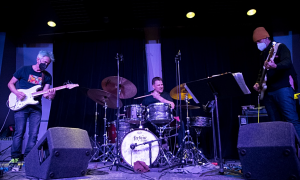
On this Tuesday night, the club was mostly filled, and one could hear much accented English mixing with the smell of American barbecue. The band present was the one on the recording: Newsome, Ban, baritone saxophonist Alex Harding (a long-time partner of Ban's, see The Tuba Project, (CIMP, 2006)), guitarist Sorin Romanescu, bassist Arthur Balogh and drummer Willard Dyson.
The musicological fusion of Romanian folk music and American jazz worked extremely well. There were a number of very heavy grooves set up that had the house swaying. Odd-meter dances were kept lively and pulsating by the close interaction of the bass of the Romanian Balogh and the drums of the American Dyson, who was having some serious fun. Romanian scales set the harmonic context for much of the music, which, when juxtaposed with the jazz soloing aesthetic, produced music that belonged in neither world exclusively.
Newsome was magnificent. Possessing an extraordinary technique that includes circular breathing and a finely-honed harmonic sense, he would let fly with ecstatic streams of notes in one tune, while getting inside the plaintive sounds of a Romanian Christmas carol in another.
The front line was shared with Newsome by Harding, who has an ebullience about him that is infectious. Whether providing harmonic support or belting out an extended solo bordering on the free, Harding's intensity and joy of playing came through loud and clear. Romanescu, using a much cleaner sound than that on the record, also had some fine moments where he caught fire.
Ban, although he is the musical progenitor of this music, rarely soloed, but his comping, and the obvious joy of playing that which represents both his heritage and musical life, solidified the proceedings, allowing everyone else to relax and let go. After an opening arrangement by Newsome, his "Danube Stroll" rocked the house.
The original four-movement "Romanian-American Jazz Suite" ended the set. Moving from the simpler hymns and carols of "Prelude" and "Colinda" through the pulsating rhythms of "Bucharest Part Two," the music brought everyone, regardless of their cultural heritage, together as one.
About Sam Newsome

Tags
PREVIOUS / NEXT


Sam Newsome Concerts
Become a Sustaining Member

Since 1995, All About Jazz has championed jazz as an art form and supported the musicians who create it. Over three decades, it has grown into one of the world's leading jazz resources, serving hundreds of thousands of readers, musicians, presenters and industry professionals each month.
Help Build the Future of All About Jazz
Your support helps us continue building All About Jazz for the next generation—expanding our editorial coverage, preserving jazz history, developing new community features and creating better ways to discover the music and the people behind it.
Become a sustaining member for as little as $20 per year and you'll immediately enjoy an ad-free experience along with access to subscriber features and future articles for a full year.
Together, we're not simply sustaining All About Jazz—we're building its future. Thank you for being part of the journey.