Home » Jazz Articles » Book Review » Rob Hirst: World Is Almost At Peace - A Lifetime of Song...
Rob Hirst: World Is Almost At Peace - A Lifetime of Songwriting for Midnight Oil and More
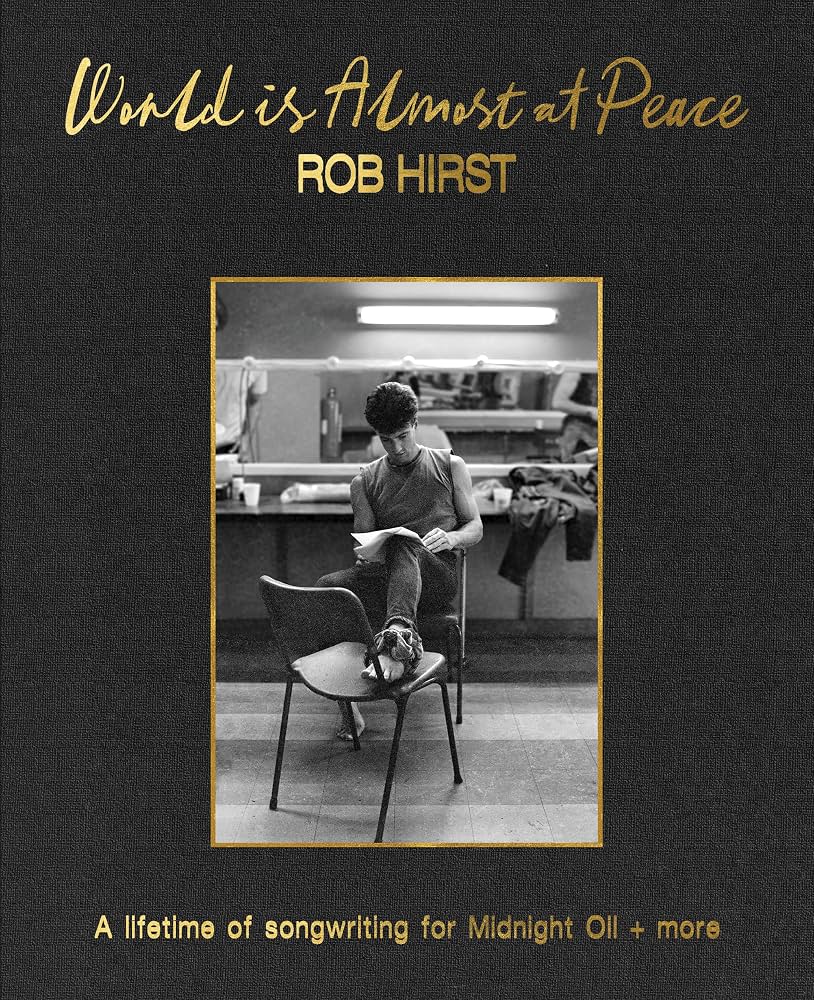 World Is Almost At Peace: A Lifetime of Songwriting for Midnight Oil and More
Rob Hirst
408 Pages
ISBN: 9781923390379
Pantera Press
2026
Rob Hirst's World Is Almost At Peace: A Lifetime of Songwriting for Midnight Oil and More wholly and completely fulfills the concept of a lavish gift item. Yet, not surprisingly, it is hardly a conventional musician autobiography, despite the fact that the book covers the usual territory of the artist's roots and the subsequent progression to commercial success and its attendant recognition.
Instead, the drummer/vocalist/songwriter for Australia's now-defunct Midnight Oil presents lyrics to a plethora of songs he helped write, record and play live. And the cyclical juxtaposition of text in the form of evocative remembrances by the author, as well as those with whom he collaborated over the course of his 50-plus-year career, appears right alongside vintage photographs and replications of memorabilia such as concert posters.
Emerging from this virtual multimedia exhibit is a fully formed portrait not only of the author, but also of the deep and abiding resonance of creativity itself in all its ever-evolving stages. A mere cursory perusal of the four-hundred-plus pages between the hardcovers reveals what a slower and more careful inspection clearly illustrates: the physical design of the book reflects its contents and, in turn, Hirst's artistic versatility.
Flip over the gold-embossed cover, with its glossy raised photo of the author in appropriately intense study, and there is yet another such decoration on the back, picturing the man in kinetic form at his drum kit. And, fittingly, between those embellishments is sheet music for the title song appearing as the endpaper. Taken as one—and designed as such—the graphics are indicative of the efficiency with which Hirst wrote, recorded and performed as a member of his best-known band as well as the other ensembles of which he was a member.
Hirst wasted no words or fillips of melody in songs such as "Dreamworld" any more than he allowed extraneous beats or elements of arrangements in the recordings. And yet the superficially sparse mixes of voices and instruments belie density of execution as well as the fundamental intent of a piece. Take, for instance, Hirst's reminiscence of his father, placed on the page facing the commercial turning point of the Oils, Blue Sky Mining (Columbia, 1990).
As a follow-up to their breakthrough album Diesel and Dust (Columbia, 1987), this seventh album implicitly declared that there was no more room for insularity in the wider world than there was for proselytizing by the band members in their songs or performances. (Lead vocalist Peter Garrett actually served in the House of Representatives from 2004 to 2013.) Consequently, the music reflects a collective self-awareness that comes directly from the individuals in the group. That attribute is not often an infectious element of material or playing and singing; for Midnight Oil that psychic component became the unit's calling card.
Accordingly, poring over the sections devoted to that band's material—"Kosciusko," "Best of Both Worlds"—illuminates the strengths of World Is Almost At Peace to much the same degree. The very presence of "Almost" as a disclaimer in the title suggests the wise approach Hirst brought to his work. Not surprisingly, then, he was diametrically opposed to wasting efforts frivolously, so much so that he devoted time and energy to multiple projects outside the main band.
It was as if Backsliders and Ghostwriters, to name just two, were conceived as means to confront and forestall the long-term effects of racism's petty and mean-spirited attitudes as well as the willful ignorance tearing asunder the environment. Recurring themes in Midnight Oil's work too, these overriding concerns suffused Hirst's involvement in one endeavor or another centered on those movements.
Intentionally or not, these varied enterprises stimulated his imagination rather than depleting his reservoir of ideas. And he applied the same premise over the course of time it took to assemble the materials for this weighty tome. With evocative images of art peppering the pages of lyrics—many handwritten by the composer himself—in rapid succession, one eye-catching insertion follows another. If it is not the photo of a dawn protest blockade, it is a group portrait of The Break (whose song was a soundtrack for the aforementioned sit-in).
The seeming incongruity there is thus a red herring. With a healthy sense of pride a major foundation of all Hirst's activities, no matter the form they took, it is no wonder World Is Almost At Peace is no exception. There is a readily discernible logic to an otherwise unorthodox narrative. And to that end, the ability to turn the pages slowly, stopping at will to become wholly immersed in the content—such as the presence of Sylvia MacCormick's "Painting Of Mum" on page 284—is not so much a luxury as a downright necessity.
This is not necessarily a book to read from start to finish even though many sittings might allow the book to be absorbed as a single piece. It is better perhaps to designate it a proverbial coffee-table book, left out in plain, readily accessible sight, except this is one that transcends pure cosmetics and demands to be pored over in greater or lesser detail whenever time allows.
The cover and internal design by Alissa Dinallo and editing by Casey Mulder only scratch the surface of contributions further recognized through Hirst's acknowledgments. It would be most appropriate to assign the name "masthead page" to the collection of minutiae relevant to publication particulars for World Is Almost At Peace.
A force for musical and cultural change over the course of his history as a public figure, this industrious individual invoked his indomitable spirit once again as he battled cancer during the two-year period he collated all the material that comprises his ultimate offering to the globe. There's a vibrancy emanating from this work that should leave it as a lightning rod of relevance far beyond its necessarily arbitrary timeline of pre-1978 to 2026.
As with so many of Hirst's other efforts on behalf of worthy causes, the book's impact will only grow over the course of time.
 FOLLOW Doug Collette
and get notified whenever a new article published.
DC writes regularly about jazz and blues plus rock and roll, composing reviews of CDs, DVDs, live performances, books and films.
PREVIOUS / NEXT

About Midnight Oil

Tags
Become a Sustaining Member

Since 1995, All About Jazz has championed jazz as an art form and supported the musicians who create it. Over three decades, it has grown into one of the world's leading jazz resources, serving hundreds of thousands of readers, musicians, presenters and industry professionals each month.
Help Build the Future of All About Jazz
Your support helps us continue building All About Jazz for the next generation—expanding our editorial coverage, preserving jazz history, developing new community features and creating better ways to discover the music and the people behind it.
Become a sustaining member for as little as $20 per year and you'll immediately enjoy an ad-free experience along with access to subscriber features and future articles for a full year.
Together, we're not simply sustaining All About Jazz—we're building its future. Thank you for being part of the journey.