Home » Jazz Articles » Live Review » Ornette Coleman's Reflections on "This Is Our Music"
Ornette Coleman's Reflections on "This Is Our Music"
Royal Festival Hall
London
June 21, 2009
Like the equally successful All Tomorrow's Parties festivals, London's Meltdown—now in its 16th year—leaves the artist selection process in the hands of a guest curator. Though past candidates have included such phenomenally original artists as Massive Attack and David Bowie, asking Ornette Coleman to oversee the 2009 event must still qualify as one of the festival's braver choices. And the line-up was appropriately impressive, from the broadly predictable (Charlie Haden, James Blood Ulmer, Acoustic Ladyland, Marc Ribot, Keiran Hebden & Steve Reid, Yoko Ono, The Bad Plus) to such relative surprises as The Roots, Patti Smith, Yo La Tengo, Mike Patton, Robert Wyatt and, in Ornette's one apparent lapse of judgment, Moby.
Nevertheless, this gig, the culmination of ten days of music-making on the South Bank, was surely the climax. Billed as "Ornette Coleman's Reflections of This Is Our Music," it promised the world's most important surviving jazz musician performing tracks from one of the all-time great jazz albums. The fact that Charlie Haden was also slated to appear added the still rarer chance to see Coleman perform alongside a second member of the classic quartet who appeared on that release.
In such circumstances, perhaps it was inevitable that there were hints of anticlimax in the early moments of the show. It did not help that Coleman elected to open with new material, the recent (and less than classic) "Follow the Sound." Even on older tunes, despite his trademark departures from saxophone to both trumpet and violin, energy was somewhat lacking—hardly surprising given Coleman's 79 years—but still the question lingered: Was this appearance to offer only the decidedly mixed emotions common to seeing any bona fide legend when past his prime?
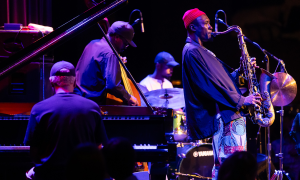
Thankfully, the answer proved a resounding no. Things stepped up a gear when Coleman, already accompanied by both upright and electric bass as well as his son Denardo on drums, invited a third bassist onto the stage. In a move that would have seemed extraordinary from almost any other artist on the planet, it was par for the course with Coleman. The surprise, rather, was that it was not Haden, but another advertised guest. Flea from the Red Hot Chili Peppers promptly positioned himself within what may well have been a minority of one: jock-rock megastars able to hold their own amongst some of the world's finest jazz players. Not only does he clearly have the necessary chops, but his edgy, urgent tone added a welcome rawness to the proceedings. He even managed to refrain from slapping, at least until the finale.
Continuing Meltdown's ethos of one-off collaborations, Senegal's Baaba Maal also made a brief, and unannounced, cameo on vocals. The performance was substantially less rewarding, however, and he soon scuttled from the stage. The next significant change of gear came instead with the appearance of the Master Musicians of Jajouka (or re-appearance, the eight-piece band having also served as the evening's support act). Celebrated over the years by everyone from the Rolling Stones to Talvin Singh, the Moroccan ensemble has been linked to Coleman since the 1960s. Their shrill, almost nasal pipe drones and polyrhythmic hand percussion can, in truth, take some getting used to. Yet, in this context they proved a potent catalyst, not least for Coleman himself who the ensemble pushed well out of his comfort zone by the sudden competition in terms of both timbre and register. Though cacophonous at points, their alliance proved triumphant, and much on-stage embracing ensued. The audience responded with shouts of, "We love you, Ornette!" The hollers—like the hugs—were thoroughly deserved. The concert had reached an apex, and all could go home satisfied. And Haden had yet to appear.
That historic reunion was saved for the encore. The rest of the band (save for a particularly restrained Denardo on percussion) was absent from the stage to allow the saxophonist and double bassist maximum space. Half a century after its initial appearance on record, the ballad "Lonely Woman" remains a hands-down classic, and it was approached here with a fresh tenderness. The performance was a truly sublime moment, even if, as the opener from The Shape of Jazz to Come (Atlantic, 1959), the song is strictly from the wrong album. When it was over, Coleman, rockstar-like, touched the raised hands of adoring fans from the front of the stage as the crowd responded with the most protracted of standing ovations. He deserved every second.
FOLLOW Marcus O'Dair
and get notified whenever a new article published.
Marcus O'Dair is an English journalist and broadcaster.
About Ornette Coleman

Tags
PREVIOUS / NEXT

Become a Sustaining Member

Since 1995, All About Jazz has championed jazz as an art form and supported the musicians who create it. Over three decades, it has grown into one of the world's leading jazz resources, serving hundreds of thousands of readers, musicians, presenters and industry professionals each month.
Help Build the Future of All About Jazz
Your support helps us continue building All About Jazz for the next generation—expanding our editorial coverage, preserving jazz history, developing new community features and creating better ways to discover the music and the people behind it.
Become a sustaining member for as little as $20 per year and you'll immediately enjoy an ad-free experience along with access to subscriber features and future articles for a full year.
Together, we're not simply sustaining All About Jazz—we're building its future. Thank you for being part of the journey.