Home » Jazz Articles » Album Review » McCoy Tyner Quartet: New York Reunion
McCoy Tyner Quartet: New York Reunion
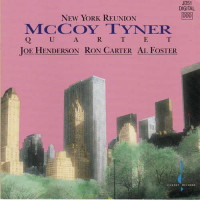
The interplay is immediately striking. Tyner, Henderson, Carter and Foster are each attuned to the fine shadings and explosive surges possible in small-group jazz. Henderson's tenor tone, still luxuriant but darker than in his hard-bop prime, weaves through Tyner's harmonies and the supple, often unorthodox pulse of Carter's bass. Foster's drumming—nimble, textural and unfailingly responsive—provides a modern edge to the otherwise classic lineup.
Tyner's command of the keyboard remains as formidable as ever. His left-hand voicings underpin much of the session's character, anchoring and yet propelling the group with unstoppable momentum. On "Recorda Me," Tyner distills the piece to its essence before launching into a solo that highlights his blend of percussive attack and lyrical ingenuity. His reading of ballads, such as "What Is This Thing Called Love?," reveals an undiminished ability to balance muscularity with sensitivity.
An impressive part of this album is the sheer beauty of the sound; the spaciousness and the separation enables an appreciation of the sound. The music was lauded for its sonic splendor on its initial release. The album boasts an acoustic clarity that brings out the timbral richness of each instrument. Nowhere is this better shown than in the Thelonious Monk track, "Ask Me Now." This is Henderson's track. With him, the tenor saxophone can be an instrument of beauty that is capable of exploring deep musicality. Henderson is not afraid to breach the edges of tonal fluency. His music is rooted in the blues but is made individual by his idiosyncratic harmonic twists. The rhythmic complexity of an otherwise straightforward solo has an inbuilt tension. All Henderson's work has influences from his past experiences; from bop, the avant-garde. His tone has force and flexibility and he is well able to express a lyrical side. Even when he is playing a conventional theme he still is able to be spontaneous. He has absorbed influences from Charlie Parker, Sonny Rollins and John Coltrane, but they are incorporated in a voice that is uniquely Henderson. The depth of his sound is startling as he explores the nuance of the tenor. The way that his sound has echoes of most of the tenor players that have influenced him is intriguing, making for unique idiosyncratic tones. When, towards the end of the track, Tyner enters to play alongside Henderson, the music is transformed into a potent delightful duet.
Carter has rarely been better presented than here, in "What Is This Thing Called Love." His playing in the past was often lost in the sonic mush but here the piquant percussive clarity is well captured. Carter's playing style is defined by its musicality, rhythmic sophistication and a keen sense of adaptability and nuance. Creative melodic invention and walking bass lines are important aspects of his playing. Rather than relying on speed or showy virtuosity, Carter emphasizes space, clarity and harmonic depth, with glissandos and unconventional note choices to shape the ensemble's direction.
Carter, in his own composition "A Quick Sketch," maintains a relentless bass figure. Tyner solos above the ever-present bass. The whole track is a demonstration of one other aspect of Carter's playing. The relaxed solo from Henderson is almost a winding down but Carter ensures that eventually he has the last word.
Foster is a listening drummer, a master of restraint. His style has changed over the years and what we have here is late period Foster. His work on the album is marked by taste and elegance. He is there to serve the music with melodic rhythm and subtle swing,
New York Reunion is far more than a nostalgia project. It is a living document of four major artists revitalizing the vocabulary they helped define, offering both homage and fresh invention in every bar.
 FOLLOW Jack Kenny
and get notified whenever a new article published.
FOLLOW Jack Kenny
and get notified whenever a new article published.
Jack was turned on to jazz by a mixture of Stan Getz, Lee Konitz and Earl Bostic.
Track Listing
Recorda Me (Remember Me); Miss Bea (Dedicated To Mother); What Is This Thing Called Love?; My Romance; Ask Me Now; Beautiful Love; A Quick Sketch; Home.
Personnel


Album information
Title: New York Reunion | Year Released: 1991 | Record Label: Chesky Records
About McCoy Tyner
Tags
PREVIOUS / NEXT

Become a Sustaining Member

Since 1995, All About Jazz has championed jazz as an art form and supported the musicians who create it. Over three decades, it has grown into one of the world's leading jazz resources, serving hundreds of thousands of readers, musicians, presenters and industry professionals each month.
Help Build the Future of All About Jazz
Your support helps us continue building All About Jazz for the next generation—expanding our editorial coverage, preserving jazz history, developing new community features and creating better ways to discover the music and the people behind it.
Become a sustaining member for as little as $20 per year and you'll immediately enjoy an ad-free experience along with access to subscriber features and future articles for a full year.
Together, we're not simply sustaining All About Jazz—we're building its future. Thank you for being part of the journey.