Home » Jazz Articles » Interview » Nadav Remez: At the Intersection of Modern Jazz and Jewish Folk
Nadav Remez: At the Intersection of Modern Jazz and Jewish Folk
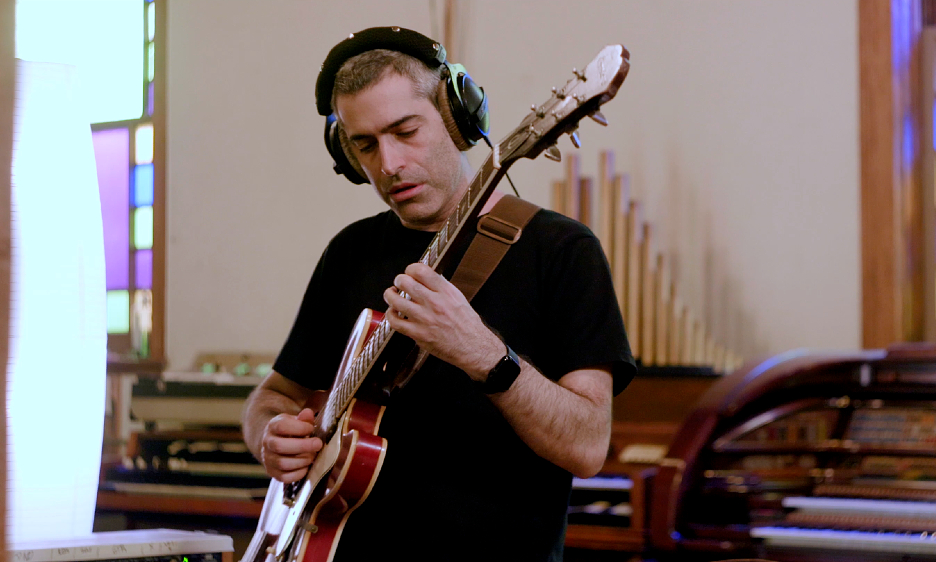
Courtesy Yoel Levy
I write about my ideal imagination of things. I look for beauty. I'm not trying to depict things that exist; I'm trying to depict things that could exist.
—Nadav Remez
Summit was conceived as something where the sequence would really matter—that it wouldn't be thrown together by happenstance after Remez had all the material recorded, but it wasn't actually written in sequence. There were little surprises along the way. Ideas popped like neurons in Einstein's cerebral cortex. Ears were perked like hummus looking for some chips. Something about composition, collaborative or not, is that you do have to be careful not to let your own concepts get in the way of what the music actually really means. They were able to not fall prey to that. As Remez noted, "There's a strong central gesture being displayed or communicated. It's really fun to free yourself up conceptually. You find yourself inventing new things when you're in a new situation."
Nadav Remez is a jazz guitarist, composer, and arranger whose music lives at the intersection of modern jazz, alternative rock and Jewish folk. Known for his haunting tone and understated, imaginative writing, he has become a distinctive voice in the global jazz community. He assures it will not be 14 years before his next album as a leader.
All About Jazz: You have two albums out as a leader with 14 years in between. There is also one called Phishes, which is more rock music.
Nadav Remez: All three musicians are jazz musicians, but we have our share of overlapping influences between the three of us. We all love rock and prog, and all these other influences were expressed more on that project.
AAJ: There was a concert you fronted at Beit Avi Chai called There Were Nights: The Nadav Remez Quintet Performs the Greatest Songs of Esther Ofarim.
NR: That was from a Hebrew Jazz series in 2014. Barack Weiss runs it in Jerusalem, and he commissioned these concerts from Israeli artists, usually artists that live in New York, who would come to Israel. He would give each artist a topic and ask us to write a suite of arrangements and get a band to play it live. After I had all this music, and what do I do with it?
AAJ: You brought it to New York?
NR: I started playing it in a few concerts here, and then I noticed that some of these arrangements were very easy to bring into my quintet. I played them with my band, but it never got recorded. Then when we sat down to do Phishes, I thought a couple—"Shedamati" and "Hinach Yaffa Raayati"—could fit on Summit. As a matter of fact, I'm toying with the idea of getting the entire suite recorded.
AAJ: Where are you from in Israel?
NR: A place called Rishon LeZion. It's a suburb of Tel Aviv.
AAJ: I'm familiar. We flew into Tel Aviv years ago on a tour that was basically following the path of Jesus—Beersheba, Wedding at Cana, the Church of the Holy Sepulchre, etc.
NR: Greg Tardy who plays saxophone on Summit is a real devout Christian. I used to play with him in Omer Avital's band many years ago. When we played in Israel, he would make it a thing to stay in a Christian hostel in the Old City.
AAJ: You wrote the songs for Summit over a long period of time.
NR: Basically, when I sat down to figure out what tunes I wanted to bring into the studio, I wanted to make that into a concept and try to find a common thread between all the songs. I didn't want it to sound like a collection of songs that have nothing to do with each other. There is more music that I have collected over that same period of time that didn't get selected to be recorded on this album. But those songs, as different as they are, I asked myself how can I make them sound like it's one project, one band? This is the thing with musicians, that as soon as I'm done writing a tune, it's very easy to say, oh, I don't write like this anymore. I sound like something else now. It was a challenge. I wanted to pick tunes that I could bring something into today rather than play a song I wrote in high school.
The oldest song was one I wrote for a great uncle when he passed away. "King Tut" was also very old. I wrote it when I went to Berklee College of Music. And for years, I played it with another band, a co-led band that's no longer around called The Secret Music Project with musicians, Haggai Cohen Milo, who lives in Berlin now, Matan Chapnizky and Itamar Doari, who both live in Israel. Listening to the aesthetic of Summit and going around it, treating it as the peak, the summit, what's the path to climb up there? That's how I approached the selection of the tunes.
AAJ: Your playing is impressive but the way you fit snugly into the band without dominating is well done.
NR: There are many approaches. When I worked on Phishes, for example, we went back and forth for weeks ordering the songs. We even sent the music to friends who are not in the band and asked their opinion. The answers were varied, but for me, it's always been about the story insofar as an arc. Imagine I wrote a book and started with chapter eight because it has the most action in it. That wouldn't make sense. Since we're dealing with an LP format, here it's more than an LP. It's 74 minutes, like a big book. I want to order it in a way that if you as the listener decide you want to listen to the album, it has to make sense.
AAJ: You have a smooth and sensual style of playing, and I say that in the best terms.
NR: Well, I'm never going to shred because, A—I can't shred. I'm not that kind of musician. And B—I think that my playing, my writing, other than the fact that it naturally lends to a more gradual building of the tension and release throughout the song, I prefer it this way, to take it slow.
If you go to Brooklyn Jazz Underground Records, my label from the first record, they asked me to write some, not liner notes, but to write something about the album on their website. I don't know if it's still there or not. I could name characters and how they come in and how they get introduced across the record. There was something about a pairing of solos, and it's gradual throughout the album as characters. There is a thing about letting people exist in the space of the album, letting people express themselves. I do like the spotlight here and there, but I knew that if I chose strong musicians, I'll be able to feature them and not have to be in the front all the time.
AAJ: The band is incredibly tight. How long have you all been together?
NR: This combination of five people met for the first time in the studio for rehearsal the day before the recording. I've played my music with Gregory Tardy since 2012. Ben Tiberio, I met him in Banff in 2014. We did the jazz workshop there. Between his writing and mine, there is a lot of simpatico. David Sirkis and Guy Moskovich, drums and piano, are new. I met David during COVID and played a session with him, and I didn't know Guy at all until I did a show in 2022. I've been doing this collaborative show with another friend of mine, Avri Borochov, who's in Israel. Almost every time I go to Israel to visit, we do a project together where it's half my music, half his music, and we've been doing this since 2007. Every time we get a different band, and in '22, he suggested we get David and Guy.
AAJ: "The Awakening" is a strong opener where you let the other players set the tone before you enter.
NR: That was a tune I wrote as a theme song for a film that I didn't get hired to write the music for. There is a legit film out there in Israel called Awakening, and he wanted me to write a scene for it, mainly sound effects. It wasn't the theme song but as I wrote it, I was inspired to write the theme song. I didn't even play it for the guy, then I started developing it independently. It kept changing until the day before the studio date. So, I've added to it over the years until very recently. It doesn't feel old in my repertoire.
The next song is "Shedemati," part of the Esther Ofarim Project. It's an arrangement of an old agricultural song about sowing and reaping, and it's the only tune in the record that's in swing. It's an existing song; I wrote the arrangement. Everyone knows it, and it's a very visual song. It goes back close to one hundred years.
AAJ: "King Tut" goes back even further, centuries. Not the song of course.
NR: That's very visual and now you'll see as we go through all the songs, a lot of them are. In this kind of writing, I'm very direct. It's not about abstract. The song is supposed to take you into that space. Listen to it and get transported into times in ancient Egypt. That's the goal here. It's like nostalgia for a time and place before we were born. And I've played it again with the Secret Music Project. After that, I abandoned the tune for some time and only got back to it in the last few years realizing that, hey, this is still relevant. It's paired with "Hephaestus" as a mini suite taking you to ancient Greece. He is the God of fire, blacksmithing. That's the fastest, most intense tune on the album.
AAJ: The piece "Soon" is interesting for me as I am thinking of the TV series The Chosen. When one of the apostles asks Jesus a question, and he doesn't want to reveal something right away, he says it will happen soon.
NR: I wrote this tune the first year of COVID, and it was like the world that we knew before was gone. Go to a coffee place, go to see people, go to parties, go to get in your car, go to the grocery store without having to wipe everything. The inspiration here was the "soon" like, "Okay, soon, hopefully we'll be back to real life." It's a hope anthem in two parts.
AAJ: You wrote a tango for your horn player, Greg.
NR: That song I actually wrote when I went to New England Conservatory for my master's. We had the honors band at school. This tango was an exercise in composition for a class with the head of the jazz department, Ken Schaphorst. It's actually my mom's favorite song of mine, so I keep joking about it when I play live.
AAJ: Apparently, you didn't have the same issue with "Tribute" as the name is simply that.
NR: "Tribute" was to a great uncle, Maurice. The record is divided into two acts, and up till the tango is Act One. Then imagine flipping the record if you are listening on CD or digital media. The idea of a first and second act is something that I always look for when I record an album. I grew up listening not to LPs, but CDs. You don't flip it. You just play it. I try to keep this concept in making my records. Now, it's even worse, right? I'm talking about the way we consume the music. It is just different. But when someone comes to one of my shows, I'm not going to sell them Spotify. They want to take away something tangible.
AAJ: Next on the record is another Israeli folk song, "Hinach Yaffa Raayati."
NR: The first time I played it was with a band that I had called The Alchemists that was active up until when we all flew to America to start our lives and to go to college. Musicians love to play it. It's a little tricky. There are all these rhythms overlapping. Not too hard of a challenge, but it keeps the musicians on their toes. It's actually part of a verse from Song of Songs. "You Are Beautiful, My Wife," but it's talking about God. It's usually done as a ballad, very slowly. And my response was to make it into a song that's more rhythmic. There's a little original piece that I tag on to the end of the melody. After that comes "Beyond," which is a vehicle for one long solo. It's just a big open and, sure, there's a melody and I stand behind it. When we play it live, Greg will also take a long solo.
AAJ: You mentioned earlier that "Summit" was the true center of the record.
NR: It started when a friend sent me a picture from a trip she made to one of the summits in the French Alps. And I was so in awe of the image, that I was inspired to write a song based on that. The piece has five different parts that are each very different, something like a classical piece. It starts with the A section in this rubato kind of melody that repeats three times, and then the band picks up in time to the main melody. Then we go to this maze that eventually leads us to the solo section, which has nothing to do with the other parts. It wasn't a school exercise, but I wanted to write a composition that goes through very distinct different parts, as many as I could.
AAJ: It invokes the sense of climbing, which makes sense since the title is "Summit."
NR: Yes, that's good. And then at the end, we squeezed everything we could out of the tune, ending with that same A section, but now we're at the top of the mountain. It's super intense. And we use that section, that same melody to break the energy. To me, visually, it's like if we got to the mountain, then that last A section is the bird's eye view or a helicopter flying away from it.
AAJ: Next is "Adon Olam," meaning Master of the Universe, a poem I've read that is about God's nature, His oneness.
NR: That is Greg's favorite tune, by the way, and it's his feature. The whole piece is just for him to take us to infinity and beyond. This is a core Jewish text that people sing. And what's interesting about it is that it has hundreds and hundreds of melodies. Anywhere you go, you might find that the community, the specific synagogue sings it a different way. This arrangement contains two of them. By the way, in my previous record, So Far, there's a similar thing, "Lecha Dodi," which is another Jewish text that also I work with two alternating melodies. There's a Yemeni melody and an Algerian melody. Again, we're not in the same place we were in the beginning because we've built up to a peak. Maybe it's an additional peak like K2.
AAJ: The album comes to the end, and you finish with a flourish on "Boulevards." On some records, the artist finishes with what you might call a throwaway piece but not here.
NR: "Boulevards" is a translation of Sderot, the name of a town in Southern Israel less than a mile from the Gaza Strip. I actually wrote this tune very early in 2008, when it was starting to get hit by rockets from Gaza. It's only an hour away from Tel Aviv but it gets sandier. It's also a town that's a very well-known cultural hub; a lot of bands came out of there that are Moroccan Jews that fused Moroccan music with rock. Very interesting musically. And after they suffered the first round of rockets, that's when I wrote this piece, which also has three different parts, one part that starts just being very naive, banal, a major melody, which then shifts into a more minor mode halfway through, a little more sober shalom kind of thing. And then it opens into solos, which are again, a little more hopeful. In a way, the song is about the resilience of the town and an homage to the people that live there from the point of view of back in the day.
AAJ: What are your preferences in guitars? Do you use a different one in the studio than playing live?
NR: I have a few, of course, but my main guitar is a '65 Epiphone Riviera. They were all made around the same time in Kalamazoo when Gibson bought Epiphone. They kept the factory, so it was the same makers and the guitar says Epiphone, but Haggai Cohen Milo, the bassist of the Secret Music Project was like, "You can't keep playing on that thing. You need a grown-up guitar, something that respects you as a musician." So, I went to Southside Guitars and there were three semi-hollows on the wall and two of them were Gibsons, like the sunburst, classic Gibson. And in the middle, there was this red Epiphone. That one looked quirky and I was interested in a Gibson, but the owner said I must check it out. I played it and from the first note, that was it. What's important for me is the tone. This guitar has a unique tone that I couldn't find in any other guitar. I mean, it is very comfortable to play, though I have other guitars that are way more comfortable, but they will not get anywhere near the tone of this Epiphone. I have Strandberg guitars, they're Swedish, headless, very easy to play and sometimes I use them because they're easy to travel with. But these days, if it's my band, even as a sideman, I bring the Epiphone.
AAJ: During an interview I did with Kenny Garrett he said, "You have to imagine everything first a split second before you play it. Sometimes you take a mental break and play a scale or something just to get you to the next section of your solo. Most of the time you try to stay mentally connected to what you want to do." How does that strike you in terms of your soloing?
NR: I can only play what's in my head at the time. I guess in solos in some compositions there are places where you have an idea of what should go there generally speaking. But no, jazz is about improvisation, and for me, it's just what comes into my head and through my fingers. I don't see any other way to play.
There is this split second and also the idea of forks in the road. You come to a specific place and can go this way or that way. And there's also something I call interventions, where you play what's in your head, but there's an element of autopilot and sometimes you have to break it. And how do you break it? There are all these techniques of like, okay, now I'm going to play the opposite of what I hear or now I'm going to lay out mid-phrase. I'm just going to cut off my phrase in the middle and see what happens. There's a million things you can do, a million little tricks that you can play on your own and on the musicians in order to poke them at the right place so that we can all bring up the music and take it to the next level.
AAJ: Do you think music has the power to change people's perspective? By that I mean, listening to a rock, folk or country song, it has lyrics that can be interpreted in some way, whether it is what the musician intended or not. But with jazz, the listener only can interpret by images.
NR: For example, Jason Moran used to be an artist in residence in the New England Conservatory. I remember him saying we should stop writing music about ourself. Write music about the world or about the people or something about politics. That's one approach. Some people can do it; some people can't or don't. Some people prefer to write about what they perceive as transcendent or that transcends them. To me, the way I write is what inspires me, the ideal world, the spiritual world that I look for, that I yearn for. I write about my ideal imagination of things. I look for beauty. I'm not trying to depict things that exist; I'm trying to depict things that could exist.
 FOLLOW Dean Nardi
and get notified whenever a new article published.
FOLLOW Dean Nardi
and get notified whenever a new article published.
I am a retired journalist, first covering pro sports in Boston for a daily newspaper then publishing two magazines.
About Nadav Remez
Tags
PREVIOUS / NEXT
Become a Sustaining Member

Since 1995, All About Jazz has championed jazz as an art form and supported the musicians who create it. Over three decades, it has grown into one of the world's leading jazz resources, serving hundreds of thousands of readers, musicians, presenters and industry professionals each month.
Help Build the Future of All About Jazz
Your support helps us continue building All About Jazz for the next generation—expanding our editorial coverage, preserving jazz history, developing new community features and creating better ways to discover the music and the people behind it.
Become a sustaining member for as little as $20 per year and you'll immediately enjoy an ad-free experience along with access to subscriber features and future articles for a full year.
Together, we're not simply sustaining All About Jazz—we're building its future. Thank you for being part of the journey.