Home » Jazz Articles » The Jazz Life » May Yu and the Evolving Voice of the Jazz Violin
May Yu and the Evolving Voice of the Jazz Violin
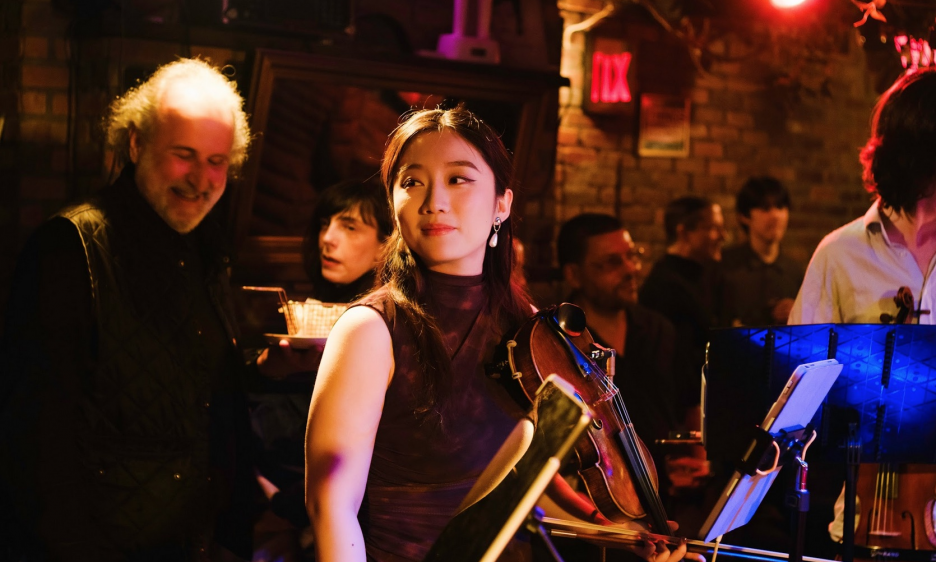
It was something that had always been there. Jazz gave it a name.
—May Yu
The production brought together institutional Chinese arts programming, conservatory-level training, and a contemporary New York performance venue. Within that setting, Yu stood out for her command of both classical performance and jazz improvisation.
Yu's artistic identity is grounded in an uncommon dual fluency: the discipline of classical violin and the real-time invention of jazz. The structure of classical performance, counterbalanced by jazz's improvisational freedom, has led Yu to discover her identity as a violinist as she explores the instrument's evolving role in jazz.
Although the violin has been present in jazz since the music's early history, it has rarely occupied the front-line role traditionally held by saxophones, trumpets, or vocalists. Later performers such as Joe Venuti, Stuff Smith, and Stephane Grappelli proved that the violin could hold its own with other instruments in a jazz setting. However, it mainly existed in a minor role, never quite occupying equal space with the saxophone or trumpet. Yu's work reflects that shift. Her performances suggest a violinist less interested in crossing genres for novelty than in expanding what the instrument can do within jazz. This shift is not simply broader acceptance, but a change in overall perspective. The violin brings a distinctive presence to jazz, and Yu wants to help preserve it.
Reframing the Jazz Violin
For Yu, this is an exciting time for jazz violin. Although the instrument has been in the mainstream for years, it has always had a somewhat complicated relationship with jazz. Yu takes a different approach. "I think that's actually what makes this moment so exciting." The pioneers brought the instrument from the margins into the mainstream, and later artists such as Regina Carter and Sara Caswell opened up new possibilities for jazz violin. "And now I feel like we're in a moment where the door is just open." With the new possibilities, the conversation has shifted from "can the violin belong in jazz?" to "what can the violin bring to jazz that nothing else can?"This openness to exploration resonates with Yu's artistry. She takes cues from other musical styles to explore new possibilities for jazz. "Look at what's happening in pop music right now—artists like Raye and Rosalía are drawing on tradition, on classical influences, on folk roots." Yu describes the importance of a more hands-on approach to music. "In the age of AI, there's something really profound about watching people run back toward the human, the acoustic, the ancient." This attitude dates back to her earliest exposure to music in childhood. "The violin is one of the most human sounds in existence. Maybe that's why people are more open to hearing it in unexpected places right now." Yu carried that same argument into contemporary pop, opening for Nessa Barrett's 2026 world tour with a string quartet. This engagement placed the acoustic violin inside a high-profile popular music context rather than treating it as a purely classical instrument.
Classical to jazz transformation
Yu spent years building her foundation as a classical violinist, a path that might, at first glance, seem to encourage reliance on written music. But for her, that training helped move her beyond dependency, ultimately opening the door to freedom. The discipline and technical control she developed became a way of eventually letting go.That sense of freedom, however, did not originate with formal study. It was already there, long before Yu even had a name for it. As a child in Harbin, she began playing by ear long before ever taking a lesson. Music, at that stage, was a way to express herself, rather than something to be read or analyzed. This connection with musical expression never disappeared; it simply became less visible than her classical studies.
This formal training helped Yu strengthen her technique and control over the instrument. Over time, however, that rigorous practice began to feel more confining than liberating. By her undergraduate years, the structure that had once grounded her began to limit her connection to music. "I still loved the violin, but I wanted more space to be curious, to listen differently, and to find my own voice."
What brought her back was improvisation. In those moments, she would move freely across genres, playing over whatever music she felt drawn to, whether it was jazz, pop, or film scores. This openness gave her room to explore without a fixed path. "I loved being in control and not in control at the same time," she says, capturing the essence of improvisation.
Returning to that creative space proved to be a rediscovery rather than something new. "It was something that had always been there, waiting," Yu reflects. "Jazz gave it a name."
Personal sound
For Yu, playing the violin is inseparable from the idea of voice. She often describes music in terms of language: not as something fixed, but as something shaped by experience, memory, and instinct. Like any language, it carries what a person has lived through, but it also allows them to move beyond it.Her classical training provides the foundation: precision, control, and a deep understanding of structure. But what she describes goes further than that. "What I'm always reaching for beneath that is something open and curious," she explains. "A sound that's willing to go anywhere."
Yu first experienced that sense of freedom during a 2022 performance at Dizzy's Club with Grammy-nominated composer and bandleader Darcy James Argue. Selected as a violin soloist, a notable role in a large jazz ensemble where the violin is rarely featured, Yu entered a completely open improvisation with Spanish jazz pianist Álvaro Torres. There was no plan and no predetermined direction, just musicians listening and responding in real time. "That felt closest to who I am as a musician," she recalls. "Not because it was perfect, but because I stopped overthinking and trusted the moment."
In that moment, Yu began to understand how her classical background and improvisational instincts could exist together. The technique was still there, but it was no longer the center of the performance. It became something she could lean on while making room for risk, instinct, and real-time connection. "I think that's where I feel most myself," she says. "When the foundation is there, but I'm not trying to control every second of the music."
Boundaries dissolving
Yu's artistic identity takes shape across a wide range of musical settings. Her work moves between classical, jazz, pop, and more fluid, genre-crossing spaces, but the throughline is not simply versatility; it's the level of trust placed in her musicianship across very different environments. She has served as concertmaster in conservatory orchestras, been named a Heifetz Ensemble in Residence Fellow, performed as a featured soloist at the Apollo Theater, appeared with Darcy James Argue at Dizzy's Club, and opened for Nessa Barrett with a string quartet. Across these settings, her work points to the same idea: the violin is not merely an ornamental color, but a central voice capable of shaping contemporary sound.That openness reflects something deeper than versatility. Moving between traditions isn't about shifting styles as much as following a more direct connection to sound. For Yu, that instinct traces back to her early years in China, where music was tied not only to training, but to memory, ritual, and everyday life. Moving across genres becomes less about leaving tradition behind and more about carrying it forward into new spaces. "I find that so moving," she says, "this idea of artists going back to find what is original, what is human, what existed before all the noise."
Identity and movement
One aspect of Yu's life that has expanded her musical foundation stems from the places she has lived. Each location finds its way into her music. Harbin showed her the value of curiosity and diversity. "It's a city with such a rich mix of cultures, religions, and artistic traditions." During these early years, music was something expansive and communal. "The world felt big and full of possibility, and I never stopped wanting to explore it."Her move to Canada opened new possibilities. She was eleven years old, living in Calgary, feeling alone and separated from everything familiar to her. Although this might seem like a setback, the loneliness and separation deepened her relationship with the violin in a way nothing else could. The violin "became my closest friend. When you have no words, you find other ways to speak." The Canadian landscape taught her to focus on her surroundings, an experience that translated into her music. "Something about that landscape, so enormous and so quiet, taught me to be still, to listen, and to let things be bigger than myself. It gave me a sense of expansiveness that I carry into everything I play."
Eventually, she moved to Toronto, which opened her up to uncertainty and ultimately, jazz. She always had a connection to music beyond the written page, and her exposure to jazz in Toronto gave that instinct room to grow. She also started questioning who she was as a musician and where she fit in musically. Although she did not have the answers to these questions, she was ready to face the uncertainty head-on.
She relocated to New York City. "And New York made me confident." Confidence and acceptance created new possibilities for her as a musician. "Confidence, I think, is the single most important ingredient in improvisation. You have to be willing to commit to a note, a phrase, a direction, even when you don't know where it's going." New York City became a proving ground for her, but she quickly learned that this was an accepting community. And better yet, all the defining factors of her life became less important than her music. "For the first time, I didn't feel like I had to choose between classical and jazz, between Chinese and Canadian, between tradition and freedom. In New York, all of it belongs. And when you feel accepted, you play differently. You play like yourself."
The violin has become a defining presence in Yu's life and music, and she is not afraid to make her voice heard. "Jazz and life, for me, are the same thing. You're always improvising. You're always figuring it out in real time." She also wants to elevate the violin's place in jazz. "Not delicate, not decorative. I want it to feel like it belongs at the center of the conversation, not at the edge. That's what I'm pushing toward."
 FOLLOW Kyle Simpler
and get notified whenever a new article published.
FOLLOW Kyle Simpler
and get notified whenever a new article published.
Longtime jazz listener
About May Yu
Tags
PREVIOUS / NEXT

Become a Sustaining Member

Since 1995, All About Jazz has championed jazz as an art form and supported the musicians who create it. Over three decades, it has grown into one of the world's leading jazz resources, serving hundreds of thousands of readers, musicians, presenters and industry professionals each month.
Help Build the Future of All About Jazz
Your support helps us continue building All About Jazz for the next generation—expanding our editorial coverage, preserving jazz history, developing new community features and creating better ways to discover the music and the people behind it.
Become a sustaining member for as little as $20 per year and you'll immediately enjoy an ad-free experience along with access to subscriber features and future articles for a full year.
Together, we're not simply sustaining All About Jazz—we're building its future. Thank you for being part of the journey.