Home » Jazz Articles » Live Review » Maerz Musik 2026
Maerz Musik 2026
Courtesy Fabian Schellhorn
Berlin, Germany
March 22-24, 2026
Every March, this extended Berlin festival opens up around a multitude of venues, presenting moderne works (often premieres) that involve bulging orchestras, chamber ensembles, small groups or solo performers. Maerz Musik frequently inches towards electronics or free improvisation, with few limits on its new music range. Your scribe was in town for a thin three-day slice, involving great variety even within this corral.
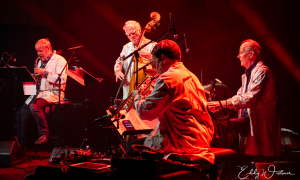
At the expansive Silent Green bunker-venue in the Wedding area, the Dedalus group (from Toulouse) presented two programmes (and an installation), exploring the compositions of Éliane Radigue, Peter Ablinger (long living in Berlin) and Catherine Lamb, those first two having only recently departed this sphere. Dedalus have now been active for three decades, their present line-up of guitar, flute, saxophone, trumpet, trombone, violin, viola and cello specialising in open scores, which leave space for interpretation and individual manoeuvre.
Radigue's "Occam Hepta 1" (2018) continues the French composer's move towards acoustic instrumentation in her later times. A minimalist sustain included long pauses, being relatively inert, an ongoing characteristic of Radigue's later pieces, inhabiting this pleasing palace of reverberational worship.
The Austrian Ablinger's "Weiss/Weisslich 17" (assembled over three decades) involved a sequence of six divided showcases for different (mobile) instruments, mostly framed very simply, and usually married to the surrounding environment in their soft-drone or spatial intervention natures. The audience gathered and sprawled in a slightly-shifting mess of bodies, as it became apparent that a player was going to suddenly rouse into activity, around different points of the Silent Green interior. Was that the sound of a hoover in an adjacent room? But issuing from a box of equipment on a plinth?
Lone violin held a hovering singularity, with not much going on, a trombonist sat in waiting, then stood up to activate, deeply burbling, cast around the speakers, prompting electronic bass lumps. The violin was matched with sine waves, continuing phrases out from a central whine, or adding to their after-trail. An alto saxophone held its notes. Each part followed on, like a pseudo-suite formation, and for the trumpet sequence, your scribe just so happened to be standing right between the two relevant speakers, as chugging rhythm patterns were set, mixing wind-scurf and raw blobs. A surf-erama swelling of spume-noise cowled the performers at first, subsumed by the spraying-waterfall tap, until it's sharply turned off, revealing them in another guise, followed by a spell of silence, and thence a returning babble, as if arriving from a free improvisation quarter. There were faint emissions from the scattered crew, broken by heart-attack stabs of hard hits, like a jump-scene in a science fiction flick, out of control.
The second half held three works by the lesser-known veteran Parisian composer Pascale Criton, "Process," "Steppings" and "Stream." These were produced via a more conventionally-arrayed grouping, employing a highly sensitised palette of acoustic traceries. Dedalus crafted a brooding build-up, especially from the acoustic guitar of their founder Didier Aschour, leading this levitating state of the instruments. The lubricated violin was akin to the interior of a khoomei singer's throat. A soft trombone anti-fanfare underlay the quite radical presence of Aschour's strings within the morose conversations of this group spread.
Ellen Fullman has designed her long string instrument, and it is indeed a corridor-length construction, a lattice of taut tuning, along which she perambulates, stroking its length in order to issue shimmering soft-drone harmonics. The following evening, in the hard-to-find Saint Elisabeth-Kirche, she was joined by NYC's JACK Quartet to perform "Energy Archive 4," a long piece that harboured little change in its progress. This was all quite spectacular, at root, but as the performance developed, it soon became clear that, while visually interesting, the long string instrument doesn't possess so much of a range, and that JACK were here to make the evening more interesting. This was a world premiere, but there was the feeling that all of Fullman's works are 'world premieres,' unstable as they probably are in any possibility of predictability.
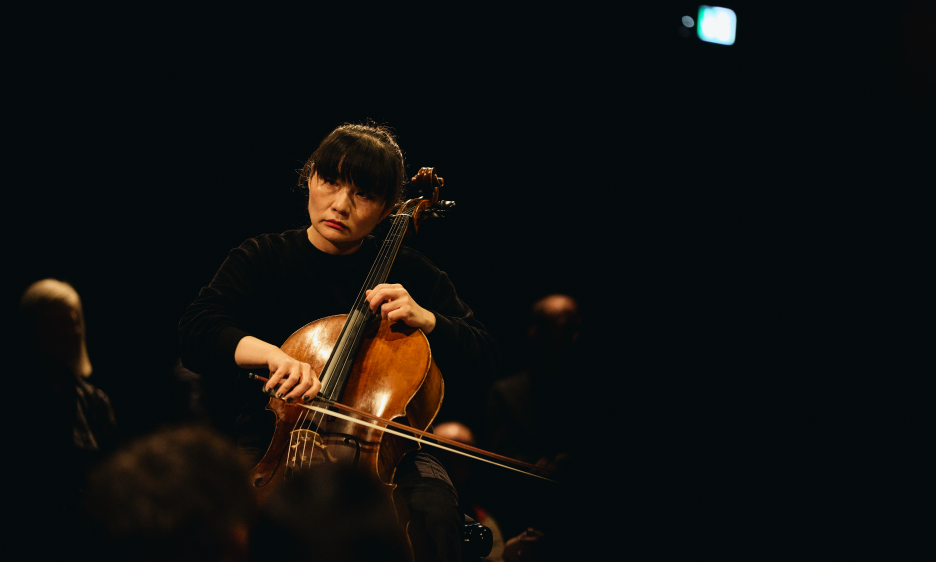
The third evening of your scribe's stay also involved another artist with a conceptual mission. The South Korean cellist Okkyung Lee has spent the bulk of her time over the decades as a free improviser, collaborating very successfully with John Zorn, Christian Marclay, Thurston Moore, Evan Parker, Cecil Taylor, and the likes. In more recent times she's moved closer to composition, ambient environmentalism and extended constructions that sound like potential movie soundtracks.
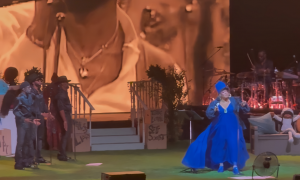
Here, she took over the rear stage-area of the Berliner Festspiele's main concert hall, clearly intending to muss up the divisions between performer and audience, to play good cop and bad cop via encouraging informality and intimacy, but also by hectoring and bullying, or even mocking the assembled crowd. There were tactics, but little shaping, attempting to disrupt convention, but ending up merely being irritating. "Aurora (Mesophase)," as it was termed, ended up like some failed performance art experiment from the 1970s. There wasn't much cello action, or indeed much music, although keyboards, viola and upright bass did join the fray. There was a (supposedly) avant stage manager and 'object director' who wheeled a large screen at various points, setting out to obscure certain performers at certain times and angles. Lee's microphone pronouncements were garbled by too-bassy amplification and throwaway diction, and communication was cut off rather than facilitated.
 FOLLOW Martin Longley
and get notified whenever a new article published.
Martin Longley also writes for Jazzwise, Songlines, Downbeat, We Jazz, Qwest TV, The New York City Jazz Record & The Brooklyn Rail
About Okkyung Lee

Tags
PREVIOUS / NEXT

Become a Sustaining Member

Since 1995, All About Jazz has championed jazz as an art form and supported the musicians who create it. Over three decades, it has grown into one of the world's leading jazz resources, serving hundreds of thousands of readers, musicians, presenters and industry professionals each month.
Help Build the Future of All About Jazz
Your support helps us continue building All About Jazz for the next generation—expanding our editorial coverage, preserving jazz history, developing new community features and creating better ways to discover the music and the people behind it.
Become a sustaining member for as little as $20 per year and you'll immediately enjoy an ad-free experience along with access to subscriber features and future articles for a full year.
Together, we're not simply sustaining All About Jazz—we're building its future. Thank you for being part of the journey.