Home » Jazz Articles » Live Review » Joe Morris at Vision Fest 30
Joe Morris at Vision Fest 30
Abrons Arts Center
Vision Festival
New York, NY
June 23, 2026
"Joe Morris is the real deal," said Matthew Shipp, relating the first time he met the multi-hyphenate musician and educator, who was presented with the Arts for Art's Lifetime Achievement Award at the 30th annual Vision Festival. Morris introduced himself to the pianist after a show in the early '80s. He gave Shipp his first record, of which Shipp admits he "let sit for a couple of weeks" before listening on a whim. Ever since, he's been one of Morris' most consistent collaborators and strongest proponents. "There are certain cliches like 'he's one of a kind'[... ]it can feel unnerving to run into someone who is actually 'one of a kind.'"
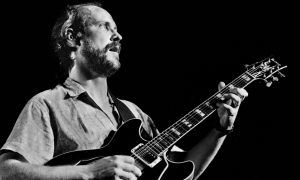
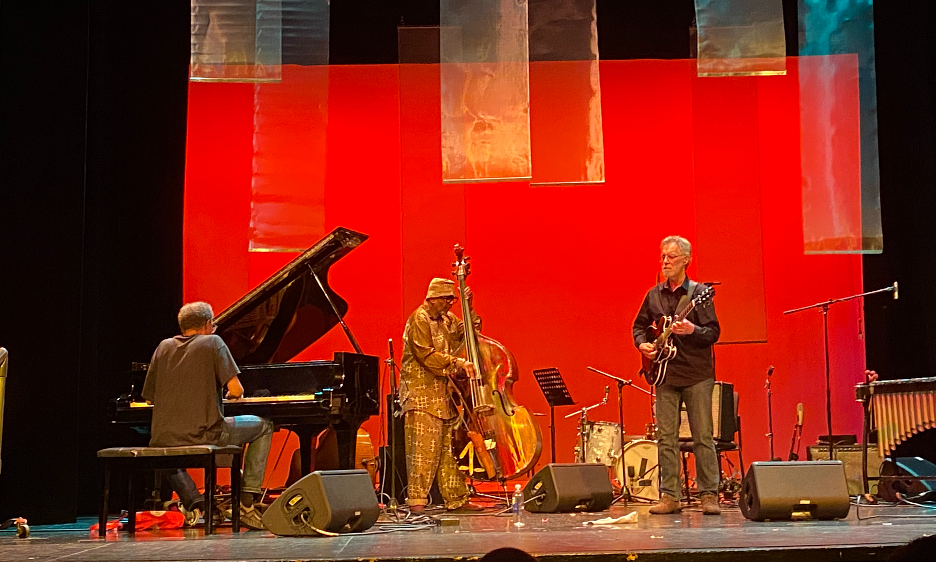
There was no better illustration of Shipp's astute praise than Morris' night-long blank check performance at the Abrons Art Center. He lead five groups—a total of seventeen musicians—in back-to-back sets. William Parker once said you can't "get a feel for a gig unless you go to every single night." This could not be more true for a career like Morris.' Guitarist, bassist, percussionist, theorist, educator, and organizer are a few of his titles, however they are not separate entities, but interlocking facets of an artist's endless devotion to improvisation. Morris makes it easy for the audience: he combined all these elements into a single, marathon performance.
The night begun with a duo: Morris on guitar with consummate flautist Nicole Mitchell. Mitchell is a versatile and exacting artist. She does not stop a given section until every sonic possibility is realized, often repeatedly. Along with her flute, she brought a number of electronic effects: delay pedals making up the bulk of modification, forming a strange, alien breath that seems to energize Morris' fingering. It was a perfect match of temperament, as Morris, too, built unraveling loops with microscopic proficiency. The duo was quiet, but invigorated in conscious listening.
Morris then invited a trio of string performers for a set of interpretive compositions. Tomeka Reid played an intelligent cello, gyrating underneath Melanie Dyer's mellifluous viola and the strong physicality of Solomon Caldwell on bass. Morris acted as a bridge between these players and the stark environments of his compositions. They are quasi-classical at times, imbued with sharp, tremulous drama that inevitably decouples into less organized exploration. The set was a departure for four free jazz veterans, but each managed to anchor themselves to the depth of a given phrase, eventually transplanting intense breakages in form, usually goaded by Caldwell, that turned the group into a panoply of askew rhythms.
A trio and quintet followed the strings. Parker and Shipp are both longtime veterans in Morris' bands, yet the interplay between them was never derivative. Shipp provided a dense meld of bop and blues—drenched rhythm that his bandmates served to deconstruct, pricking at the repeated phrasing with rapid fingering until the piece turned into a dense wall of sound. Parker's bow is always multifaceted, never more than against Morris' strumming. He delivered a unique, tactile depth in league with Nicole Mitchell's experiments with relay. Their playing was almost incantatory when coiled together. After the set, there was an odd silence from the audience, as dreamers slowly coming back to life.
Though Morris is the only common player between the two bands, the performances could be understood more fruitfully as companion suites. Morris switched to the bass, and took with him Parker's enveloping style with his own unique edge. Hidemi Akaiwa may be a more classical presence on the keys than Shipp, but she shares with her colleague the theoretician's touch, an ear always listening for the possibility of disruption. Rob Brown and Hery Paz on alto and tenor saxophone respectively, though singular performers in their own right, continued the oneirism of the previous show with their own syncopated squawks and bleats. This band, however, came to a more raucous finish. Brown's inexhaustible licks, when paired with the cymbal-heavy Matt Rousseau, constructed an impenetrable display of sheer volume, naturally escalating from the dreamy foundation of the previous set.
The final performance of the night was also the largest: an octet. Patricia Nicholson Parker introduced the group as Morris' students, but he objected to this. "That's just how I met them," he corrected, and Nicholson-Parker was quick to continue: "and they never were the same, and [Joe Morris] never was the same from meeting them." More than just modesty, the exchange illustrated Morris' goals, both as musician and teacher, to a tee. For him, improvisation is not a skill, not like cooking or sewing or even playing the guitar. It is a method of discovery, close to a religious endeavor, that cannot be completed without fellow initiates. Education and performance are not one-sided. Morris conducts a universal effort in the exploration of sound, as unfamiliar for him as it is for his students. Though he did his most active "conducting" during this final performance, his band leadership was always instinctual and generous. DoYeon Kim's intense and unique gayageum inaugurated the piece, Morris accompanying on the bass with a droning bow. Nick Neuberg supplied that same patient intensity and grace of Andrew Cyrille in his free bands. Then came Jonathan Paik, whose loping, lyrical keys give room for the brass section to come blaring in: lemuel marc on trumpet, Dan Blacksberg on trombone, and Noah Campbell.
Morris' approach to this larger group was very similar to the previous sets. He directed with uncompromising generosity, jumping head first into the unexpected. He expects (and delivers) bold strokes from his bandmates, but he does not provoke them. His fingering was steady, granular, almost bluesy in its unerring signature. When pitted against Kim's percussive weight, Marc suddenly conjured a solo, punctuated by short squeaks and rough, tinny bugle calls that seemed to both mimic and exasperate the string section. Morris' light touch compels a unity that does not often metabolize in such boisterous sets. There was an air of deep listening, even as the brass rose to crescendo or Paik's quick fingerwork reached its climax. Solos are etched out in the composition, but nevertheless felt as communal as the interplay.
If there was a standout in the set, however, it was Selendis Sebastian Alexander Johnson on the vibes. She was a powerful presence, a rather physical one akin to other free jazz vibraphonists like Khan Jamal, but with an emotional frankness that shines in her dynamic style. When Campbell was given the spotlight, the vibes accompanied his flutter tonguing with a garrulous applause, careful low bars interchanged with the popping of the reed until a new layer integrates; she added an eerie, emotive depth to the gayageum. Both as accompanist and soloist, she was a formidable sonic force, and clearly of Morris' own school. Both know to look patiently for margins as a fisherman looks for flights of silver in a river, and just the same, they strike with confidence and tenacity at the "right" moment. That is the "real deal" of any Joe Morris concert: the intense study of a stream of sound, made deeper by the intricacies of composition and form. One feels, even in a crowded concert hall with eight musicians on stage, an essential component of that study, not only as student, but as teacher.
 FOLLOW Fran Kursztejn
and get notified whenever a new article published.
FOLLOW Fran Kursztejn
and get notified whenever a new article published.
Southern writer, filmmaker, & jazz freak.
About Joe Morris

Tags
PREVIOUS / NEXT
Become a Sustaining Member

Since 1995, All About Jazz has championed jazz as an art form and supported the musicians who create it. Over three decades, it has grown into one of the world's leading jazz resources, serving hundreds of thousands of readers, musicians, presenters and industry professionals each month.
Help Build the Future of All About Jazz
Your support helps us continue building All About Jazz for the next generation—expanding our editorial coverage, preserving jazz history, developing new community features and creating better ways to discover the music and the people behind it.
Become a sustaining member for as little as $20 per year and you'll immediately enjoy an ad-free experience along with access to subscriber features and future articles for a full year.
Together, we're not simply sustaining All About Jazz—we're building its future. Thank you for being part of the journey.
Near

New York City Concerts