Home » Jazz Articles » Live Review » Hua Hin Jazz Festival 2006
Hua Hin Jazz Festival 2006
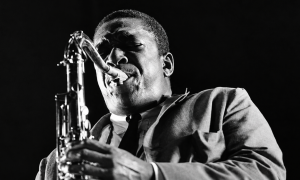
Despite his short life, Coltrane left behind a great musical legacy that set a new direction for contemporary music and continues to inspire so many musicians and artists to this day. His message is beauty, love, and divinity!
Amina Figarova, piano (Azerbaijan)
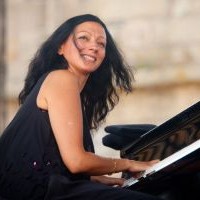 Some of the most important musical lessons in my life have come through conversations rather than concerts. One of those conversations was with the late, great Toots Thielemans.
My husband is Belgian, and he knew Toots quite well. About twenty-five years ago, I was performing at a festival with my sextet, and Toots was there with his quartet. One evening, the festival invited all the performing artists to dinner at a beautiful restaurant. By chance, I found myself sitting next to Toots.
We started talking about music—about the records that had inspired us, the musicians who had changed us, and those moments when something you hear suddenly opens a door you didn't know was there.
At some point, Toots began telling me about a period in his life when he had felt stuck. Toots was born in 1922, and in the early 1960s, when he was in his forties, he had already developed such a distinctive musical language that he was known around the world. But he told me that, despite all of that, he had become frustrated with himself. He felt that he was always playing the same language, the same vocabulary, and he had become tired of hearing himself repeat it. He felt stuck in his improvisation.
Then he heard John Coltrane's solo on Some Day My Prince Will Come.
Something happened.
Toots told me that he transcribed the solo, learned it by heart, and then played along with Coltrane over and over again. For him, that solo contained something he had been searching for. It represented what modern jazz meant to him—freedom, intensity, direction, and the possibility of going somewhere he hadn't been before.
He told me that learning that solo changed his playing significantly. It helped him become more free.
I never forgot that conversation.
When I returned home from our tour, I decided to do the same thing. I transcribed that particular Coltrane solo and learned it. It became a turning point for me as well, opening the door to a deeper exploration of Coltrane's music.
And the more I listened to that recording, the more fascinating the story behind it became. Some Day My Prince Will Come, recorded in 1961, came at an unusual moment in Miles Davis's musical life. John Coltrane was no longer touring with Miles's band; Hank Mobley had taken his place. Yet Coltrane was still invited into the studio for this recording, appearing on a few tracks.
There is something almost mysterious about the way the session unfolds. On the title track, Miles plays the melody, and after he has played the head out, Coltrane enters. It feels almost like Coltrane is arriving from another world—suddenly bringing a completely different energy and language into the music.
The song itself is already an unlikely vehicle for this kind of jazz. Originally written for Walt Disney's 1937 Snow White and the Seven Dwarfs, Some Day My Prince Will Come is an innocent, wide-eyed love song. But in Miles's hands, it becomes something altogether different.
Paul Chambers's throbbing bass and Jimmy Cobb's cymbal work create an opening vamp that builds a quiet tension. Then, almost at exactly the right moment, the music opens into waltz time and Miles enters with the melody—delicate, elegant, and just a little sly. There is innocence in the tune, but also something sensual underneath it.
Miles's solo is lyrical and rhythmically masterful. Ira Gitler described it in the original liner notes as "sweet and sour," and that seems exactly right.
Then there is Hank Mobley, relaxed and lyrical, followed by Coltrane, whose improvisation feels more intense, searching, and cerebral. Hearing the two saxophonists on the same track is extraordinary—two very different musical personalities, meeting for a brief moment in the studio. It was a meeting that could only happen once. And it never happened again.
But for me, the most important part of that recording is not only the history of Miles, Coltrane, or the remarkable musicians on the session.
It is the memory of sitting next to Toots Thielemans at that dinner, listening to him talk about the moment when John Coltrane changed the way he heard himself.
Years later, I still think about that conversation.
A great musician told me about another great musician who had helped him find freedom. And then, in a small way, he passed that freedom on to me.
David Lyttle, drums (Northern Ireland)
 When I think of the giants I'm always brought back to my earliest experiences of jazz. I remember driving around in my Ford Fiesta listening to cassettes I'd recorded, Trane's solos on Kind of Blue, Blue Train and later A Love Supreme taking my intrigued mind to new places.
Even with inexperienced ears I recognized his incredible modes of intensity and sensitivity, his distinct tone and his commanding style. After a few notes, or even one long note, you know it's John Coltrane, more so than many of the greats. When I hear Trane now and reflect on his greatness, I still think of these simple observations, knowing that they are the qualities of the giants and the aspirations of us mortals.
Yacoub Abu Ghosh, bass guitar (Jordan)
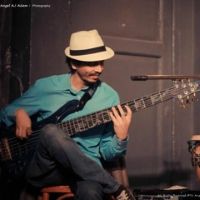 John Coltrane's music played a profound role in helping me find freedom in my own musical expression. Coming from a musical tradition where modal music is at the very heart of Arabic music, his approach to modes opened up a whole new way of thinking for me. He inspired me to search for new ways of approaching our own musical language and gave me the freedom to look at it from different perspectives, whether melodically, harmonically or rhythmically.
More importantly, he taught me that true musical freedom does not come from abandoning knowledge and tradition, but from knowing them deeply enough to be able to move beyond their expected boundaries. That idea has stayed with me throughout my life as a musician.
My two favourite Coltrane albums are A Love Supreme and My Favorite Things. I have probably played "My Favorite Things" in one form or another with almost every musical outfit I have founded or been part of. There is something endlessly liberating about the way Coltrane takes a familiar melody and uses it as a starting point for exploration rather than a limitation. That, for me, is one of the most enduring lessons of Coltrane: knowing the language deeply, then finding your own voice within it, and eventually discovering places the language itself had not yet taken you.
Jerry (Burundi)
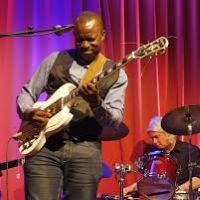 I was born in Burundi, a country where, at the time, music schools were almost non-existent. So I learned music in another way: by listening. I searched through records and cassette tapes, discovering many great jazz musicians, and among them was John Coltrane.
Coltrane accompanied me throughout my musical journey like an invisible teacher. In many ways, he became one of my mentors, guiding me along this path of jazz. I discovered his music while surrounded by the sounds of Burundi—the sounds of nature, the voices of everyday life, and the rhythmic pounding of women preparing cassava in the evening.
Somehow, Coltrane's sound found its place among all those sounds. His music spoke to me, guided me, and helped shape the musician I became. Even without ever meeting him, I felt that I was learning from him.
That is the extraordinary legacy of John Coltrane: his voice continues to travel across generations, cultures and continents, reaching musicians in places he may never have imagined.
His was
the eye
of a solid
sender
blues deeper than
the sound
of water
that spiritual sound
-the high
holy way.
An eye
(always an eye)
tender
but fierce
piercing
all seeing.
Hooded//lidded//shrew-shrew.
It was Arkansas, 20 acres
or more. In the holiness flame
of summer. Cutting junk up
with the gospel plough.
Five days sick
to kick it solid,
with a growl, couldn't tap
the horn.
Could not puncture the rim of it.
Five days thick
with spit to split the grip of it.
To punch through fever
to emerge reborn
like newborn wood.
Those Saturdays,
night roll of darker fields,
where those hymns
swayed across the land
from little churches
hid in bush.
Where the members sung
la da la da la da la
da da
la da la da la da
da da
whirling in the firmament of the spirit
It is the eye,
which listens.
Oh Dewey, the ocular.
Say-say, play what you may.
—he said, "Just play.
Call it anything."
Call it the bliss of it.
The times it was when black
was our name
and we were double-conscious,
ferociously black and real.
Black being
nothing but skin but
I was not
my skin.
1678 Broadway,
New York City,
1959
the new blues
came tumbling down.
The lip split, the blood
of Davis the third.
Press-wise
to the first, second and third valves.
Hey Dewey, the three
after the sun, the spirit lash,
the holy roll—the ocular.
I saw an angel and the devil
sat between two
cold priests, loas
of hidden frequencies,
I saw sour mountains of rotting
rice and red beans, saw secret colours.
But we had no power at all.
So we spread out our trinkets
our hot shirts, our very souls,
hip shake and moan, slid sideways,
moved
aloof like bop/in which the synapse
fluctuates with its concurrent
principle
while blowing a high C.
In Bird thereof, the high priest
of our tribe.
To follow the line he leads
is to get lost, to blush.
We were brutalised, our teeth
cut in half. Beat bloodied
even as our names
burned in lights above * Birdland *
—MILES —MILES—
wringing hot heat.
It were the eyes
that stayed black and bright,
stayed hard and tactical
and unafraid.
Them was those
knots and levers
of our rage.
Of maggots,
of brain coral — of foam.
Vampiric//light can't touch
his eyes.
The kink of him.
That eyeball beneath the rim
beckoning.
And inside was dim lit, a mess
of sheep skin jackets
and knee high boots, waistcoats
in leather, suits never worn in daylight.
We had entered the house of the demon, the snake,
The prince and poet of darkness under islands,
standing there smiling
with cock in hand.
New York City. 1979.
Miles
thereafter
emerging
as flame
as arcturus the star
as any vision//parallax rubric
slick
as a brokedick dog.
Sharp as
the grinning
edge of
a beloved
blade.
 FOLLOW Ian Patterson
and get notified whenever a new article published.
Ian is dedicated to the promotion of jazz and all creative music all over the world, and to catching just a little piece of it for himself.
About Bill Bruford

Tags
PREVIOUS / NEXT
Become a Sustaining Member

Since 1995, All About Jazz has championed jazz as an art form and supported the musicians who create it. Over three decades, it has grown into one of the world's leading jazz resources, serving hundreds of thousands of readers, musicians, presenters and industry professionals each month.
Help Build the Future of All About Jazz
Your support helps us continue building All About Jazz for the next generation—expanding our editorial coverage, preserving jazz history, developing new community features and creating better ways to discover the music and the people behind it.
Become a sustaining member for as little as $20 per year and you'll immediately enjoy an ad-free experience along with access to subscriber features and future articles for a full year.
Together, we're not simply sustaining All About Jazz—we're building its future. Thank you for being part of the journey.