Home » Jazz Articles » Live Review » Festival International de Musique Actuelle de Victoriaville 2026
Festival International de Musique Actuelle de Victoriaville 2026
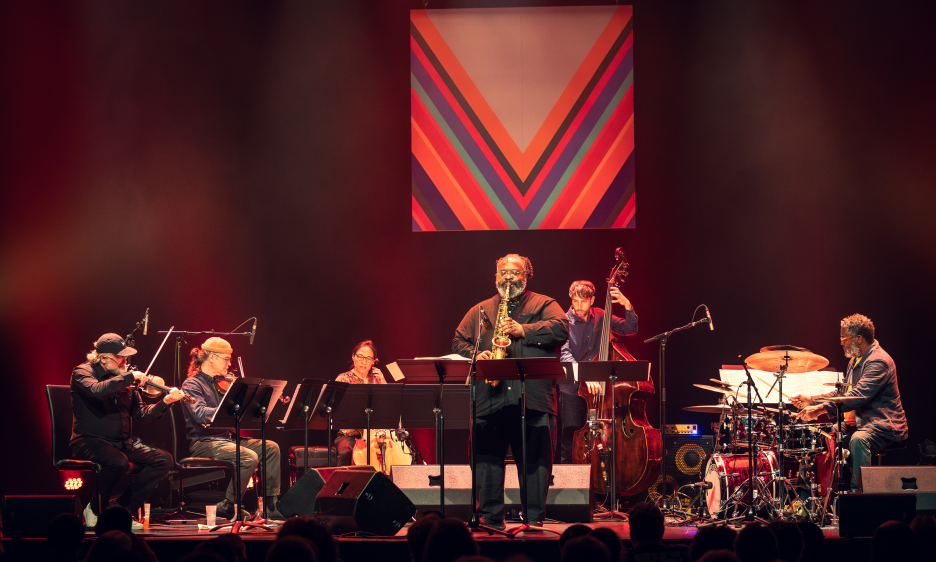
Courtesy Martin Morrisette
Victoriaville, QC
May 11-17 2026
The theme of the 42nd edition of the Festival International de Musique Actuelle de Victoriaville was change. This was the third edition of the festival under the artistic and general direction of Scott Thomson. The 40th edition in 2024 was very much like a typical Victo schedule, and 2025 saw a drastically cut-down edition due to unforeseen manpower issues. Consequently, this was the first full edition that Thomson was able to put his vision for FIMAV, or Victo, into action.
One of the criticisms of FIMAV over the years is that the festival has seemed disconnected from the city of Victoriaville. Avant-garde music is not, after all, an easy sell in a small city two hours east of Montreal in le Coeur de Québec. Thomson made some changes that he hopes will make the festival more accessible and appealing to a potential local audience, with four free performances of his piece Les Oiseaux de Marsville by Friendly Rich Marsella and a Sunday-afternoon concert by longtime Quebec large ensemble Fanfare Pourpour. The free performances took place in a pavilion along the path of the Installations Sonores, a feature of the festival since 2010. Additionally, two concerts were presented at a $10 admission charge, including [Ahmed], perhaps the most anticipated concert in the FIMAV lineup.
With most of the performances in the Carré 150 cultural centre, the festival felt anchored in a way that it never had before, and this year inaugurated a new room in le Carré, le Quartier General, a space where free performances took place: surprise ad hoc combinations of improvisers at 6 pm, and a session of John Oswald's Plunderphonics at 11 pm, with Oswald providing mixes of samples drawn from popular music—Elvis Presley, Willie Nelson and Dolly Parton, Louis Armstrong, and others—for a different small group of improvisers to work with each evening. With concerts scheduled at 5, 6, and 7:30 pm, finding time to eat became a problem. For the first time, it was impossible to see everything at FIMAV. Thomson seemed quite pleased to point this fact out when I noted how difficult it was to find time to eat dinner between concerts.
While the sound installations were open from Monday the 11th, and several performances took place on Tuesday and Wednesday, the main portion of the festival began with two concerts and a Plunderphonics meeting on Thursday evening. There were many, many highlights during the four days. In fact, I cannot remember an edition of FIMAV that had so many solid, engaging performances.
First up at 7:30 pm on Thursday was the quintet of vocalist and harmonium player Amirtha Kidambi's Elder Ones. The horn section of Matt Nelson (soprano saxophone) and Alfredo Colón (tenor saxophone) had a wonderfully sour tone, and the rhythm section of Lester St. Louis on bass and Jason Nazary on drums laid down a loose groove. The music was interesting on its own, but the presentation could have done with less preaching, given that the majority of the audience had already been converted. Protest music should, I believe, speak for itself, without a large amount of explication.
The Darius Jones Trio, with Jones on alto saxophone, Chris Lightcap on bass and Gerald Cleaver on drums, delivered a high level set titled Legend of éBoi (The Hypervigilant Eye), the latest chapter of the series Man'ish Boy. The trio played with a special authority, music at the edge of snapping out of place at any time but remaining firmly in control of the material, with deep feeling borne of childhood trauma, healing, and reconciliation.
On Friday evening, French saxophonist Sakina Abdou performed a finely-textured set with her Hammer, Roll and Leaf Trio with drummer Toma Gouband and pianist Marta Warelis. Later, the Josh Zubot Strings premiered a suite of compositions by violinist Josh Zubot who performed with a group of British Columbia compatriots: Jesse Zubot (violin), Peggy Lee (cello), Meredith Bates (alto violin), and James Meger (bass). The music carried a ferocious energy throughout, intricate string lines cascading all around, rubbing, colliding, intertwining, in a tight dance.
Montreal alto saxophonist Yves Charuest brought British bassist John Edwards and drummer Mark Sanders to Quebec for a first-ever performance that proved the worth of bringing these three musicians together. Edwards was the driving force of the trio that kept the improvisational balls in the air the entire performance. That concert was preceded by a solo set by Portuguese guitarist Rafael Toral, in which he used a wide variety of effects to deconstruct jazz standards.
Following pianist Pat Thomas's luminous solo set on Saturday at 7:30 pm, Darius Jones with fLuXkit Vancouver saw the Zubot brothers, Peggy Lee, and James Meger with Jones and Gerald Cleaver performing music developed during Jones' residencies at Vancouver's Western Front from 2019-2022. Their Saturday night performance of the piece that came out of that time, (
Queen Mab, the duo of pianist Marilyn Lerner and clarinetist Lori Freedman, celebrated 40 years of making music together in a set of improvised music that simply worked from beginning to end, because of a history of close listening and communicating. Angular, by turns aggressive, subtle, and witty, this was an engaging musical conversation between two longtime associates.
The British quartet [Ahmed], comprised of alto saxophonist Seymour Wright, pianist Pat Thomas, bassist Joel Grip and drummer Antonin Gerbal have recently turned to the music of Thelonious Monk, and so they did what they do, which is to start with a Monk theme and then improvise for an extended period around the structure of the piece. In this case, the theme was "Evidence," and the group worked the music with a startling intensity. The festival concluded with a charming performance by guitarist/singer Eric Chenaux and keyboard player Ryan Driver in a set of songs that were a sideways take on a Chet Baker vibe.
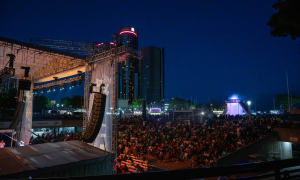
Recent years have been difficult for music festivals. Victo has had to weather COVID and a leadership transition on top of trying economic conditions. FIMAV artistic director Scott Thomson has responded by innovating in a way that made maximum use of the resources at hand. For one thing, almost every musician played at least twice during the festival. This is a practice that has been common at small jazz festivals such as the Guelph Jazz Festival, where Thomson served as artistic director for several years. The GJF was inspired by FIMAV in the first place, so the two festivals came full circle in this regard. With the programming's focus on acoustic music, it was the most like a jazz festival of any FIMAV since 1999, when I began attending the festival. I noticed a lot of Americans in the audience, many of whom we had not seen at Victoriaville for some years. That may have been because of the attractiveness of the schedule. The concerts were generally well attended, and the Fanfare Pourpour outdoor concert on a sunny Sunday afternoon attracted a crowd of about 300 people, including children, dancing to the oompah swing of the music.
For those who care about FIMAV, the changes were like an injection of oxygen to the festival. Satisfaction with them was virtually universal among longtime festival goers and my fellow journalists. FIMAV no longer has access to large concert spaces as in the past, but it does have an anchoring centre. So, on the one hand, there must be some modesty in ambition, but on the other hand, there is an opportunity for the festival to become more tightly focused on community, both local and musical.
 FOLLOW Mike Chamberlain
and get notified whenever a new article published.
FOLLOW Mike Chamberlain
and get notified whenever a new article published.
Writer, editor, teacher, loves beer, blues, and baseball.
About Darius Jones

Tags
PREVIOUS / NEXT


Become a Sustaining Member

Since 1995, All About Jazz has championed jazz as an art form and supported the musicians who create it. Over three decades, it has grown into one of the world's leading jazz resources, serving hundreds of thousands of readers, musicians, presenters and industry professionals each month.
Help Build the Future of All About Jazz
Your support helps us continue building All About Jazz for the next generation—expanding our editorial coverage, preserving jazz history, developing new community features and creating better ways to discover the music and the people behind it.
Become a sustaining member for as little as $20 per year and you'll immediately enjoy an ad-free experience along with access to subscriber features and future articles for a full year.
Together, we're not simply sustaining All About Jazz—we're building its future. Thank you for being part of the journey.
Near

Montreal Concerts