Home » Jazz Articles » Book Review » Cool Heat: Anita O'Day And Her Dangerous Jazz Life
Cool Heat: Anita O'Day And Her Dangerous Jazz Life
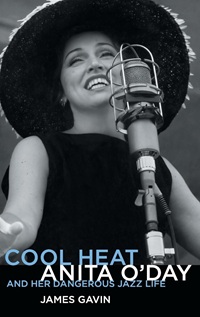 Cool Heat: Anita O'Day and Her Dangerous Jazz Life
 James Gavin
214 Pages
ISBN: # 978 80050 309 0
Equinox
2026
The last words James Gavin writes of the jazz singer, Anita O'Day in Cool Heat: Anita O'Day and Her Dangerous Jazz Life are in thanking the Equinox publication staff for ..."paving the way for me to tell one of the greatest stories in jazz."
For more than two decades, James Gavin has distinguished himself as a premier scholar of jazz history, specializing in the genre's most psychologically complex figures. In thoughtful biographies such as Deep In A Dream: The Long Night of Chet Baker and Stormy Weather: The Life of Lena Horne, Gavin consistently eschews the binary conventions that frequently compromise musical historiography: hagiographic idealization and moralistic sensationalism. Rather than reducing his subjects to cautionary tales, he employs a rigorous method that presents the historical record with a strict minimum of judgment. By allowing raw facts to speak for themselves, Gavin avoids imposing a definitive moral framework, choosing instead to let flawed historic lives retain their inherent contradictions.
This analytical sophistication is fully realized in Cool Heat: Anita O'Day and Her Dangerous Jazz Life. O'Day was a formidable innovator whose revolutionary rhythmic acuity altered mid-century jazz vocals. Crucially, Gavin mirrors his subject's artistic method within the very architecture of the text. The biography is a remarkably concise, kinetic work, structured with a velocity that mimics the syncopations of scat singing. This frenetic narrative pacing serves a deliberate thematic purpose, structurally replicating the chaotic trajectory and professional instability of O'Day's career. Within this rapid framework, Gavin provides critical musicological analysis of O'Day's seminal mid-century output for Verve Records. He traces how her monumental discography of the '50s and '60s coexisted alongside severe personal and systemic challenges, including addiction and institutional misogyny. Here, Gavin's neutrality acts as his greatest asset. He documents her legal crises, drug overdoses, and professional triumphs with an evenhanded detachment that neither excuses nor condemns. Gavin captures the uncompromising ethos that defined her career: "I will live exactly as I choose." Yet, his analysis remains objective, mapping the profound liabilities generated by that defiance without ever moralizing the underlying trauma.
The distinctiveness of Cool Heat becomes clear when contrasted with Deep in a Dream. Though both monographs analyze the intersection of jazz virtuosity and substance abuse, they possess antithetical narrative energies dictated by the agency of their subjects. Chet Baker operated primarily as a passive catalyst of his own ruin, letting addiction dictate a decline that Gavin charts like a chilling, slow-motion autopsy. Conversely, O'Day functioned as an active agent who fiercely navigated her own trajectory, confronting medical emergencies and the gendered hierarchies of the big band era with remarkable resilience. As a result, Cool Heat reads as a high-velocity momentum study. Where Baker succumbed to inertia, O'Day engineered her own survival against overwhelming structural odds. Throughout both narratives, Gavin's stylistic signature remains his refusal to adjudicate the character of his subjects, trusting the reader to navigate the tension between human failing and artistic brilliance. Cool Heat exemplifies a rare form of historical compassion born directly from this absence of moral arbitration. By refusing to simplify O'Day's chaotic reality, Gavin honors both the formal innovation of her discography and the severe precarity of her life, establishing a blueprint for objective, empathetic musical biography. At once bracing and matter-of-fact, Gavin completes O'Day's biography thusly:
One last audience awaited her. Anita O'Day: The Life of a Jazz Singer, co-directed by [Robbie] Cavolina and Ian McCrudden, was finally ready, and Cavolina screened the documentary at the Fine Arts Theater in Beverly Hills. The 410-seat house seemed nearly full. As O'Day sat in the back in a wheelchair, fans saw her onscreen cheerfully narrating her story. It was illustrated by a wealth of old footage and comments from Johnny Mandel, Russell Garcia, Bill Holman, Buddy Bregman, and other former colleagues. Cavolina had even located Denny Roche, the trumpeter and ex-boyfriend whom she had nearly dragged down with her in the early '50s. Although the exchange didn't appear in the film, Cavolina had been the first to tell him that O'Day had aborted his child. He started to cry.
As the closing credits rolled, someone shouted, "THERE'S ANITA!" Everyone turned and spotted her. They gave her a huge, prolonged standing ovation. Seldom had she shown her soft side to the public; now they saw her on the verge of tears.
A few weeks later, O'Day developed the flu; it escalated into pneumonia. Cavolina put her in a nursing home in West Hollywood. Two days before Thanksgiving, he was at her bedside when she hugged him and, in a rare show of sentiment, managed to declare: "You made my life. You did what you said you were going to do." Her final words held a ring of farewell. "What's the matter?" he said. "I'll be taking you to my house for turkey dinner." She didn't want to wait. "Get me out of here," she told him.
Two days later, at 6:17 am on Thursday, November 23, 2006, someone at the hospital woke him with a call. O'Day had died in her sleep of heart failure. She was 87.
 FOLLOW C. Michael Bailey
and get notified whenever a new article published.
FOLLOW C. Michael Bailey
and get notified whenever a new article published.
I'm Sanctified and Southern Fried / Mama tried and daddy cried / I tell the truth 'cept when I've lied / And like my huevos on the side.
About Anita O'Day

Tags
PREVIOUS / NEXT

Become a Sustaining Member

Since 1995, All About Jazz has championed jazz as an art form and supported the musicians who create it. Over three decades, it has grown into one of the world's leading jazz resources, serving hundreds of thousands of readers, musicians, presenters and industry professionals each month.
Help Build the Future of All About Jazz
Your support helps us continue building All About Jazz for the next generation—expanding our editorial coverage, preserving jazz history, developing new community features and creating better ways to discover the music and the people behind it.
Become a sustaining member for as little as $20 per year and you'll immediately enjoy an ad-free experience along with access to subscriber features and future articles for a full year.
Together, we're not simply sustaining All About Jazz—we're building its future. Thank you for being part of the journey.