Home » Jazz Articles » Interview » Chris McNulty: A Siren From Down Under
Chris McNulty: A Siren From Down Under

Naïveté and Composition
AAJ: You have admitted that you also bring a certain naïveté to composing.
CM: Well, if you were to interpret not having come out of a schooled background, I guess you could say that. I think I alluded to this in an earlier question. My musical education and background has been of an informal variety, so I did not learn the fundamental or rudimentary forms of harmony first. I stumbled over things as I matured and sometimes the discovery might have appeared kind of innocent, I think that's what I was alluding to.
But I don't think the music that I write could be classified as naïve either. The harmony is mostly untraditional therefore fairly complex, it's neither awkward nor simple, that's just the way I hear it. I think the fact that I am also a singer first has affected a certain development in my writing. I hear intricate harmony but have the added advantage of knowing what to hear naturally, based on what the voice can do.
Because I write from the piano, my compositions are obviously going to be more pianistically based, though I am not a pianist per se. The harmony I write can occasionally be difficult to negotiate because there's rarely any II-V-I harmony involved and the modality is shifting constantly. But as several musicians have pointed out, the music still works, logically speaking, because the melodies I create have to be strong. I don't mean in a catchy, poppish way, but in a way that has to hold the harmony together.
The melody functions by threading a needle so to speak through what sometimes feels like a harmonic maze or should I say rather a harmoniccraze. Rhythmically speaking, I wish I could make my compositions more naïve. Just this week I completed a new piece and for the life of me, I was trying to write something in straight 4/4 time—I have a desire to want to sing something of mine that I don't have to sweat bullets having to count for the entire time, even if my partner thinks not [laughs].
My weakest gap is in writing rhythm, so after several attempts at scoring on paper, I was still unhappy with the way the piece was sitting or flowing. Once I gave up on the notion that it was in 4/4, I was able to write it out fairly quickly. The song is in 6/4 with a couple of 4/4 bars. Ho-hum...the simple 4/4 tune remains elusive still.
Selected Discography
Chris McNulty, The Song That Sings You Here (Challenge, 2012)
Sam McNulty, (aka Chap One), Strange Frequencies (Elefant Dreams, 2012)
Paul Bollenback, Invocation (Elefant Dreams, 2007)
Chris McNulty, Whispers the Heart (Elefant Dreams, 2006)
Paul Bollenback, Brightness of Being (Elefant Dreams, 2006)
Chris McNulty, Dance Delicioso (Elefant Dreams, 2005)
Chris McNulty, I Remember You (Mop Top-Elefant Dreams, 2004)
Chris McNulty, A Time for Love (Amosaya Records, 1995)
Chris McNulty, Big Apple Voices (Venus Records, 1994)
Chris McNulty, Waltz for Debbie (Discovery Records, 1991)
Photo Credits
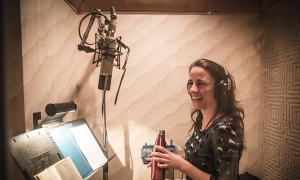
Pages 1, 4: Lena Adasheva
All Other Photos: Courtesy of Chris McNulty
About Chris McNulty

Tags
PREVIOUS / NEXT

Become a Sustaining Member

Since 1995, All About Jazz has championed jazz as an art form and supported the musicians who create it. Over three decades, it has grown into one of the world's leading jazz resources, serving hundreds of thousands of readers, musicians, presenters and industry professionals each month.
Help Build the Future of All About Jazz
Your support helps us continue building All About Jazz for the next generation—expanding our editorial coverage, preserving jazz history, developing new community features and creating better ways to discover the music and the people behind it.
Become a sustaining member for as little as $20 per year and you'll immediately enjoy an ad-free experience along with access to subscriber features and future articles for a full year.
Together, we're not simply sustaining All About Jazz—we're building its future. Thank you for being part of the journey.