Home » Jazz Articles » Catching Up With » Brain Food: A Conversation with Hiromi Uehara
Brain Food: A Conversation with Hiromi Uehara
I never really have pressure in creating music...This is my food, and I love it!
"I've been performing a lot on tour, pretty much every day. I'm just really trying to explore the new sound of the trio. I see the three instruments not just as piano and two side instruments, but as a three-piece orchestra. That's how I see the music. When I write the music I try to write the bass part [and] the drum part as if I'm scoring a big band piece"
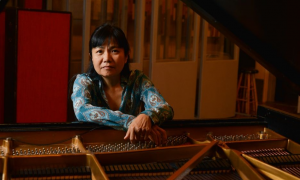
Hiromi came to the United States from her native Japan in 1999, to study at Boston's prestigious Berklee College of Music. Soon after, she achieved overwhelming success with her debut album Another Mind. Her artistic growth continues with Brain.
"With the second album, I wanted to do something like a short film soundtrack. So, these tunes have a story plot, sort of like a play. That was the biggest change from the first album. I really wanted to have a visual image; I'm the soundtrack maker and I want the listener to be a movie director."
Brain grabs your attention right away with the first track, "Kung-Fu World Champion," which leaps off the disc and delivers a funky dropkick. The piece is dedicated to Bruce Lee and Jackie Chan, two of Hiromi's idols.
"I was watching many movies of them [Chan, Lee] and one day I was watching a Jackie Chan 'the making of' feature, and I got to know how he creates the whole movie. It was like a little bit of entertainment, a little bit of artistry... and I found out it was really close to improvisation in jazz. I wanted to bring what Jackie [Chan] does in Kung Fu to what I do on piano."
Just talking about "Kung-Fu World Champion" seems to energize Hiromi. But, she says that her favorite track on the album is actually the title track, which expresses the theme of the album.
"Well, I just realize that most of the time in life what you want to do and what you should do is different and there is always a huge discussion within yourself, between reason and emotions. I wanted to try to find a way to describe that fight in music."
For Hiromi, the blending of acoustic piano and electric sounds, as in "Kung-Fu World Champion" and "Brain," is completely natural. She politely, but firmly, dismisses the complaints of any "purist" critics who cry foul at the use of the electric keyboard.
"I never really have pressure in creating music. I just want to release an album, which I am satisfied and confident with. It's like opening a restaurant -some people prefer Italian food and some prefer Japanese food. This is my food, and I love it! Maybe some people prefer another type of food, but music is about whether you feel it or you don't feel it and this is what I feel good with. I really needed a keyboard sound in particular tunes and it was very natural for me to use that instrument. It was just a natural sound that I composed and used."
At 25, with two outstanding albums and a growing fan base, Hiromi is visibly delighted with, and amused at her success.
"It's surprising to see myself on a magazine cover. Last year I might have played one night in a club and this year I can play two nights and these small things make me happy. Sometimes I get to meet people who have come to my show for the second time, or third time and that always makes me feel happy because I love sharing music and emotions with people and there is nothing happier than that to me."
 FOLLOW Kevin T. Cox
and get notified whenever a new article published.
FOLLOW Kevin T. Cox
and get notified whenever a new article published.
Kevin T. Cox is a freelance writer/photographer from Boston, MA.
About Hiromi
Tags
PREVIOUS / NEXT

Hiromi Concerts

Become a Sustaining Member

Since 1995, All About Jazz has championed jazz as an art form and supported the musicians who create it. Over three decades, it has grown into one of the world's leading jazz resources, serving hundreds of thousands of readers, musicians, presenters and industry professionals each month.
Help Build the Future of All About Jazz
Your support helps us continue building All About Jazz for the next generation—expanding our editorial coverage, preserving jazz history, developing new community features and creating better ways to discover the music and the people behind it.
Become a sustaining member for as little as $20 per year and you'll immediately enjoy an ad-free experience along with access to subscriber features and future articles for a full year.
Together, we're not simply sustaining All About Jazz—we're building its future. Thank you for being part of the journey.