Home » Jazz Articles » Album Review » Art Blakey & The Jazz Messengers: Blue Moon Over Paris:...
Art Blakey & The Jazz Messengers: Blue Moon Over Paris: ORTF Recordings 1963 and 1968
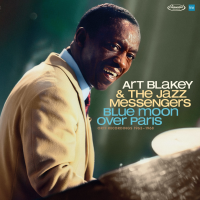
Blue Moon Over Paris: ORTF recordings 1963 and 1968 is a limited-edition, 180-gram, 2-LP collection from Elemental Music, produced by Zev Feldman, mastered from the original tapes by Matthew Lutthans at The Mastering Lab in Salina, Kansas, and pressed at GZ Media in Loděnice, Czech Republic.
The first set was recorded at L'Olympia Theater in Paris on April 25, 1963. At that time, the iconic sextet comprised Art Blakey on drums, Freddie Hubbard on trumpet, Wayne Shorter on tenor sax, Curtis Fuller on trombone, Cedar Walton on piano, and Reggie Workman on bass.
The moment Shorter wets his reed and Hubbard presses the mouthpiece to his lips, we hear the grateful audience applaud. It is as if they possess the prescience to anticipate the spectacle that is coming their way.
The first tune is "Moon River" and the band dives in headlong. After Shorter's first glowing appearance, Hubbard takes his turn and is equally radiant. Next, a trombone solo from Fuller emerges, likewise incandescent. Walton and Workman also shimmer. Lambent in its entirety, listeners can only hope the shine of this introduction will persist throughout the evening's performance. They will not be disappointed.
During "Buhaina's Delight," Workman lays down a sublime bass line, unbridled by register, which is a subtle precursor to his ornate soloing that soon follows. Blakey's metronome-steady cymbal sticking gives way to locomotive-like snare work and unrelenting hi-hat play, which in turn yields to tom strikes and rim clicks, before the entire kit rocks. Aptly named, this delight is propelled forward with compelling force.
On "I Didn't Know What Time It Was," after a brief, light piano introduction, Shorter's honeyed saxophone solo enraptures the audience. His gorgeous tonality is delicately supported by Cedar Walton on piano and Reggie Workman on bass. Along with Blakey's subtle touch, this rhythm enchants, providing a quintessential accompaniment for Shorter's spotlight performance, which does indeed possess the power to erase the concept of time. A breath seems to be taken here , offering a brief respite—just a moment of stillness—before the tempo rises again on the track that follows, "Caravan."
Ah, "Caravan." The tune was written in 1936 by valve trombonist Juan Tizol and Duke Ellington and, most notably, covered by innumerable artists and captured on more than 500 recordings. Such a statistic should intimidate and make it difficult for any one performance to stand out, yet this spectacular hard bop version clearly does—triumphantly so.
In addition to this historic recording collection itself, the accompanying liner notes exquisitely capture the majesty and relevance of the music and those who created it.
As a centerpiece, an extraordinarily thoughtful, masterfully penned essay by the incomparable Bob Blumenthal stands out. Zev Feldman warmly introduces this Elemental Music archival production, and other notes include excerpts from Feldman's noteworthy conversations with Billy Harper, Julian Priester, and Blakey's close friend Cindy Blackman Santana, from April of 2026. The liner also features a heartfelt reminiscence by Blakey's son, Takashi, who reflects on his father's adoration of Paris and the comfort he found there.
It is worth noting here that this body of work is the latest example of Feldman's rich and productive ongoing collaboration with France's Institut National de l'Audiovisuel (INA), which oversees the archives of Office de radiodiffusion-télévision française (ORTF), the French Radio and Television Broadcasting Office.
The second set on this album was recorded five and a half years later at Salle Pleyel, Paris on November 6, 1968. At that time, the new composition of The Jazz Messengers brought together Bill Hardman on trumpet, Julian Priester on trombone, Billy Harper on tenor sax, Ronnie Matthews on piano, and Lawrence Evans on bass.
Some might say five years makes a difference. While others might contradict that line of thinking by asking, How much stays the same? What is indisputable is that while the constituent elements of The Jazz Messengers between 1963 and 1968 were distinctly different, similarities prevail, with Blakey's inspirational leadership being the constant.
In both sessions, the audiences' response acts almost as a seventh member of the ensemble, helping shape each piece and coloring the way today's listeners apprehend what they hear.
The Salle Pleyel set leads off with two back-to-back marathon pieces—each more than 14 minutes long. In both instances, Priester's versatility and virtuosity stand out. "Slide No. 1" eases into the session with such clearly defined instrumentation that it is pleasantly challenging to take in the ensemble as a whole. That is not to say the players fail to coalesce; it is simply the acknowledgment that each musician offers his respective individual contribution with singular artistry.
"Blues for Eros" continues to thrill in all aspects, and it is easy to imagine the feelings shared by those in attendance, appreciating their good fortune, knowing that they are witnessing a rare spectacle of human achievement, yet unaware that they are contributing to a part of history that is being captured for listeners of the next century to enjoy.
Harper's solo saxophone's plaintive tone on "You Don't Know What Love Is" reverberates as if through an empty hall. The song, like the title itself, resonates like an accusation and feels like spurned love.
Upon the audience's recognition of the first strains of the tremendously popular "Moanin'" they simply erupt. And the band matches their enthusiasm. In his fervent trombone solo, Priester is once again magnificent, adding dimension to an already luminous work. Matthews follows with a riveting extemporization that seems to hold everyone, including his bandmates, in thrall. Then it is time for bassist Evans to have his say. Everyone else remains silent throughout his stunning solo. Then the familiar introductory melody is reprised, leading the entire band to a blazing cohesive conclusion to this monumental performance.
On the following track, "Blue Moon," trumpeter Hardman walks the audience into a sultry night under that namesake celestial body, showcasing his extraordinary tone and improvisational skill. This Blue Moon does not leave anyone standing alone, as the 1934 lyric written by Lorenz Hart for Richard Rodgers' composition would have us believe. Instead, listeners may find themselves clinging together, deeply moved, wet-eyed, and collectively breathless.
Finally, thunder crashes from Blakey's kit and its accompanying electrical discharge ignites the finale, "The Theme." It is a raucous conclusion. And there is an unmistakable theme at work here: an artistic, orchestral theme that spans both of these sets across a five-and-a-half-year period. It is a theme to which no superlatives can do justice. Art Blakey & The Jazz Messengers bring together a pedigree of players possessing the talent to create an experience of gripping intensity, capable of captivating listeners—then and now.
 FOLLOW Keith Flint
and get notified whenever a new article published.
A passionate observer and inquisitive, attentive listener.
Track Listing
Moor River; Buhaina's Delight; That Old Feeling; I Didn't Know What Time It Was; Caravan; Slide No.1; Blues For Eros; You Don't Know What Love Is; Moanin'; Blue Moon; The Theme.
Personnel

Art Blakey
drums
Freddie Hubbard
trumpet
Curtis Fuller
trombone
Wayne Shorter
saxophone
Cedar Walton
piano
Reggie Workman
bass
Bill Hardman
trumpet
Julian Priester
trombone
Billy Harper
saxophone
Ronnie Mathews
pianoLawrence Evans
bassAlbum information
Title: Blue Moon Over Paris: ORTF Recordings 1963 and 1968 | Year Released: 2026 | Record Label: Elemental Music
About Art Blakey
Tags
PREVIOUS / NEXT

Become a Sustaining Member

Since 1995, All About Jazz has championed jazz as an art form and supported the musicians who create it. Over three decades, it has grown into one of the world's leading jazz resources, serving hundreds of thousands of readers, musicians, presenters and industry professionals each month.
Help Build the Future of All About Jazz
Your support helps us continue building All About Jazz for the next generation—expanding our editorial coverage, preserving jazz history, developing new community features and creating better ways to discover the music and the people behind it.
Become a sustaining member for as little as $20 per year and you'll immediately enjoy an ad-free experience along with access to subscriber features and future articles for a full year.
Together, we're not simply sustaining All About Jazz—we're building its future. Thank you for being part of the journey.