Home » Jazz Articles » Live Review » Wayne Shorter Quartet with NEC Philharmonia, Boston
Wayne Shorter Quartet with NEC Philharmonia, Boston
Jordan Hall, New England Conservatory
Boston, Massachusetts
October 24, 2009
Crushing waves, pound against jagged stone. Water breaks into spotted foam, falling, rising, then pounding again. The sounds splash and spray, captivating a stunned and silent audience.
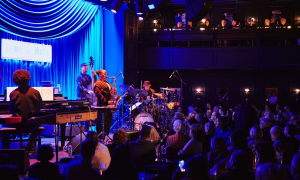
The Wayne Shorter Quartet took the stage for the final performance of the New England Conservatory's 40th anniversary celebration of jazz studies. For its second set, the Quartet was accompanied by the NEC Philharmonia, conducted by Hugh Wolff. The results were noteworthy.
"I knew Wayne had been performing with orchestras," explained Ken Schaphorst, presiding jazz studies chair. "I thought this might be fitting to have a concert that goes beyond jazz and includes the classical students."
It would only be too easy to describe this event as a performance combining elements of classical music with jazz. There was more at work here. This was a cinematic expression of sound.
"These pieces have never really been played," Shorter stated, noting "Promentheus Unbound" as the band's lone exception. "What we do as a quartet is prepare for the unexpected—live reality performance."
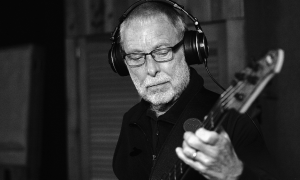
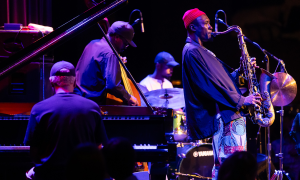
The first piece, "Orbits," began with John Patitucci's walking bass figures. He broke into dissonant sounds, as drummer Brian Blade worked percussive rhythms. While pianist Danilo Pérez plodded through fragmented chord phrasings, the audience sat mesmerized, even though Wayne Shorter's saxophone hadn't uttered a single sound.
 As the band wound down, Shorter played his first, brief phrasing. Patitucci bowed the bass; Blade's cymbals emitted splashing sounds. The tempo was slow, almost brooding, as Shorter played ethereal lines. The music flowed in unexpected ways, slowing when you anticipated it might move faster, disparate sounds not combining.
 Blade continued working a closed hi-hat cymbal, producing a thumping sound. Patitucci aggressively plucked the bass, emphasizing what Blade was building. Shorter returned. And then, right when you expected things to explode, the music turned light and airy, ascending towards a place of sunlight and sky.
"I'm celebrating something called nobility... courage... fearlessness," said Shorter. "These things have to be worked on. When we actually perform without rehearsing, some of this interplay, about trust and all that stuff, and nobility, and integrity, will be a parade of all of that transpiring. We have to trust each other. In order to do that everyone has to keep studying music. What it is, the nature of it, not just the rules, but the nature."
Wayne Shorter has been an active member of the jazz scene for over five decades. The seminal acts with which he has performed and written include: Art Blakey and the Jazz Messengers, the Miles Davis Quintet, and Weather Report.
When discussing playing with his present Quartet, Shorter stated: "I think we all kind of recognize something that we [each] had before we played with anybody. It's what Miles wanted to record, what I was writing right away, something children or infants have given up when they become adults. It's like 'Now get back those memories you threw away when you were a kid and tell that story.'" Shorter laughed, drawing up a memory of playing with Blakey. "Blakey would be kicking those drums saying 'Tell that story, tell that story!' With Blakey, I had a book of study I was working on and he'd say 'Let's play this. Let's play that.' What he liked was the innocence of it."
Shorter recalled a similar experience with Davis. "One time, I was at his house before I joined his band. He sat me at a piano [and] said play something." Shorter was reluctant, but Davis kept prodding, encouraging Shorter to play anything. "I think Mies was drawn to something called innocence, no expectations. People would bring [music to him] and Miles would say 'Oh, You're trying to be cute,' and strip it down. He was trying to get to the essence of it."
As someone who learned music in a university setting as well as through bandstand jam sessions, a single word summarizes Shorter's learning experiences—challenge. "What I find challenging is that the person involved has to, at the earliest point in time, always look at the real challenge in themselves. I think music students, in school or out of school, should study music philosophy. Get some kind of philosophy, the interaction of humanity, then you'll know what's really challenging you. You're on the road to think for yourself, feel, I like to call it."
Feeling and emotion dominated the performance. Shorter brought the audience through stellar journeys, earthy landscapes, and quiet, reflective places. Rhythmic pulses combined with orchestral strings as the music of "Flagship," "Prometheus Unbound," "Midnight in Carlotta's Hair," and "Forbidden Plan-it!" rounded out the set.
"The object of education is happiness," Shorter explained. "The big challenge for me is writing music that celebrates eternity." Perhaps these ideas are influenced by Shorter's Buddhist beliefs. Perhaps they are personal or creative challenges. Whatever their origins, they contributed to a magical performance, reflecting the oceans of creativity that churn in Wayne Shorter's mind.
 FOLLOW Timothy J. O'Keefe
and get notified whenever a new article published.
FOLLOW Timothy J. O'Keefe
and get notified whenever a new article published.
Tim O'Keefe covers jazz in the Boston area.
About Wayne Shorter

Tags
PREVIOUS / NEXT

Become a Sustaining Member

Since 1995, All About Jazz has championed jazz as an art form and supported the musicians who create it. Over three decades, it has grown into one of the world's leading jazz resources, serving hundreds of thousands of readers, musicians, presenters and industry professionals each month.
Help Build the Future of All About Jazz
Your support helps us continue building All About Jazz for the next generation—expanding our editorial coverage, preserving jazz history, developing new community features and creating better ways to discover the music and the people behind it.
Become a sustaining member for as little as $20 per year and you'll immediately enjoy an ad-free experience along with access to subscriber features and future articles for a full year.
Together, we're not simply sustaining All About Jazz—we're building its future. Thank you for being part of the journey.
Near

Boston Concerts