Home » Jazz Articles » Book Review » The Rolling Stones - The Biography
The Rolling Stones - The Biography
Skillfully manipulated and amplified through his choice use of words conveying memorable and very real images into the mind’s eye of his readers, Spitz produces a palpable sense of anxiety and growing expectation.
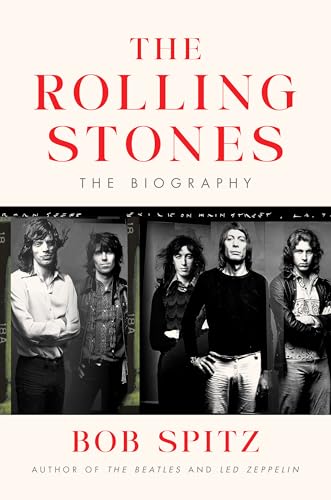 The Rolling Stones, The Biography
 Bob Spitz
704
ISBN-10 : 0593489098 ISBN-13 : 978-0593489093
Penguin
2026
Anticipation mounts as the lights are turned down low and finally... the curtain rises and the announcement from the PA system bellows—"Please welcome the Greatest Rock 'N' Roll Band in the World—The Rolling Stones!
That endorphin rush never fails to well up upon hearing those words accompanied by the unmistakable sound of the most dynamic, long-standing rock 'n' roll band the world has ever known. And that's how this book reads; it's a page turner. As if reading a best seller, despite knowing what comes next, Bob Spitz takes his readers on a ride from the innocent beginnings of two youngsters, fresh-faced teenagers meeting on a train station platform to marvel over the other's modest collection of blues albums—a mail order delivery from Chess Records in Chicago to the tumultuously storied, much-reported-on life as a member of The Rolling Stones. He tells of a young optimistic Brian Jones whose vision of the blues played out in a west London club attracted the pair of kids who, too, had sought inspiration from its birthplace in Chicago.
The band with Mike (his given name) Jagger, initially described by many as an awkward performer with questionable vocal skills, and Keith Richards, his guitarist friend with noticeably large ears whose early fascination with Chuck Berry's guitar style would eventually help define the sound of modern rock and roll were still not together enough to make much of a name for themselves in the club scene.
First Bill Wyman on bass, a mature man with a wife and child—an anomalous background which initially put the others off—joined the band followed soon after by Charlie Watts, an aspiring drummer of growing renown among sophisticated jazz acolytes in "sleepy London Town." With a coherently skilled rhythm section finally in place, Jones' multi-talented instrumentalism and devotion to R&B, Jagger's developing stage presence, and the solid sound of Richards' prowess on guitar, they were poised for a relatively rapid ascent to stardom.
Not to say that the going was easy, as Spitz reveals the earthy, at times grimy, details—including the squalor of their west end apartment and Brian Jones' descent into debilitating substance abuse—of the unlikely journey this cover band took to become the "greatest rock 'n' roll band in the world." From an initial gig after a rare London snowstorm on a Sunday afternoon with barely 30 kids in attendance, to an overflowing crowd numbering over a hundred two weekends later, the word quickly spread. This band had to be seen. And they were and, unbelievably, are still touring and recording more than sixty years later.
Spitz dissects the dynamics that propelled the band forward. An 18-year-old, self-taught con artist, Andrew Loog Oldham, decided he was in charge of this disparate group of strong personalities, and somehow it worked. People bought into his stories and, like the Leonardo DiCaprio character in "Catch Me If You Can," Oldham sold the band, arranged for their initial recordings and is credited as the "producer." Oldham only had stories, but they flew true and these Rolling Stones (altered from "Rollin' "as they were first billed) really got rolling.
Relying on first-hand accounts, quoting girlfriends, wives and children, business associates, friends, record producers, other musicians and the band members themselves, this biography rings true above the usual overblown hyperbole or uncompromisingly biased slagging. The group members come off as they were—flawed human beings, as well as ambitious and immensely talented musicians. At times flattering in tone, the savvy Mick was the flashpoint then as he is now and is portrayed as the motivational force behind this extraordinarily durable marketplace entity.
Marianne Faithfull, Mick's lover and partner after discarding Chrissie Shirmpton, comforted him when he was sentenced to jail, describing him as shedding real tears in despair, imagining he had thrown his life away. Not really a "street-fightin'" man nor too proud to beg, Jagger, with a middle-class background and schooling at the London School of Economics, had no stomach for the consequences and notoriety created in their carefully cultivated image of miscreant rebels. Hardly a hard-core criminal (he was sentenced to prison for possession of four amphetamine tablets), he was released a day later.
When were they first called "the Greatest Rock 'N' Roll Band in the World?" With no one else around, road manager Sam Cutler was asked to introduce the band as they took the stage in Fort Collins, Colorado, for the opening concert of their 1969 return to touring after a two-year hiatus from the irresistible spectacle of live performances. Uncharacteristically at a loss for words, the usually loquacious Cutler paused for a moment after "Please welcome," then blurted out "the Greatest Rock N Roll Band in the World—The Rolling Stones!" and thus they shall be known for eternity. Chastised by Mick afterward for the over-the-top intro, Cutler, without hesitation, immediately rebuked him—"You either are or you're not" and left it at that.
Spitz's style has seemingly evolved over time. His similarly detailed biography of The Beatles begins with tracing the Lennon family back to Ireland and the dire circumstances forcing emigration to Liverpool. Initially a factually dry, history including details of the cotton trade and the Liverpool ports, it did not immediately grab this reader, missing the vigor with which he embarks upon The Stones' tale. The anxious account of the mania surrounding their early live performances oozes with energy as he places the reader within the confines of the small north London club, The Crawdaddy, that even attracted attention of their dauntingly successful competition to the north in Liverpool. In contrast to Spitz's earlier work, he communicates the excitement when The Beatles dropped in to witness a swarming scene of excited teenagers and the unearthly din of amplified guitars bouncing off the dingy walls inside the packed, dank and damp-with-sweat club. George and Ringo eventually departed wide eyed, indubitably impressed.
Skillfully manipulated and amplified through his choice use of words conveying memorable and very real images into the mind's eye of his readers, Spitz produces a palpable sense of anxiety and growing expectation. Each chapter ends with carefully constructed narrative suspense, motivating this reader to continue, to turn that page and read on with unexpected and fresh anticipation of familiar events presented with obscure, extremely colorful background details.
As with a carefully crafted James Bond or Agatha Christie novel unfolding, the time taken to run through the 700+ pages passes in a flash... and "it's a gas, gas, gas."
 FOLLOW Thomas Cole
and get notified whenever a new article published.
FOLLOW Thomas Cole
and get notified whenever a new article published.
A world traveller in the past, and now... an obsessive writer and observer of life.
About The Rolling Stones

Tags
PREVIOUS / NEXT

Become a Sustaining Member

Since 1995, All About Jazz has championed jazz as an art form and supported the musicians who create it. Over three decades, it has grown into one of the world's leading jazz resources, serving hundreds of thousands of readers, musicians, presenters and industry professionals each month.
Help Build the Future of All About Jazz
Your support helps us continue building All About Jazz for the next generation—expanding our editorial coverage, preserving jazz history, developing new community features and creating better ways to discover the music and the people behind it.
Become a sustaining member for as little as $20 per year and you'll immediately enjoy an ad-free experience along with access to subscriber features and future articles for a full year.
Together, we're not simply sustaining All About Jazz—we're building its future. Thank you for being part of the journey.