Home » Jazz Articles » Live Review » Terence Blanchard & Ravi Coltrane: Miles Davis & John Co...
Terence Blanchard & Ravi Coltrane: Miles Davis & John Coltrane Centennial At Miner Auditorium
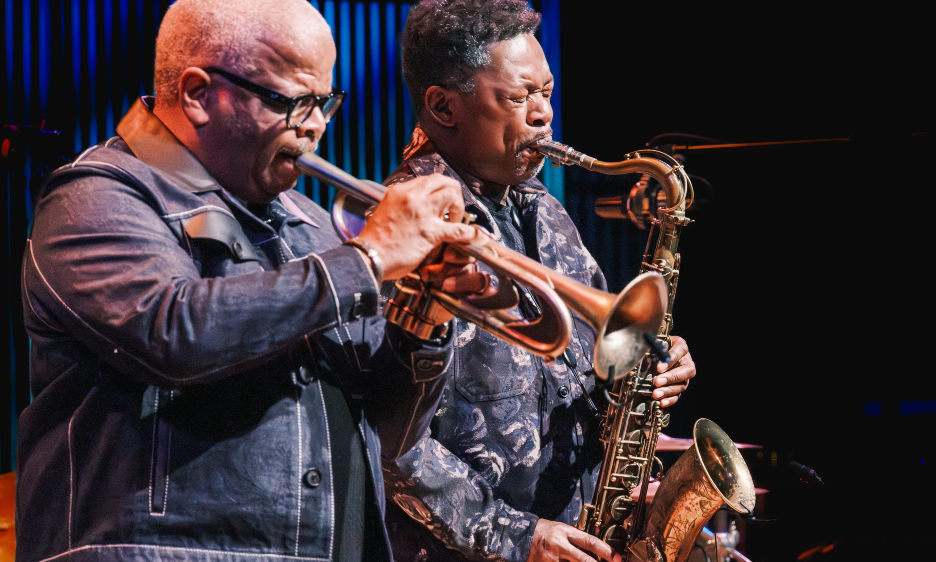
Courtesy Steven Roby
Miner Auditorium
Miles Davis & John Coltrane Centennial
San Francisco, CA
May 31, 2026
At SFJAZZ's Miner Auditorium, Blanchard and Coltrane treated the Miles Davis songbook as an ongoing conversation.
Over the past six months, Bay Area jazz fans have enjoyed a series of centennial celebrations honoring Miles Davis and John Coltrane. This past weekend in Oakland, as part of the Coltrane Centennial, the Saint John Will-I-Am Coltrane African Orthodox Church hosted a vibrant musical gathering featuring its legendary church band and choir.
In recent months at SFJAZZ, we've seen a slew of live Coltrane/Miles tributes, including Emmet Cohen and The M.E.B. (Miles Electric Band), which featured Davis's nephew, Vince Wilburn Jr., and Miles alum Keyon Harrold on trumpet. There was also a Miles tribute from local jazz orchestra leader Marcus Shelby, and across town, percussionist Mino Cinélu and pianist John Beasley performed their homages at the Presidio Theatre.
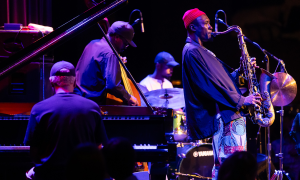
Last Sunday, trumpeter and SFJAZZ's Executive Artistic Director Terrence Blanchard, along with John Coltrane's son Ravi, capped off a four-night residency and the Center's 2025-26 season with an event billed as a Miles Davis & John Coltrane Centennial. It's been a heyday for jazz fans, both new and old.
The duo's commemorative show at Miner Auditorium is part of a limited global tour celebrating the joint centennial, with upcoming stops in Germany and France, and it concludes in Washington, D.C., in November. However, the show's structure is skewed in Blanchard's favor: he gets top billing, uses his band the E Collective, and the set features two compositions from his 2005 album Flow.
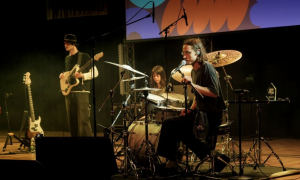
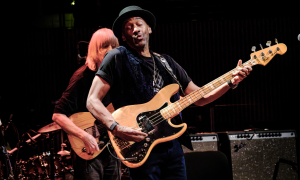
For his SFJAZZ residency, Blanchard used an alternate band lineup from the one advertised: David Ginyard Jr., Oscar Seaton, and Julian Pollack were replaced by Tom Oren (piano, keyboards, and synth), Alex Smith (bass), and Mark Whitfield Jr. (drums).
A Different Opening Statement
On Sunday night, Blanchard walked out, trumpet in hand, and joined the E Collective, already in full swing. What emerged was "Flow," neither a Miles Davis standard nor a Coltrane composition. Blanchard's horn was run through an effects pedal, and the sound fell somewhere between a Harmon-muted trumpet and an overdriven electric guitar. Before a single note of the shared repertoire was played, the evening's aesthetic thesis was already in place.This was not going to be a note-for-note tribute. "One of the things we're not doing tonight, we're not doing the original arrangements," Blanchard stated at the start. "If you came here to hear what was on the records, I feel sorry for you." The audience's laugh acknowledged the point. It was a gentle provocation, but it carried weight. Blanchard was asking the room to let go of a certain kind of reverence and trade it for something more demanding. Forget (or forgive) the use of electric bass, keyboards, and guitar, and, er, go with the "flow."
Inheritance Over Recreation
Sunday evening's repertoire was drawn entirely from the years 1958-1961 when Miles Davis and John Coltrane played and recorded together. "Flamenco Sketches," from Kind of Blue, arrived early in the set, its open modal structure inviting the kind of spacious, patient improvisation the composition has always demanded. But the arrangement didn't try to reproduce the recording's famous atmosphere. It simply used the form as a frame, letting the musicians bring their own present tense to it."On Green Dolphin Street" pushed further into that territory, with Blanchard and Coltrane delivering a blazing two-horn encounter. The tune moved through its changes with a looseness that felt earned rather than casual: the rhythm section held its ground as Blanchard and Coltrane exchanged ideas above it, their conversation elastic and unscripted. The real-time negotiation between the two horns was where the performance made its strongest case for the residency's premise. Neither musician played toward the other's legacy. Both played toward the music.
Ravi Coltrane and the Weight of a Name
The most quietly remarkable thing about the evening was Ravi Coltrane's restraint. The pressure the Coltrane surname places on any saxophonist who bears it is obvious, and the temptation to lean into it—to deploy a few strategic phrases that nod to the father—must be constant. Ravi doesn't do that.His playing is linear and controlled, whereas John Coltrane's could be torrential. He finds tension in space and pacing rather than in density. During a public soundcheck, Blanchard described Ravi as "an amazing individual to have his own voice on that instrument in this day and age," and the performance made it clear why that achievement mattered. The most visible tribute to John Coltrane in Ravi's playing was his refusal to impersonate him.
The Medley and the Collective
The set's most striking passage came in the mash-up. "Someday My Prince Will Come" folded into "All Blues" and then into "Teo," the transitions so smooth that the seams disappeared. The sonic conversation between tunes flowed without interruption, each piece surfacing from within the previous one rather than following it. Guitarist Charles Altura moved through arpeggios with an ease that made the harmonic complexity feel inevitable. The rhythm section—Alex Smith on a five-string bass, Mark Whitfield Jr. on drums—held the medley's shape while leaving space for it to breathe.The evening's final tune, "Two Bass Hit," pushed that energy into its most insistent form before the encore pulled the temperature back down.
Throughout the night, Blanchard served as MC and shared anecdotes, but it would've been nice if he had let Ravi say a few words between songs about his father. Instead, Ravi sat on a stool while Blanchard handled all the commentary.
Closing: "Benny's Tune"
The encore was "Benny's Tune," written by guitarist Lionel Loueke and drawn once again from Blanchard's Flow album.Sadly, the names John Coltrane and Miles Davis were never mentioned during the two-hour sold-out show. The jazz icons were referred to only as "they." Meanwhile, Blanchard took the time to introduce the next chapter of his own project.
"We have this project we're going to do, Flow Revisited, and one of the tunes we want to play for you right now is from that album," Blanchard announced. "It's become a bit of a classic amongst the younger musicians. They all love playing this tune, and we never get a chance to play it, so we're going to play it for you right now."
Opening and closing with compositions by Blanchard was an odd choice for a show billed as a Centennial Celebration of Miles and Coltrane.
 FOLLOW Steven Roby
and get notified whenever a new article published.
FOLLOW Steven Roby
and get notified whenever a new article published.
San Francisco-based Steven Roby is a music journalist, best selling author, and host of the Backstage Bay Area.
About Ravi Coltrane

Tags
PREVIOUS / NEXT

Become a Sustaining Member

Since 1995, All About Jazz has championed jazz as an art form and supported the musicians who create it. Over three decades, it has grown into one of the world's leading jazz resources, serving hundreds of thousands of readers, musicians, presenters and industry professionals each month.
Help Build the Future of All About Jazz
Your support helps us continue building All About Jazz for the next generation—expanding our editorial coverage, preserving jazz history, developing new community features and creating better ways to discover the music and the people behind it.
Become a sustaining member for as little as $20 per year and you'll immediately enjoy an ad-free experience along with access to subscriber features and future articles for a full year.
Together, we're not simply sustaining All About Jazz—we're building its future. Thank you for being part of the journey.
Near

San Francisco Concerts