Home » Jazz Articles » Album Review » Albert Ayler Quartet: Reference: Albert Ayler Quartet Go...
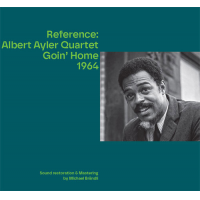
Albert Ayler Quartet: Reference: Albert Ayler Quartet Goin' Home 1964
That February New York session would eventually be released under the alternate titles Spirits (Debut, 1964) and Witches & Devils (Polydor, 1972). Ayler enlisted trumpeter Norman Howard, drummer Sunny Murray, and bassists Henry Grimes and Earle Henderson to perform his original compositions "Spirits," "Witches and Devils," "Holy, Holy" and "Saints," music he would return to throughout his brief career. These pieces contain the seeds of the ecstatic, highly personal style that would soon become synonymous with Ayler.
Less well known is that Ayler recorded a second set of music at Atlantic Studios that same day. Because it remained unreleased until after he died in 1970, few critics or listeners were aware of its existence. The quartet featured Grimes and Murray alongside pianist Call Cobbs Jr., who had worked with Johnny Hodges in the 1950s. Rather than performing his own compositions, Ayler turned toward traditional music, African-American spirituals and gospel. The quartet's interpretations of "Ol' Man River," "Swing Low, Sweet Chariot" and "Goin' Home" were hardly incompatible with the radical concept of musical freedom Ayler would soon champion.
This embrace of familiar repertoire also places Ayler within a broader continuum of African-American jazz. Around the same time, John Coltrane was exploring standards and spiritual material alongside his increasingly adventurous work, releasing three LPs in 1963 for Impulse! Records: Ballads, Duke Ellington & John Coltrane and John Coltrane and Johnny Hartman. For both saxophonists, the pursuit of freedom did not require abandoning the music that came before. Standards, blues, spirituals and the sounds of the African-American church remained vital sources, capable of carrying new meanings even as the language of jazz was being transformed.
The six performances here, accompanied by three alternate takes, all beautifully remastered by Michael Brändli, are almost played straight. Almost. Cobbs, and even the normally freewheeling Murray, largely maintain a straight-ahead rhythmic approach, providing Ayler with a remarkably stable foundation. Ayler, meanwhile, applies his distinctive vibrato to both tenor and soprano saxophone. That vocal, almost crying quality would become a signature of his sound, but its roots reach back to New Orleans and the expressive playing of Sidney Bechet. Goin' Home connects the saxophonist's roots in traditional jazz and spiritual music with the innovations of his emerging freedom aesthetic.
These recordings are valuable not because they reveal a different Albert Ayler, but because they reveal how much of the future Ayler was already carrying with him. The distance between the church, the jazz standard and free improvisation was never as great as it might have seemed. For Ayler, the old music was not something to escape; it was material to be transformed. Goin' Home makes that connection audible, offering a glimpse of the roots beneath one of jazz's most radical voices.
 FOLLOW Mark Corroto
and get notified whenever a new article published.
Mark misses his dogs Louie & Freddy, but endeavors daily to find and listen to new and interesting sounds.
Track Listing
Ol' Man River; Down By The Riverside; Swing Low, Sweet Chariot; Deep River; When The Saints Go Marchin' In; Nobody Knows The Trouble I've Seen; Ol' Man River (Take 1); Swing Low, Sweet Chariot (take 1); Down By The Riverside (Take 5).
Personnel


Additional Instrumentation
Albert Ayler: soprano saxophone.
Album information
Title: Reference: Albert Ayler Quartet Goin' Home 1964 | Year Released: 2026 | Record Label: thingamajig
About Albert Ayler
Tags
PREVIOUS / NEXT


Become a Sustaining Member

Since 1995, All About Jazz has championed jazz as an art form and supported the musicians who create it. Over three decades, it has grown into one of the world's leading jazz resources, serving hundreds of thousands of readers, musicians, presenters and industry professionals each month.
Help Build the Future of All About Jazz
Your support helps us continue building All About Jazz for the next generation—expanding our editorial coverage, preserving jazz history, developing new community features and creating better ways to discover the music and the people behind it.
Become a sustaining member for as little as $20 per year and you'll immediately enjoy an ad-free experience along with access to subscriber features and future articles for a full year.
Together, we're not simply sustaining All About Jazz—we're building its future. Thank you for being part of the journey.