Home » Jazz Articles » Live Review » Pasborg's Odessa 5 Blasts Helsinki
Pasborg's Odessa 5 Blasts Helsinki
Pasborg's Odessa 5
Rytmihairioklubi at Juttutupa Bar, Helsinki
October 1, 2008
Stefan Pasborg is yet another Nordic artist gradually raising his profile across international borders as he leads his new five-piece outfit around Europe this autumn. Started on his career with a gift of drums to the then 3-year-old boy from Godfather and celebrated fellow Danish drummer Alex Riel, Pasborg progressed rapidly on the instrument, lately starting the ensemble Odessa 5 to exploit the textures of a truly brassy instrumentation. The band playing in Helsinki on October 1 included the local saxophonist Mikko Innanen, a Pasborg favorite as well as a stalwart of many young Finnish free- and experimental ensembles in his home country. But despite Innanen's stellar contributions, the program was largely a Danish affair (though the term Viking springs more readily to mind).
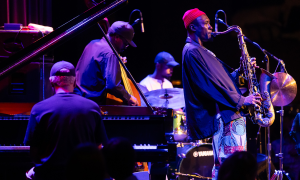
That designation was indeed the title of the encore ending an evening of sometimes raucous, sometimes rare pieces from this exciting young band. Unlike the band's eponymous album released this autumn and using trombone and cornet, the evening was dominated by the three saxophones of Innanen, original member Anders Banke, and Pasborg's old collaborator: Lithuanian Liudas Mockūnas. With all members repeatedly switching from tenor to either soprano or baritone the sonic textures ranged from unison onslaught to delicate woodwind harmonies. Most pieces exploited the players' individual virtuosity, but in principle the writing for the group emphasized collectivity rather than individuality. With Pasborg's soloing disposed of with the opening piece, the program flowed between experimental and classic reed-based inventiveness. Hints of Klezmer and nods to New Orleans reappeared frequently amidst the turmoil of rhythms and riffs, as well as a 12-minute medley of Ornette Coleman tunes and a piece by Julius Hemphill, always knitted tightly by Pasborg's strong drumming.
For visual impact and for extreme virtuosity in the lower registers, all laurels must go to bassist Jakob Munck—performing the role not on tuba but on surely the rarest of modern jazz instruments, the sousaphone. The most visibly outfitted Viking in the band, Munck dominated the back stage with a combination of tousled red hair, coils of tarnished and battered brass, and an outpouring of mellifluous lines. With its very directional sound (and unmistakable visual impact) the instrument demands attention, which it received from a highly appreciative audience—though again it's noteworthy that the instrumentalist's musical role was always subordinate to a collective, collaborative result. In fact, the mellowness of blown bass lines worked exquisitely with the lower registers of the saxophones, and to the vibrancy of the animated independent saxophone lines it added a haunting, deeply spacey feeling. Odessa—a name that to film buffs evokes Eisenstein's mind-blowing The Battleship Potemkin. As an explosive musical group, Odessa 5 is certainly a band to be blown away by.
 FOLLOW Anthony Shaw
and get notified whenever a new article published.
FOLLOW Anthony Shaw
and get notified whenever a new article published.
Former rock and folk freak, now with tastes fully fermented by 30 years living in Finland.
Tags
PREVIOUS / NEXT

Become a Sustaining Member

Since 1995, All About Jazz has championed jazz as an art form and supported the musicians who create it. Over three decades, it has grown into one of the world's leading jazz resources, serving hundreds of thousands of readers, musicians, presenters and industry professionals each month.
Help Build the Future of All About Jazz
Your support helps us continue building All About Jazz for the next generation—expanding our editorial coverage, preserving jazz history, developing new community features and creating better ways to discover the music and the people behind it.
Become a sustaining member for as little as $20 per year and you'll immediately enjoy an ad-free experience along with access to subscriber features and future articles for a full year.
Together, we're not simply sustaining All About Jazz—we're building its future. Thank you for being part of the journey.