Home » Jazz Articles » Album Review » Thelonious Monk: Monk Live In Paris 1967 Volume One
Thelonious Monk: Monk Live In Paris 1967 Volume One
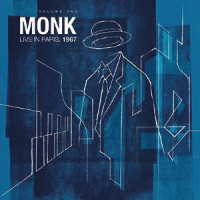
The tour opened in London and continued through Rotterdam, Stockholm, Copenhagen, Berlin, Baden-Baden, Böblingen and Mainz. Several performances were recorded and circulated for years on unofficial releases. The Monk Estate's decision to issue a fully restored edition—Monk Live in Paris, 1967—may well echo Sue Mingus's response to widespread bootlegging of Charles Mingus recordings, when she reclaimed material and reissued it through her own Revenge label. The Paris concert now appears in an authorized, remastered form, released across two volumes.
At its core is Monk's working quartet of the period: Charlie Rouse (tenor saxophone), Larry Gales (bass) and Ben Riley (drums). This unit is augmented by a distinguished horn section: Phil Woods (alto saxophone), Jimmy Cleveland (trombone), Ray Copeland (trumpet), Johnny Griffin (tenor saxophone) and Clark Terry (flugelhorn), the latter featuring more prominently on the second volume.
Johnny Griffin—Rouse's predecessor in Monk's quartet—brings a volatile, sinuous intensity. On "Epistrophy," his fierce, high-velocity lines create a striking contrast with Rouse's more measured, architecturally coherent approach. Phil Woods contributes a fluent bebop vocabulary, but more importantly, a deep structural understanding of Monk's language. His solo on "Evidence" is particularly compelling, shaped as much by Monk's comping as by the thematic material itself.
Ray Copeland, who had prior experience with Monk, emerges as a quietly adventurous presence. On "Evidence" and "We See," he deploys sharply etched accents and asymmetrical motifs, probing the harmonic edges rather than simply outlining them.
Rouse remains the stabilizing force within the front line. He does not compete for attention; instead, he delivers characteristically lucid solos, navigating Monk's angular harmonic terrain with an ease born of long familiarity.
The rhythm section is exemplary. Larry Gales, a member of the quartet since 1964, provides firm yet flexible time, anchoring the expanded ensemble while maintaining a melodic sensibility. Ben Riley, also with Monk from 1964, demonstrates remarkable subtlety, using both sticks and brushes to supply coloristic detail and responsive accents that mirror Monk's phrasing.
Monk himself is in vigorous form. When he withdraws during the horn solos, his re-entries are decisive: percussive, flat-fingered attacks punctuated by silences that reshape the musical space. The enlarged ensemble appears to invigorate him. There is a palpable sense of release—his characteristic dissonances are sharper, more acidic, and his accompaniment more provocatively interactive, pushing the soloists into less predictable territory.
The restored recording enhances these qualities. The improved clarity and dynamic range bring out the density and interplay of the writing, allowing the listener to fully appreciate both the ensemble textures and the individuality of the solo voices.
 FOLLOW Jack Kenny
and get notified whenever a new article published.
FOLLOW Jack Kenny
and get notified whenever a new article published.
Jack was turned on to jazz by a mixture of Stan Getz, Lee Konitz and Earl Bostic.
Track Listing
Epistrophy; Evidence; We See; Ruby My Dear.
Personnel

Thelonious Monk
piano
Charlie Rouse
saxophone, tenor
Larry Gales
bass
Ben Riley
drums
Phil Woods
saxophone, alto
Johnny Griffin
saxophone, tenor
Jimmy Cleveland
tromboneRay Copeland
trumpet
Clark Terry
trumpetAlbum information
Title: Monk Live In Paris 1967 Volume One | Year Released: 2026 | Record Label: Thelonious Monk Estate’s Rhythm-A-Ning Entertainment
About Thelonious Monk
Tags
PREVIOUS / NEXT
Become a Sustaining Member

Since 1995, All About Jazz has championed jazz as an art form and supported the musicians who create it. Over three decades, it has grown into one of the world's leading jazz resources, serving hundreds of thousands of readers, musicians, presenters and industry professionals each month.
Help Build the Future of All About Jazz
Your support helps us continue building All About Jazz for the next generation—expanding our editorial coverage, preserving jazz history, developing new community features and creating better ways to discover the music and the people behind it.
Become a sustaining member for as little as $20 per year and you'll immediately enjoy an ad-free experience along with access to subscriber features and future articles for a full year.
Together, we're not simply sustaining All About Jazz—we're building its future. Thank you for being part of the journey.