Home » Jazz Articles » Mr. P.C.'s Guide to Jazz Etiquette and Bandstand Decorum » June 2011
June 2011
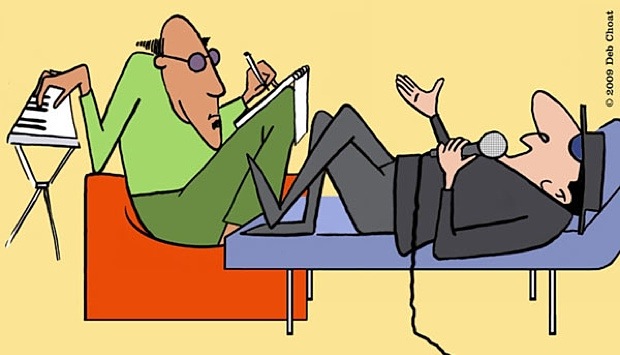
I just finished playing a gig on an army base. I thought it was going to be a social function for the soldiers. But it turned out to be a warfare convention called "BattleCom 2011." In the exhibit hall, vendors were selling lasers for nighttime shooting accuracy, flak jackets, and even grenades. We played in the lounge next door, where attendees could relax with a beer while they contemplated the best way to kill people.
They've invited me back for next year, but the whole thing is kind of freaking me out. I'm wondering if it's wrong for me to support the military-industrial complex this way. Warren Pease
Dear Warren:
You might be surprised to learn that as a boy I was the normal, insensitive sort, blowing up slugs with firecrackers, ripping earthworms into squirming bits, throwing my poodle like a football and—yes—staging wars with toy soldiers. I was testosterone-driven well into adolescence, right up until the magical day I discovered jazz. Suddenly I could redirect all my pent-up energy into blistering scales, breakneck bop heads, and bombastic quartal voicings. Only then, with my adrenalin fully channeled, was I able to mature into the self-actualized, holistic, peaceful man that you (and countless other AAJ readers) trust as your moral compass.
Well, just as there's a warrior inside every boy, there remains a boy within every warrior. And the boys playing "BattleCom 2011" are ready—and very willing—to be touched by you; to experience the same epiphany I felt even through my raging adolescent hormones. Listen closely to me, Warren: These young men are the future foot-soldiers of jazz and peace, and you've been enlisted as their commanding officer.
Now I realize this is no small responsibility, and you're probably questioning your own ability to meet the musical challenge. Consider this: My Aunt Vernice felt the same self-doubt as she played "Giant Steps" for me on the day that changed my life. Trane's melody was nearly buried beneath the chord organ's Teen Beat Auto-Rhythm, and harmonized only in wheezy push-button triads. But it was Auntie V's intent that reached through to me; Trane's tune was a mere vehicle, the chord organ a minor accessory.
You have that same purity of heart within you, Warren; it sings out to me, full-throated, between the lines of your troubled letter. Now go make the world a safer place.

Dear Mr. P.C.;
I like to have lots of sex after the gig and talk with my wife afterwards...if there's a telephone nearby. Is it wrong to call collect? John
Dear John:
Yes, it's very wrong. Collect calls are a terrible waste of money. And as you know, this isn't going to be a short call.
Because while the gig is still fresh on your mind, you need to tell your wife all about it and get the reassurances you've come to depend on. Catalog the injustices for her—the singer who cut off your solo, the drummer who played so loud you couldn't hear yourself, and the pianist whose dissonant voicings made your lines sound all wrong. Share your insecurities—the fact that you didn't get to solo on every tune, the changes you couldn't remember on "Lush Life," and the strange way the bassist said goodbye to you.
Your wife has always been there for you, John, and hopefully always will be. But calling collect puts unnatural pressure on both of you to keep the conversation short. You may be left with some nagging doubts about your performance, and she may feel that she didn't adequately console you; not exactly the formula for a happy marriage.
I'm surprised you don't know better, unless maybe all that sex has clouded your thinking.
Dear Mr. P.C.:
A III-VI-II-V turnaround, if applied to beats, still adds up to 16, so it can be four bars. Chris, Tacoma Dear Chris:
Well, I thought I'd seen all the codified forms of bigotry: sexism, ageism, and racism for starters. But now, thanks to your divisive letter, a new one is born: Meterism.
Because in 3/4 time, for example, a III-VI-II-V turnaround, applied to beats, yields a very discomforting 5-1/3 measures. I'm not saying there isn't a place in music for mixed fractions, or, at the more personal level, for discomfort; I'm neither a fractionist nor a comfortist. But—to bring it all home—consider the cultures that have no 4/4 whatsoever, and are totally excluded from your xenophobic calculation. How do you think they feel?
As if that's not enough, you and your meterist brethren have labeled 4/4 as "common time," suggesting that it's somehow a defining element of civilization (the sheer intolerance of it all—as if other music is, what, uncommon? "Foreign"?). No doubt, you also insist that everyone around you speaks English and you staunchly resist the "other" metric system, which gives a small but crucial voice to so many of the cultures you and your fellow American meterists prefer to stifle.
Finally, there's the last part of your sentence, implying that four-bar phrases are some sort of universal standard, as if they're home base to artists worldwide, regardless of genre. I'm sure there are plenty of musicians in India, still fighting the good fight against phraseism, who might have a thing or two (or 5.333...) to say about that!
Have a question for Mr. P.C.? Ask him.
 FOLLOW Mr. P.C.
and get notified whenever a new article published.
FOLLOW Mr. P.C.
and get notified whenever a new article published.
Inspired by the cutting edge advice of Abigail Van Buren, the storied bass playing of Paul Chambers, and the need for a Politically Correct doctrine for navigating the minefields of jazz etiquette, I humbly offer my services.
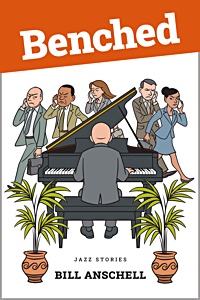
Get 'Benched!'
Benched, Bill Anschell's debut book of short stories / jazz humor. The stories are interspersed with the very best of Mr. P.C., hand-picked from the 400+ questions answered over the column's 16-year history. Benched is available on Amazon (paperback and Kindle) and most online booksellers.
Tags
PREVIOUS / NEXT

1972_jr.jpg)
Become a Sustaining Member

Since 1995, All About Jazz has championed jazz as an art form and supported the musicians who create it. Over three decades, it has grown into one of the world's leading jazz resources, serving hundreds of thousands of readers, musicians, presenters and industry professionals each month.
Help Build the Future of All About Jazz
Your support helps us continue building All About Jazz for the next generation—expanding our editorial coverage, preserving jazz history, developing new community features and creating better ways to discover the music and the people behind it.
Become a sustaining member for as little as $20 per year and you'll immediately enjoy an ad-free experience along with access to subscriber features and future articles for a full year.
Together, we're not simply sustaining All About Jazz—we're building its future. Thank you for being part of the journey.